
Full Journey of Food Through Human Body.
(Chapter 6)
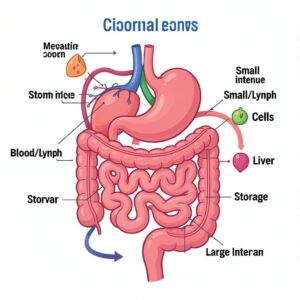
The human body functions like a small chemical factory that processes, stores, and dissipates energy. Our cells chemically extract energy from food (processing) and convert it into usable forms like ATP, they store energy in molecules such as glycogen and fat (storage), and they release excess energy as heat and work (dissipation). Note that ATP (adenosine triphosphate) is the cell’s primary short‑term energy carrier in the body. For processing the food flows in human body in this direction:
Mouth → Stomach → Small intestine → Blood/Lymph → Liver → Cells → Storage → Large intestine → Out
Now let us look at this process, in detail in respect of each step.
Mouth
Food enters through mouth and digestion starts here. Taste buds do warn through horrible taste of possible dangers. Teeth break food into smaller pieces. Saliva adds enzymes that begin breaking down carbohydrates immediately. Fat and protein are barely touched here yet. From Mouth, the food reaches stomach.
Stomach
When swallowed, food passes the esophagus into the stomach, a muscular sac whose smooth‑muscle contractions (mixing and peristaltic waves) mechanically break and mix the food with gastric secretions until it becomes a semi‑liquid slurry called chyme. The churning both reduces particle size (helping enzymes act) and moves small amounts of chyme toward the pylorus for controlled emptying into the small intestine.
In short, the food enters the stomach and gets churned into a thick liquid. The stomach releases strong acid and enzymes that begin breaking down protein. Fat floats separately and moves through largely unchanged at this stage. Next processing happens in intestine.
Small Intestine (the Main Event)
The small intestine (duodenum → jejunum → ileum) is where most chemical digestion is completed and most nutrients are absorbed into the body. The duodenum receives secretions from the liver/gallbladder and pancreas that complete the digestive processes begun earlier. The liver sends bile into the small intestine. Bile breaks fat globules into tiny droplets. This is called emulsification. (More about it in Liver section)
The pancreas sends digestive enzymes. These cut triglycerides into individual fatty acids and glycerol. They cut proteins into amino acids. They cut carbohydrates into simple sugars.
Now everything is small enough to be absorbed through the intestinal wall into the blood. The small intestine’s inner surface has folds, villi (finger‑like projections) and microvilli (brush border) that massively multiply surface area and house transporters and enzymes, permitting very efficient uptake of nutrients and water.
Absorption and Transport
Simple sugars and amino acids go directly into the bloodstream and travel to the liver first.
Fatty acids take a different route. Short and medium chain fats (like butyric and lauric acid) go directly into the blood. Long chain fats (like oleic and palmitic) get repackaged into parcels called chylomicrons and travel through the lymph system before entering the blood.
Liver
The liver is the main processing hub. Liver is to food what kidney is to blood. It decides what to do with everything that arrives.
It converts excess sugar into fat. It produces cholesterol. It processes fatty acids for energy or storage. It detoxifies harmful substances. It regulates what goes out into the bloodstream.
Gall bladder plays an important role. The liver produces bile, which is stored and concentrated in the gallbladder and released into the duodenum when fatty food arrives. Bile contains bile salts (amphipathic molecules) that surround large fat globules and break them into many much smaller droplets, increasing the total surface area — this physical process is called emulsification and it makes fats accessible to digestive enzymes.
Cholecystectomy
Many times the GallBladder is removed by surgery due to a variety of reasons. The formation of gallstones being the foremost. The surgery is therefore called Cholecystectomy. But the question is: how these people survive?
The short answer is that human body adapts. Post surgery eating patterns influence whether the gut “relearns” to handle larger or fattier meals. Some people avoid fatty foods and continue to have sensitivity long‑term, while others gradually reintroduce fats and their digestion tolerances improve over weeks to months. Thus, repeated exposure to dietary fat promotes bile release (even without a gallbladder) and can increase the gut’s functional capacity to emulsify and absorb fats.
Cells
Cells use the nutrients. Glucose goes into cells and gets burned for immediate energy inside tiny structures called mitochondria. This process is called cellular respiration.
Long‑chain fatty acids (like those in palm oil) are processed by repeated cycles of beta‑oxidation, mostly inside mitochondria, producing acetyl‑CoA plus the reduced cofactors NADH and FADH2; the acetyl‑CoA then enters the citric acid (TCA) cycle and the NADH/FADH2 feed the electron transport chain to drive ATP production. Complete oxidation of a typical 16‑carbon fatty acid (palmitate) yields many more ATP molecules than one glucose. The Textbook estimates are on the order of ~100+ ATP for palmitate versus ~30–32 ATP per glucose. This is how it takes longer to process such fat.
Fatty acids also enter mitochondria and get burned for energy through a process called beta oxidation. Fat actually produces more energy per gram than sugar does.
Amino acids get used to build proteins, enzymes, hormones, and repair tissues.
Storage
Whatever is left over gets stored. Excess glucose gets stored as glycogen in the liver and muscles first. Once those stores are full it converts to fat. Excess fat gets stored in fat cells as triglycerides as long term energy reserve. This is how it happens.
After a meal, glucose is used immediately for energy or stored as glycogen in liver and skeletal muscle. Liver glycogen buffers blood glucose (can be broken down and released systemically), while muscle glycogen is reserved primarily for local muscle use during activity. Once glycogen stores are replenished, additional glucose can be converted into fat via de novo lipogenesis, especially when carbohydrate intake is chronically high.
Dietary fat (mostly triglycerides) is digested and absorbed as fatty acids and monoglycerides, reassembled into triglycerides inside enterocytes, packaged into chylomicrons, and delivered to adipose tissue and muscle. Adipocytes take up fatty acids and store them as triglycerides. This is the body’s principal long‑term energy reservoir.
Diabetes
Insulin (released after meals) promotes glucose uptake into muscle and fat, glycogen synthesis, lipogenesis, and inhibits lipolysis. Low insulin and hormones like glucagon, epinephrine, and norepinephrine stimulate glycogen breakdown, gluconeogenesis, and lipolysis to mobilize stored energy.
Cells are “starved” despite high blood sugar when insulin is absent or ineffective, so tissues increase lipolysis (fat breakdown) and proteolysis (muscle breakdown) to supply energy, which causes weight loss.
Excess glucose is lost in urine when blood levels are high enough to exceed the kidney’s reabsorption threshold (glycosuria). The lost glucose carries calories out of the body and contributes to weight loss and dehydration.
Large Intestine
The large intestine is the final segment of the gut where undigested residue is concentrated into stool. Whatever was not digested or absorbed reaches here.
Water gets absorbed. Gut bacteria ferment fiber and produce butyric acid and other beneficial compounds. Material entering the large intestine is mostly indigestible fibre, some salts, water, bile pigments and dead cells. The colon reclaims water and electrolytes to concentrate the stool and absorbs certain vitamins and metabolites produced by bacteria.
The term “colon” refers specifically to the longest section of the large intestine (the parts named ascending, transverse, descending and sigmoid colon). People commonly use “colon” to mean the whole large intestine (which also includes the cecum, rectum and anal canal) but that is not right.
The colon contains a rich microbiota that ferments nondigestible carbohydrates (fibre) into short‑chain fatty acids like butyrate, acetate and propionate. These fats serve as energy sources for colonocytes. This helps maintain gut barrier function, and have systemic metabolic and immune effects. It also makes soften and bulk stool which makes defecation a smoother process.
The remaining material becomes feces, is stored in the rectum, and is expelled through the anus during defecation.
Role of Fatty Acids
The idea humans can live without fatty acids is incorrect. The fatty acids are essential for many vital functions and the body actively maintains and produces them as long as possible. Even in the gut.
Linoleic acid (omega‑6) and alpha‑linolenic acid (omega‑3) cannot be synthesized by body and must be obtained from the diet. Their deficiency causes skin problems, impaired growth, and immune dysfunction etc.
That some fatty acids affect cholesterol and inflammation levels is a problem that must be addressed directly. Often the medical advice to do away with all kinds of fats does not arise from the best judgement .
Therefore, elimination of fats from diet is no option but a strict management of intake of fats into human body is the only option. But this depends on individual metabolism. In the next chapter we shall deal with human metabolism.
References:
- Body Energy: https://openoregon.pressbooks.pub/bodyphysics2ed/chapter/efficiency/
- Role of ATP (adenosine triphosphate): https://www.ncbi.nlm.nih.gov/books/NBK553175/
- Human Stomach: https://www.pihhealth.org/wellness/articles/how-food-is-digested-in-the-stomach/
- How Stomach works: https://www.ncbi.nlm.nih.gov/books/NBK279304/
- Life without GallBladder: https://uppergisurgery.com.au/life-without-a-gallbladder-what-changes-and-what-doesnt/
- Cell organization: https://bio.libretexts.org/Learning_Objects/Worksheets/Biology_Tutorials/Cellular_Respiration
- Large Intestine: https://www.uhhospitals.org/health-information/health-and-wellness-library/article/adult-diseases-and-conditions-v1/the-digestive-process-the-large-intestine
- Colon: https://medlineplus.gov/ency/imagepages/19220.htm
- Oxidation of Fats: https://www.ncbi.nlm.nih.gov/books/NBK556002/