(Part 2)
How Nuclear Feeder Reactor Works?
The Process.
The particles inside reactors behave like a bar fight that keeps spreading.
One drunk man throws a punch. That punch hits two people. Those two people each hit two more. Within minutes the whole bar is fighting. Nobody added more angry people from outside. The anger multiplied from within using the people already in the room.
In the reactor, the “drunk man” is a neutron. When a plutonium atom is hit by a neutron it splits, releasing energy which becomes electricity, but it also throws out two or three fresh neutrons. Those neutrons fly outward and hit more plutonium atoms, which split and throw out more neutrons. This is the chain reaction. It is self-sustaining and self-multiplying from a single starting neutron.
The Breeding Part.
Surrounding the neutron initiated brawl is a quiet crowd standing just outside, which is the uranium-238 blanket. These people are not fighters by nature, they cannot start a fight themselves. But when a stray neutron from the brawl hits them, they do not split. Instead they absorb the neutron and transform into a completely different, naturally aggressive person, which is plutonium-239. They have been converted into a fighter by the impact.
So the reactor is simultaneously running the brawl inside, generating energy, and converting the peaceful bystanders outside into fresh fighters. More fighters are created than were consumed in the original brawl.
Those new fighters are the fresh fuel. The breeding is simply neutron absorption causing atomic transformation. No magic, just physics doing what physics does.
The Heat
The chain reaction produces extraordinary heat, not explosion, but sustained, intense, controlled heat. The reactor’s job is not to let the bar fight destroy the building. It is to let the fight happen in a fireproof room and use the heat coming through the walls to boil water, spin a turbine, and make electricity.
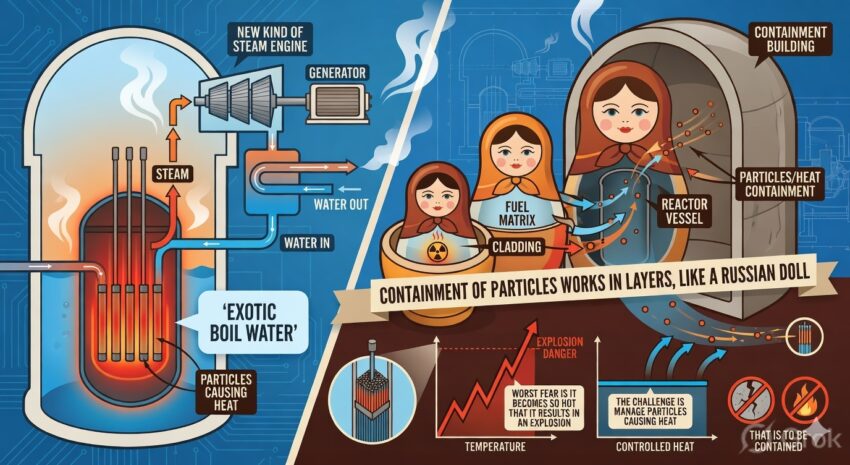
Every nuclear reactor, at its core, is just a very exotic way to boil water. A new kind of steam engine. The Challenge is to manage the particles causing heat. Worst fear is that it may become so hot that it results in an explosion. That is to be contained. The containment of particles works in layers, like a Russian doll.
The Containment
The fuel itself, the plutonium and uranium oxide, is packed into ceramic pellets. Ceramic holds radioactive material tightly even under intense heat. These pellets are stacked inside metal rods called fuel pins, made of a special steel alloy that resists radiation damage. The rods are the first wall between the reaction and the outside world.
Those rods are placed inside the reactor vessel, a massively thick steel container, which is placed inside a several feet thick, concrete biological shield. The concrete absorbs the radiation that the steel does not stop. Nothing escapes through that combination under normal operation.
Now Kalpakkam has one more challenge. It uses sodium as coolant instead of water. Sodium carries heat away from the core without slowing down the fast neutrons. Remember that sodium burns violently if it touches water or air. So the sodium is kept isolated inside a sealed container. It transfers the heat to a second sodium container, which then transfers heat to water to make steam. Thus, there are two walls of sodium between the reactor and the steam turbine.
The bred plutonium in the blanket is periodically removed, chemically separated in a reprocessing facility, and fabricated into fresh fuel rods. That reprocessing is its own contained industrial process, heavily shielded, remotely handled.
The whole system is essentially a series of increasingly robust boxes, each one containing what the inner box cannot.
A Different Universe
Every material inside that reactor is behaving differently and demanding its own solution simultaneously.
Plutonium is intensely radioactive, chemically toxic, and changes its physical properties depending on temperature in ways that make it dimensionally unstable. Fabricating it into fuel pellets requires remote handling behind thick shielding because even brief exposure is dangerous. The chemistry of turning it into mixed oxide fuel with uranium is its own specialised discipline.
Uranium-238 in the blanket is comparatively docile but after it absorbs neutrons and transforms into plutonium it becomes an entirely different material with different chemistry and different heat generation. Now its handling requirements also change. Extracting that newly bred plutonium requires reprocessing, which is a separate chemical engineering challenge.
Now a highly radioactive spent fuel is to be dissolved and separated in shielded facilities. This process again generates radioactive waste requiring further containment.
Sodium is a completely different universe. It is a metal that is liquid at operating temperature, invisible to the eye, and reacts violently with both water and air. Pumping it, monitoring it, detecting leaks in it, welding pipes that carry it, all require specialised metallurgy and instrumentation. This process too does not exist commercially and had to be developed in India itself.
The structural steel of the reactor vessel is being bombarded by fast neutrons continuously, which makes steel brittle over time through a process called embrittlement. So the steel composition and thickness has to be calculated for the entire operational lifetime of the reactor.
The control rods that regulate the chain reaction use boron or other neutron-absorbing materials with their own fabrication chemistry.
Every process mentioned above deals with a fundamentally different material. It is a different branch of science, a different industrial process, a different safety protocol, a different quality control standard. And they all have to work together simultaneously inside one machine without any of them failing.
India had to develop competence in every single one of these domains domestically. That is what four decades actually means in practice. It is not four decades of one project. It is four decades of building an entire civilisation of specialised knowledge simultaneously.
Invisible World
What India’s scientists did is closer to learning the language of a universe that operates at scales and energies completely invisible to human senses. Now they have built machines that speak that language fluently enough to extract a useful conversation from it.
The neutron does not know it is inside an Indian reactor. The sodium does not care about sanctions. Plutonium transforms according to its own nature regardless of who is watching. These particles follow rules that are universal, ancient, and indifferent to human ambition. India learnt those rules deeply enough to create conditions where the particles behave predictably and usefully. It took four decades to accomplish but here it is.
The entire visible world, every building, every ocean, every mountain, is made of atoms that are themselves mostly empty space with these tiny particles dancing inside them. The energy that holds them together is almost incomprehensibly large relative to their size.
A kilogram of plutonium contains more usable energy than thousands of tonnes of coal, because you are reaching into the interior of matter itself rather than just rearranging its surface chemistry the way burning does.
This is the scale of energy India has now learnt to harness. There is no need to conquer it. With the right understanding India has established, it will now light a billion homes.
The New RuleBook
Building a machine implies you follow instructions someone else wrote. What India did at Kalpakkam was to write the instructions themselves, from first principles. There was no one to share the notes.
Every other country that attempted this either had a mentor, a vendor, a technology transfer agreement, to rely on. India had none of it.
The scientists at IGCAR built all the individual processes, to handle each aspect of the reactor. Consider an analogy of cooking. They harvested their own grain, vegetable, and spices and then built the fire source to cook the meal.
The Kalpakkam represents complete understanding which was not borrowed, or purchased, or transferred. The knowledge was acquired through original inquiry across dozens of simultaneous scientific frontiers.