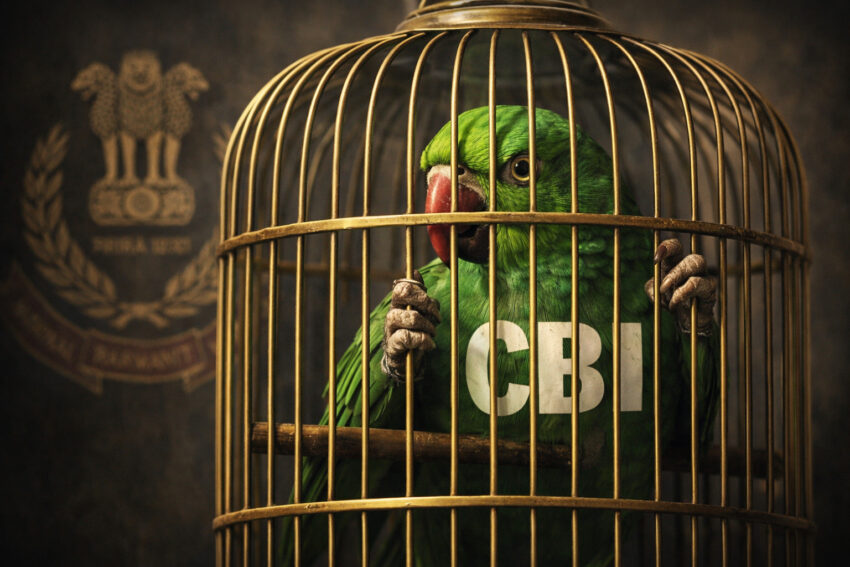
The Caged Parrot (CBI).
Chapter 6
The persistence of corruption in India, is not due to lack of laws or watchdogs to prosecute it but due to a deep inertia in preventing it. There are many practical compulsions in politics of a democratic India which make it fertile ground for corruption.
There are four primary laws which deal with the subject of corruption in public office in India. These are Prevention of Corruption Act, 1988, Central Vigilance Commission Act, 2003, Lokpal & Lokayukta Act, 2013 and Prevention of Money Laundering Act, 2002. Of course there are provisions in other laws which too are aimed at preventing corruption e.g. Income Tax Act, 1961 but those are more in the nature of subsidiary procedures such as reporting income, restriction on cash transaction or need to report large monetary transactions to appropriate authority etc.
Chanakya identified 40 types of misappropriation of funds by public servants, in his Arthashastra. It is the oldest written treatise in the world which dealt with corruption.
There is a long history of corruption during the rule of invaders who were called Moghul by British historians. Keene has documented as to how Mansabdars or local kings were collecting revenue and were not documenting in official accounts.
Bernier has documented how difficult it was to manage business during the Moghul rule. A businessman had to pay protection money to Moghul military officials for protection and there was no fixed rate for this protection. In this regard the British were more democratic while the Moghuls were centralized in corruption.
When British arrived India’s share in world’s GDP was over 20% but when they left, it fell to less than 2% of global GDP. Regarding corruption Shashi Tharoor eloquently writes:
“…Corruption, though not unknown in India, plumbed new depths under the British, especially since the Company exacted payments from Indians beyond what they could afford, and the rest had to be obtained by bribery, robbery and even murder.
India has lived with corruption as a lifeline to survive and to do business. There is no moral taboo attached to corruption. Therefore, it takes no extra effort for any government official to earn by corrupt means. Let me tell a story here. This story tells how easy it is to be corrupt where people fear the unknown
The Story of Sea Counter
A corrupt official was punished by king. He was sent to count waves by sitting at the seashore. He obeyed. Every day at dawn he would pack his lunch and go to seashore with a big register and faithfully count the waves as each wave hit the shore. Ships passing through the shore watched him writing something in register every day. After a few days a sailor approached him and asked what he was doing. He told him that he was a royal servant whose duty is to record ‘the activity’ at sea.
The sailor took out some coins from his pocket and handed it to the ‘Sea Counter’ with folded hands and said ” Please do not mention the name of my Ship in your records. Who knows what new tax is going to be levied by King.”
The Sea Counter smiled and nodded in affirmative and pocketed the money. The people found a way to bribe him.
It was necessary to tell this story as this story tells what Government of India could not find in 80 years even after appointing several commissions of inquiry.
Government in 1962 appointed Kasturiranga Santhanam (1895 – 28 February 1980), to chair a committee to look into the corruption in high offices. He took two years to inquire. In his report submitted to the Government in 1964, he noted three reasons for corruption:
- Too many regulatory functions managed by Government,
- Too much personal discretion in the exercise of powers vested in the hands of public servants and
- Cumbersome procedure to seek facilities to citizens in their day to day affairs. Government could have read the story of ‘Sea Counter’ and find this out. But it did not act. It will not act. Why? Because cumbersome procedure maintain the prestige of Bureaucracy and help them sustain the VIP culture discussed in Chapter 3 of this series of articles.
Rushing back to 2026 Niramla Sitharaman is now Finance Minister since 2019. After being in office for 7 years she addressed Income Tax Officers. She made two points worth noting:
“The taxpayer who interacts with your system is not your adversary………..Every case that goes to tribunal or court is a failure of the system.”
She is saying in 2026 what Santhanam said in 1964. The officers in the room nodded politely and went back to their offices. What she said is a confession that the Government is not in control. Bureaucracy is. It does not want an end of its discretion.
The same pattern repeated itself in the judiciary one day later. On 21 March 2026, Justice B.V. Nagarathna of the Supreme Court addressed a national conference on judicial governance. She identified why pendency in Indian courts never reduces:
“A lawyer loves adjournments because he benefits from per appearance fees. A government department reduces bureaucratic risk by appealing rather than accepting defeat. A judge prefers procedural caution to avoid appellate reversal. Each of these decisions is individually rational. It is only leading to systemic delay.”
She then noted:
“The government publicly expresses concern about judicial backlog, while simultaneously feeding that backlog through relentless litigation.”
Santhanam said it in 1964. Sitharaman said it in 2026. Nagarathna said it the next day. The diagnosis is not the problem. The will to change the incentives is.
However, without resolving the root cause of corruption, various institutions have been created to deal with corruption. One such institution is Central Bureau of Investigation.
The CBI: A Burial Ground for Corruption.
The Central Bureau of Investigation was designed as India’s premier anti-corruption agency. It has become, in the words of Vineet Narain, the journalist who broke the Hawala scandal, “not an agency to investigate corruption — it is a burial ground of corruption.” That description, first made in 1993, remains accurate in 2026.
Structural Disabilities
First, the Prevention of Corruption Act itself bars the CBI from investigating senior bureaucrats without prior government approval. Section 17A of the Act completely bars CBI jurisdiction from investigating corruption charges against bureaucrats, requiring permission from the government before a case can even be registered. The Supreme Court struck down an earlier version of this restriction. The NDA government reintroduced it through the 2003 amendment to the CVC Act, the Supreme Court struck it down again in 2014, and then the government amended Section 17A of the Prevention of Corruption Act to reimpose the same restriction in different legal clothing. The government has consistently found a way to shield its officers from the very agency meant to investigate them.
Second, the CBI cannot operate freely across state borders. Eight states have now withdrawn general consent for the CBI to investigate within their territory, including West Bengal, Kerala, Tamil Nadu, and Karnataka. The stated reason from most is that the CBI is used as a political tool by whichever party controls the Centre. That accusation is bipartisan and seems credible.
Third, the CBI reports to the Department of Personnel and Training under the Prime Minister’s Office, making it administratively subordinate to the very executive it is supposed to hold accountable.
The “Caged Parrot”
In 2013, during the Coalgate scam hearings, the Supreme Court declared: “The CBI has become a caged parrot speaking in its master’s voice. It is a sordid saga that there are many masters and one parrot.” The court found that the heart of the CBI’s status report had been changed on suggestions of government officials from the PMO and the Coal Ministry.
In 2024, during Arvind Kejriwal’s bail hearing, Justice Ujjal Bhuyan used the same metaphor again. He noted that the CBI had not felt the need to arrest Kejriwal during fourteen months of interrogation, but moved to arrest him immediately after his bail in the ED case was stayed.
Eleven years separated the two similar remarks and nothing changed between them.
The agency investigating corruption, caught taking bribes
The deepest irony is that CBI officers themselves are regularly caught demanding and accepting bribes. A CBI Inspector, Rahul Raj, who had been awarded the Union Home Minister’s Medal for Excellence in Investigation in 2023, had that medal revoked in 2024 after his arrest for accepting bribes to manipulate inspection reports for nursing colleges.
An Enforcement Directorate officer was caught red-handed accepting a Rs 20 lakh bribe from a Mumbai businessman he was threatening to frame in a false case. These are not aberrations in the record. They are a consistent pattern across recent years.
A Political Weapon
Every political party that has held power at the Centre has used the CBI to arm-twist political opponents. Cases against allies are buried. Cases against rivals are pursued or dropped depending on whether the accused has since switched sides.
Former CBI directors and joint directors have publicly exposed the agency as engaging in nepotism, wrongful prosecution, and corruption. The book “Who Owns CBI” by former Joint Director B.R. Lall details how investigations are manipulated and derailed from within.
The Conclusion
The CBI is provided as a solution without resolving the problem. It is like taking medicine for cholesterol while eating a very high fat diet. It does not work that way. The underlying causes for corruption have to be resolved first.
CBI was created to fight corruption. It was then systematically defanged through legal amendments requiring prior government approval for cases of senior bureaucrats. Every party in power has found CBI, too useful in the culture of political deployment. There is no incentive to reform.
What remains is an agency that catches small-value bribery cases at the lower end of the bureaucracy while the cases involving the most powerful people are either never registered, quietly shelved, or pursued only when politically convenient.
The CBI does not fail to fight corruption. It absorbs it, buries it, and then issues a press release about a trap it laid for an auditor who took Rs 3.5 lakh.
References:
- Nirmala Sitharaman Speech: https://www.newindianexpress.com/business/2026/Mar/20/fm-asks-i-t-dept-not-to-take-adversarial-attitude-towards-taxpayers
- Justice Nagarathna: https://www.newindianexpress.com/cities/bengaluru/2026/Mar/21/justice-nagarathna-calls-for-creation-of-judicial-reforms-commission-to-reduce-pendency-in-courts-2
- Law of Corruption in India by Sandeep Bhalla (2020): https://books.google.co.in/books/about/Corruption_in_India.html?id=SR3JDwAAQBAJ&redir_esc=y
- The Fall of the Moghul Empire of Hindustan, by H. G. Keene (1887) Oxford.
- Travels in the Mogul Empire 1656-1668 by François Bernier (1916) Oxford University Press, London.
- An Era in Darkness; The British Empire in India by Shashi Tharoor (2016) Aleph Book Company.
- Caged Parrot: https://www.hindustantimes.com/cities/delhi-news/11-years-later-sc-revives-caged-parrot-tag-for-cbi-101726251688714.html
- Rahul Raj: https://the420.in/inspectors-excellence-in-investigation-medal-withdrawn-after-being-arrested-by-cbi-for-corruption/
- Who Owns CBI: The Naked Truth by B. R. Lall published by Manas Publications, 2007: https://www.google.co.in/search?tbo=p&tbm=bks&q=inauthor:%22B.+R.+Lall%22
- Central Bureau of Investigation: https://cbi.gov.in/
- CA arrested for bribe: https://www.pib.gov.in/PressReleaseIframePage.aspx?PRID=2052887®=3&lang=2