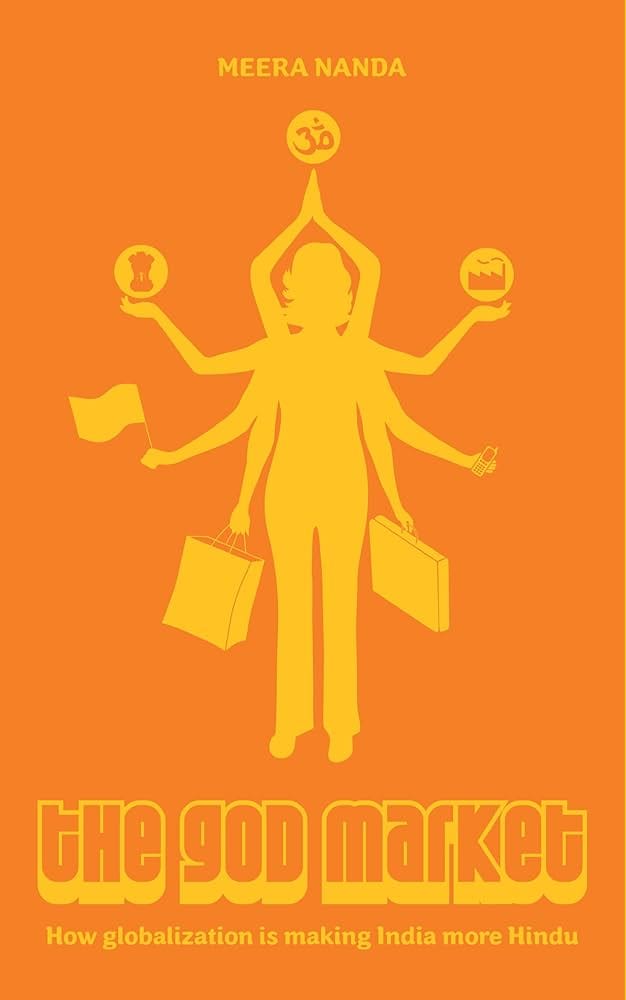
Forensic Linguistics of Meera Nanda’s book called The God Market.
This story will tell how much personal life we expose in public when we leave small nuggets of information in the public domain. The nuggets we thought were harmless and unrelated to our life.
Meera Nanda has uploaded a PDF file of her book titled “The God Market: : How Globalization is Making India More Hindu” on her profile at academia.edu
The book examines how economic globalization and neoliberal reforms in post-1991 India have fueled a resurgence of popular Hinduism, intertwining religion with politics, nationalism, and the marketplace. Nanda argues that this is not a spontaneous religious revival but a structured phenomenon supported by a state-temple-corporate complex.
Date of Publication
There is the number 1357910864 printed under the name of publisher Random House. It is called a printer’s key or number line. It means it is First Edition. Publishers print a series of numbers. During each new printing, they remove the lowest number. The lowest surviving number tells you the printing number.
The typeset/production PDF on Academia. This data appears in the header of the file:
The God Market.indd 1 7/15/2009 11:23:24 AM … Published by Random House India in 2009 … 13579108642 … ISBN 978 81 8400 095 5
Those “.indd” lines are InDesign file timestamps – basically, the date and time when the layout file for that page was last saved: 7/15/2009. That is almost certainly 15 July 2009 (US-style date formatting: month/day/year). Therefore, PDF on Academia is not a pre-press/typeset file but a post-publication author copy. The timestamp in the PDF is only the date of PDF export, not the date of typesetting. Since the book was already on sale before that PDF export, the publication must be early 2009, not late.
The seasonal cycles of Random House India (2007–2011 period) as per their flagship nonfiction titles were almost always released in January–March (Spring season) or August–October (Fall season). Therefore, a book already in circulation before July means it was published in the Spring 2009 catalogue, not the Fall one. The spring releases at Random House were usually clustered between February and April 2009. With these details the inference is that the publication window was between February to April 2009 with February–March being most probable.
Political Motivation
Now a question arises that relate to politics behind the book. Was it an academic work or a politically motivated work. 2009 was an election year. The elections were held in April 2009. If the publication was rushed then there will be an inference that its publication was motivated by political considerations.
In an article published in Economic and Political Weekly of 18 October 2008 written by Meera Nanda. She shares that she lives in America and visit India, occasionally. She wrote that she landed in Chandigarh, India on 1st August 2008 to hand over her manuscript to her publisher Navayana Publishing Pvt Ltd. They have office at 155, Second Floor Shahpur Jat, New Delhi 110049.
Thus, we know that in August 2008 Random House did not have the manuscript with them as another publisher had it sometime after 1 August 2008. The Publisher must have taken at least a month to review it before taking the decision to reject it.
Navayana Publishers
Navayana’s catalogue is very consistent. It publishes, dalit studies, anti-caste scholarship, Ambedkar, caste-capitalism critique and cultural studies of caste oppression. But they do not publish broad civilizational attacks on Hinduism as a whole. Meera Nanda’s manuscript is not a caste-analysis of Hindu society. It is anti-Hindu civilisation as a whole. It is anti-religion and call it superstition. It is anti-civilizational as she denounced every tradition. And it is polemical and written with a political bias. She openly endorses Nehru. The book starts with a quote from Mani Shankar Aiyer, a controversial Congress Leader. Thus, the book is not subtle in defending or promoting ideology even while criticizing soft Hindutva peddled by Congress party.
It was too anti-Hindu, too sweeping, too general, and outside Navayana’s caste-centric lens. Publishing such a book would hurt their ideological brand of Navayana. So they declined politely or otherwise.
Navayana in Shahpur Jat was (and still is) a micro-publisher. They publish maximum 3–6 books in a year. This kind of publisher cannot handle a large, polemical, legally risky manuscript with aggressive claims about religion, globalization and politics. The staff is not enough and no legal review capacity. They also lack production speed to match a fixed election cycle.
Thus, after receiving the manuscript in August 2008, they reviewed the book and in September 2008, they declined. That is the earliest possible date.
The 26/11 Terror
India suffered the gravest terror attack on 26 to 29 November 2008. A series of 12 coordinated Islamist terrorist attacks that took place from November 26 to 29 and were carried out by 10 members of Lashkar-e-Taiba, a Pakistan-based Islamist terrorist organisation. A total of 175 people died, including nine of the attackers, with more than 300 injured.
The book opens with Introduction which starts with following paragraph about Mumbai terror attack:
“India had its own ‘why do they hate us?’ moment after the city of Mumbai came under attack in November 2008 by a bunch of gunmen with links to terrorist outfits in Pakistan. Many in India answered the question much the same way George Bush famously explained the 9/11 attacks on the United States: Islamic terrorists hate us because we are good and they are evil; we are free and democratic and they hate freedom and democracy. This ‘us–them’ divide was further linked to globalization, a word that got bandied about a great deal in the aftermath of the Mumbai attacks. Pakistanis hate us, many argued in India, because we are winning in the global economy race, while they are a bunch of sore losers bent upon dimming the bright glow of our economic miracle. the terror attacks were seen as a conspiracy meant to destroy the confidence of global investors, slow down the outsourcing of IT and other jobs to India, and stop foreign tourists from coming.”
Therefore the manuscript was revised in December 2008, after the terror attack. Yet it was published in February 2009 within 3 months of last edit.
Considerations for Random House
Publishers Random House India (RHI) has aggressively commissioned between 2006–2012 following types of books:
- political nonfiction
- polemical books timed with elections
- India-oriented sociology
- “India rising / India collapsing” narratives
- international authors with India-related work.
They were indifferent to ideological content as long as it sold well, and it contributed to a political conversation. Taking an anti-Hindu globalization polemic for the 2009 election cycle fit in their strategy.
Writing Skills of Meera Nanda
Writing is not easy. But to write in a manner to invite the reader to continue reading is rare. If her article published in EPW (link below) is her real writing style, she is a good writer. We may not agree with her opinion or argument but we can not deny that she writes well. Her writing is sharp, sarcastic, unfiltered and direct. It has its own way of construction of sentences and choice of vocabulary.
Meera Nanda, is fundamentally a narrative writer. She thinks in scenes, metaphors, vivid contrasts. Even when she is polemical, she writes as if she is walking the reader through a mental landscape while pointing to things, reacting to them, laughing at them, arguing with them. Her sentences have personality. They move like a person talking, not like a manual instructing.
This book has traces of her writing but it is not her writing entirely. There have been too many editorial insertions and amendments. The version printed by Random House was partly written but thoroughly edited after 29 November 2008.
Her writing texture is missing in the Random House version. What remains reads as if someone took a lively storyteller and forced her to speak through a corporate compliance filter. It has the rhythm of a policy brief, the dryness of an onboarding document which contradict her rhythm. We can almost hear the keyboards of junior editors turning her paragraphs into “explainers,” scrubbing away the ironic bite, chopping out anything that could be interpreted as offensive, inserting twenty years of publishing habits between her and her reader.
The Contents of the Book
It appears the book had old material in which new political events were inserted. Many contemporary references were misplaced in wrong chapters. The historical narratives were interrupted and there are different writing styles which show involvement of multiple editors who touched different chapters without bothering to cross-check the chronology. Result was that the voice of author was flattened. It could have been done for legal reasons as well. Nanda has a tendency to be inflammatory frequently. Her interpretation of rationality has to prevail upon every other practice.
Nanda writes short sentences consisting of 10 to 18 words, diction is short, clipped, and polemical with punchy transitions and ironic phrasing. There is sudden humour or mockery expressed in active voice with minimal scaffolding. Look at this sentence:
“India is becoming increasingly Hindu as it globalizes.”
This is Nanda’s voice. It is sharp, declarative, ideological. But the next sentence reads as:
“But what do we mean by globalization? Why is it that whenever any country opens up to global trade these days, it invariably ends up adopting a package of neo-liberal economic policies?”
This is not her natural rhythm. This is introductory textbook questioning, not Nanda’s aggressive tone. Her original would have been something like:
“The globalization that India embraced in the 1990s was never value-neutral. It came packaged with the neoliberal ideology of the market, which fused easily with Hindu revivalism.”
She doesn’t normally break into childish rhetorical questions (“What is globalization? What is neoliberalism?”). This is Random House trying to make the book palatable to a general audience.
Thus, the Random House editors clearly toned her voice down in the published book. It also appears that the book was rushed, which was natural, given the time constraint. On top of it the last chapter or the ending was improvised which now reads like an office memo. Random House editors wrote this 45 word long sentence:
“It will then tell the story of how India came to embrace the gospel of free markets and global trade and how it is setting the stage for the growth of hinduism.”
This is what a book looks like when its publication is tied to an election window, and the publisher has two months to salvage, rewrite, sanitize, and print. The incoherent chronology is the most apparent result of multiple editors.
Chronology Problems
For brevity there shall be just two examples of last minute alteration to insert contemporary events. First chapter is clearly intended to narrate India’s economic phase I from 1947 to 1975 in which Nehru, early planning, Swatantra Party, Integral Humanism, early right-wing economic thought etc. all events that end before 1977. In that period Subramanian Swamy was a junior academic who had written Economic Growth in China and India (1968). He had drafted early ideas for Hindu Renaissance. Indira Gandhi reportedly dismissed one of his proposals in 1969. All of that belongs inside the pre-1975 narrative. So far so good. But the editor inserted this:
“Swamy appears to be undergoing something of a renaissance himself. His new Fundamentals of Indian Renaissance (2005) tries to revive his failed agenda…”
This is the fatal temporal fracture. The chapter is still inside the 1947–75 frame, talking about Swamy’s place in Nehru’s era. But suddenly we jump 30 years into the future by quoting a book published in 2005.
Similarly Narayana Murthy (born 1946) and Gurcharan Das (born 1943) are placed inside a 1950s–60s historical narrative as if they were political actors then. It is the same editorial signature. A contemporary reference inserted into a historical period where it does not belong.
Editing Schedule
To thoroughly edit a 240-page manuscript, with structural edits, legal vetting, voice-smoothing, fact-checking, layout, proofing, and cover design, three months is a miracle. To finalize a fully edited manuscript takes one month. Anything less means editors are doing all-nighters and the publisher is running on adrenaline and political instinct.
This exercise has been undertaken by me for 21 times. Nonfiction has too many details and last minute checks and it takes time.
Verdict is yours.
Reference:
- God Delusion at Work: My Indian Travel Diary https://www.jstor.org/stable/40278070?
- The God Market: https://www.academia.edu/65857600/The_God_Market_How_Globalization_is_Making_India_More_Hindu