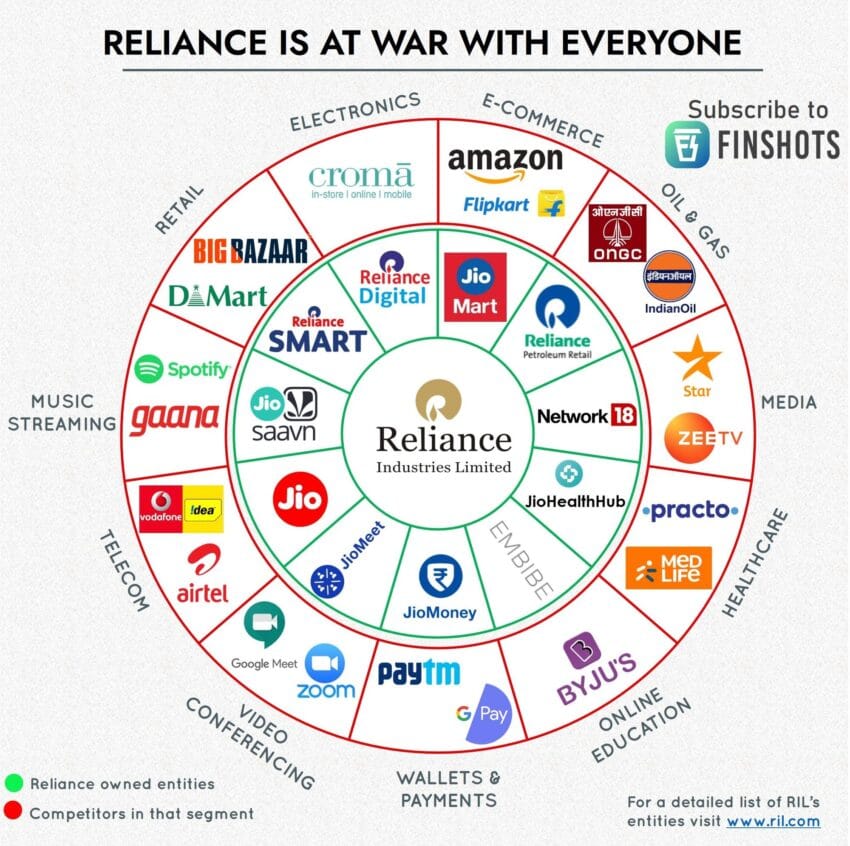
Reliance in an FMCG War with Monopolies.
Reliance Industries is rewriting rules of consumer market. It will be molding the consumer choices in India. The market is slowly taking a turn after decades of monopoly of a few companies. Campa Cola, the king of drinking beverages in Delhi in the 1980s is back. Regional staple brands from Tamil Nadu appear in Delhi stores. Old names you half remember from childhood suddenly look modern and affordable. This is not accidental. This is not slow brand building. This is This is not the first time. The template was written long time ago. It has been repeated many times in the past. It happened with Reliance Infocomm (branded Reliance IndiaMobile with “Kar lo duniya mutthi mein”) launched commercially in 2003. It was repeated again with launch of Jio Mobile.
The Jio Mobile Launch Template
Jio Mobile was launched in year 2015 as test launch. No big advertising blitz announcing “we’re disrupting telecom.” One year free data and calls on the pretext of ‘testing’. Just free SIMs appearing everywhere. Yet there was no sale counter for free SIMs. Let scarcity and word of mouth do the marketing. Middlemen sold free SIMs for ₹100 because demand outstripped visible supply.
Real or call it the formal launch, happened in September 2016. Jio offered free voice calls, extremely cheap data, and nationwide LTE-only service. This single move fundamentally reset India’s telecom pricing and usage patterns.
Reliance did not compete on brand strength against Airtel or Vodafone. It competed on making the old pricing model obsolete overnight. Incumbents could not match free without bleeding to death. By the time they realized it was not a promotion but a permanent reset, Jio had 100 million subscribers.
No major ad campaigns for Campa or revived brands. Just suddenly appearing on shelves everywhere at prices incumbents struggle to match. Consumers find them, try them because they’re cheaper or familiar, then keep buying because JioMart makes it frictionless. The growth is not driven by marketing. It is driven by availability and price disruption.
While business media focuses on telecom and retail earnings, a quieter war is being waged in the aisles where families buy soap, biscuits, cooking oil, and soft drinks. Reliance is not just entering the FMCG market. It is restructuring the entire pathway between factory and household.
The Brand Acquisition
Reliance Consumer Products Ltd has been systematically buying brands that carry pre-loaded trust. Campa Cola, once ubiquitous across India, was acquired and relaunched with aggressive pricing. Southern Health Foods, known for the Manna brand’s millet and health products, was brought into the fold. Udhaiyam Agro Foods, a longtime favorite in Tamil Nadu, now has national backing.
Reliance acquired 50% stake in Sosyo Hajoori Beverages (SHBPL), a 93 year old company, was acquired. Pune-based company SIL Food India offers a range of products including cooking pastes, jams, mayonnaise, baked beans, and Chinese sauces. Reliance has acquired this as well. Ketan Mody, COO of Reliance Consumer Products Limited, announced the ambitions of Reliance:
“…We believe that with our expertise in consumer engagement, innovation, and distribution, we can unlock the brand’s full potential and make it even more relevant in today’s fast-evolving marketplace.”
These are not random purchases. Each acquisition brings either nostalgic equity or established regional loyalty. Building brand awareness from scratch takes years and burns capital on advertising. Buying recognition costs less and moves faster. The trust is already there. Reliance just adds distribution muscle.
The strategy extends beyond food and beverages. RCPL acquired global rights to personal care brands like Brylcreem and Toni & Guy. The Velvette brand of shampoo is also now available in north India, again.
The goal is to build a portfolio across categories rather than dominate one segment. Soaps, snacks, staples, drinks, and personal care all get the same treatment.
Every acquisition follows a pattern. Find a brand people remember but cannot easily buy anymore. Secure ownership or licensing rights. Relaunch with modern packaging at competitive prices. Then push it through the distribution engine that most standalone companies could never access.
JioMart as the Amplifier
The real power behind this strategy is not the brands themselves. It is the distribution platform. Reliance Consumer Products reported ₹ 11,500 crore for the year 2025. For FY26 H1 (Q1+Q2) it jumped to ₹9,850 crore in gross revenue. By Q3, quarterly revenue hit ₹5,065 crore. The full year run rate suggests turnover of about ₹20,000 crore neaarly double from the previous year.
JioMart itself has grown rapidly as a grocery and hyperlocal delivery platform. It competes directly with BigBasket, Blinkit, and Zepto while being backed by India’s largest retail operation. Digital commerce now contributes a meaningful share of Reliance Retail’s ₹3,30,870 crore annual revenue. Quick commerce delivery grew over 200% in some quarters.
That jump in Reliance’s turnover in ten months is not organic brand growth. It is platform velocity. JioMart provides instant shelf space across digital and physical retail. When RCPL relaunches a brand, it appears simultaneously on JioMart, in Reliance Smart stores, and across the assisted commerce kirana network. No negotiation, no listing fees, no channel conflict.
This matters because demand is being manufactured by access rather than discovered through advertising. Search placement, bundling with staples, and default substitutions when brands are out of stock all nudge volume toward Reliance owned labels. Campa does not need to beat Coca-Cola in brand recall nationwide. It just needs to be one tap closer on JioMart.
SKU Jostling
SKU simply means Stock Keeping Unit. SKU is one specific sellable item, defined by a unique combination of product, size, flavour, packaging, and sometimes even region. If anything about the product changes in a way that affects inventory tracking, it becomes a different SKU.
For example, a soft drink brand doesn’t have “one product.” A 200 ml glass bottle, a 500 ml PET bottle, a 2-litre family pack, a can, and a zero-sugar variant are five or more different SKUs, even though consumers think of them as the same drink.
Launching a brand means managing SKU efficiently. Reliance is using SKU compression, it means they deliberately launch fewer variants, focus on the fastest-moving sizes or flavours, and push volume through them. One 1-kg pack that sells extremely fast is often more profitable and scalable than five variants that sell slowly.
Traditional FMCG companies spend months getting a new product onto shelves nationwide. They negotiate with distributors, pay for placement, and hope retailers prioritize their SKUs. Reliance skips all of that. The retail arm and FMCG arm are vertically synchronized. A revived brand gets default visibility the moment it relaunches.
The Tricks that Scale It
Most FMCG companies try to convince someone else’s customer to switch brands. Reliance begins by converting its own footfall into captive demand. Every household buying atta, oil, or sugar at a Reliance store already exists as traffic. The trick is redirecting default choices toward owned brands.
Inserting a Reliance product as the first visible option, the cheapest alternative, or part of a bundle quietly converts traffic into turnover without marketing spend. Traditional FMCG firms pay for that conversion every single time. Reliance internalizes it.
The second lever is pricing that ignores short term margin discipline. Most FMCG firms are publicly scrutinized on gross margin stability quarter after quarter. Reliance is not. It can afford to treat FMCG as a loss leader that strengthens the retail ecosystem. That allows undercutting incumbents not by a symbolic 2% but by amounts that force impossible choices: bleed margins or surrender shelf space.
This is why revived brands suddenly look unfairly cheap. They are not optimally priced. They are strategically priced. The goal is volume and habit formation, not immediate profitability.
Then comes advertising arbitrage. Reliance substitutes classic ad spend with owned media. Jio apps, JioMart notifications, in-store signage, billing screens, and telecom bundling offers are all advertising surfaces. They do not appear as ad costs in the FMCG profit and loss statement. When Campa or a private label staple gains traction, it rides distribution and interface design rather than television commercials.
HUL or Nestlé must pay Google, Meta, TV channels, and distributors. Reliance mostly pays itself. The cost structure is fundamentally different.
There is also supplier leverage. Reliance is one of the largest buyers of agri-inputs, packaging, transport, and warehousing in the country. That scale gives preferential pricing and priority access during shortages. When costs rise, Reliance absorbs or defers the impact. When costs fall, it passes savings on selectively to gain share. Smaller FMCG firms feel volatility immediately. Reliance smooths it across businesses.
Finally, there is the time horizon advantage. Reliance does not need this FMCG play to work this year or even next. It is building habit formation. Once a household gets used to a Campa, a Reliance staple, or a private label snack delivered reliably through JioMart, switching back becomes friction rather than choice. Incumbents think in quarters. Reliance thinks in households locked in over a decade.
Threat to the Oligopoly
India’s FMCG market was already concentrated long before Reliance entered. Hindustan Unilever dominates soaps, detergents, and personal care across multiple brand names. ITC controls biscuits and staples. Nestlé owns infant nutrition and instant noodles almost entirely. Procter & Gamble sits atop premium personal care. These are not competitive markets. They are oligopolies with the illusion of choice.
Twenty brands on the shelf often trace back to four companies. Consumers believe they have options, but pricing, distribution, and innovation are controlled by a handful of players. This concentration went largely unchallenged for decades because it appeared polite and arms-length. Brands competed, companies did not.
Reliance threatens this differently. HUL does not own the retailer. It negotiates for shelf space and pays for placement. Reliance is manufacturer, distributor, and retailer simultaneously. That collapses the negotiation layer entirely. Incumbents paid for access. Reliance owns access.
Monopoly Concerns
The traditional monopoly concern is whether one company controls too much of a category. The new concern is whether one company controls the entire pathway from factory to household. That creates different choke points. It makes competitor entry harder not because consumers prefer the product, but because the infrastructure itself is vertically integrated.
Yet here is the paradox regulators will struggle with. If they ignored decades of HUL-ITC-Nestlé market concentration because consumers still had choice, what exactly is the complaint against Reliance? That it makes oligopoly visible? That it uses owned retail instead of captured distributors? Or that it is selling similar brands at lower price?
Functionally, what is the difference between HUL paying for priority shelf placement at a kirana and Reliance simply owning the shelf? But Reliance has not denied access to competitors. Pepsi is being sold alongside Campa with price difference clearly visible.
The real regulatory risk is not monopoly but predatory pricing. If Reliance uses telecom or retail profits to subsidize FMCG below cost indefinitely, that could cross into anti-competitive territory. Not because it dominates a category, but because it prevents anyone else from entering profitably.
But proving that requires showing sustained below cost selling with intent to eliminate competition. Reliance can argue it is just passing on efficiency gains from vertical integration. Lower costs from owned logistics, reduced advertising spend, and supplier scale all justify lower retail prices without invoking predatory intent.
Incumbents will lobby. But their complaint will not be that Reliance is creating a monopoly. It will be that Reliance is breaking their monopoly. That is a much harder case to make, especially when the existing market structure was already anti-competitive.
Changes for Consumer
For households, the shelves carry brands that were unavailable or expensive before. JioMart makes grocery delivery faster and cheaper in many cities. Access improves, at least initially.
But choice and competition are not the same thing. Adding a fifth player to an oligopoly does not create a competitive market. It just reshuffles who controls what. The question is whether Reliance’s entry forces incumbents to lower prices and innovate, or whether it simply replaces HUL’s dominance with Reliance’s dominance over time.
Early signs suggest price pressure is real. Campa undercuts Coca-Cola significantly. Reliance staples often cost less than branded equivalents. That forces incumbents to respond, either by cutting prices or improving value. If sustained, that benefits consumers regardless of underlying market structure.
The risk is what happens once market share shifts decisively. If Reliance captures enough households and incumbents shrink, does pricing discipline return? Does innovation slow because the new gatekeeper controls shelf access even more tightly than the old ones?
Vertical integration creates efficiency but also lock-in. A household that buys groceries on JioMart, uses Jio telecom, and shops at Reliance Retail is not just a customer. It is part of an ecosystem where switching costs multiply across services. That stickiness is the long term prize.
The Bigger Picture
What is happening on grocery shelves today is a structural shift disguised as brand portfolio expansion. Reliance does not announce disruption. It creates conditions where disruption becomes inevitable, then lets the market scramble to catch up. The FMCG war is not coming. It already started.
That is a different kind of power. Whether regulators, competitors, or market dynamics eventually check that power remains to be seen.
The story is that India’s household essentials market is being restructured in plain sight when we were focusing on Tariff Wars abroad.
References:
- SIL Acquisition: https://www.business-standard.com/companies/news/reliance-consumer-acquires-sil-food-india-strategic-expansion-125012200410_1.html
- Sosya Acquisition: https://www.financialexpress.com/business/industry-reliances-latest-acquisition-all-you-need-to-know-about-this-100-year-old-beverage-maker-ambani-is-buying-2936432/