Reclaiming Monetary Heritage
India’s current push for local currency trade represents more than economic strategy. It marks the return of historical monetary influence that once spanned the Gulf region. This is not innovation but restoration.
The Modern Framework
The Reserve Bank of India introduced its rupee internationalization framework in July 2022. This system allows exports and imports to be invoiced and settled in INR through Special Rupee Vostro Accounts (SRVAs). These accounts are held by foreign banks in India.
In August 2025, RBI removed prior approval requirements for authorized dealer banks to open SRVAs. This easing boosted operational efficiency and expanded global rupee use. By early 2025, over 156 SRVAs from 123 banks across 30 countries were operational. Partner countries include UAE, Indonesia, and Maldives.
India has established local currency trade agreements with approximately 20 to 30 countries. Key arrangements include deals with UAE (dirham), Sri Lanka (rupee), and Russia (rouble). Negotiations continue with free trade partners in EFTA and through FTAs with Oman, Australia, UK, and EU. The goal is establishing direct rupee rates without dollar pegging.
BRICS discussions now include linking digital currencies for easier settlements. These efforts aim to reduce dependence on the US dollar as the global reserve currency.
Historical Precedent: The Gulf Rupee
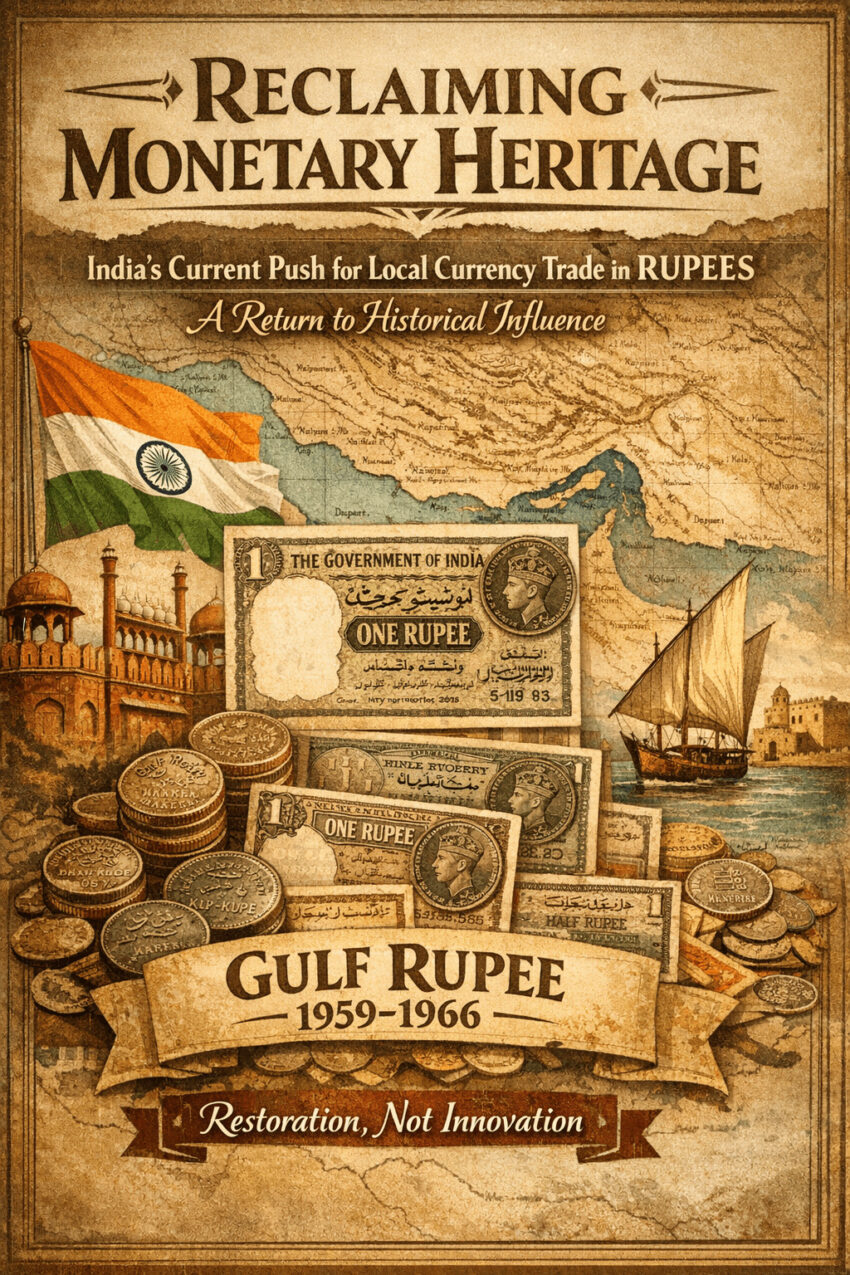
The Indian rupee circulated widely across Gulf states during British colonial times. It served as the de facto currency in Kuwait, Bahrain, Qatar, Trucial States (now UAE), and Oman. The rupee was pegged to the British pound at 13⅓ rupees per pound.
By the late 1950s, rampant gold smuggling threatened India’s foreign exchange reserves. Smugglers exploited the common currency zone. They bought gold abroad with Gulf rupees, smuggled it into India, and exchanged proceeds back for hard currencies. This drainage forced India to act.
In 1959, India issued the Gulf rupee at par with the Indian rupee. However, circulation was restricted to external territories only. This broke the common currency zone and stopped the smuggling pipeline.
The Gulf rupee notes mirrored Indian designs but featured distinct characteristics. Colors differed from domestic notes: red for ₹1 and ₹10, orange for ₹5, green for ₹100. All serial numbers carried Z-prefixes. Both the Government of India and RBI printed these special notes. Denominations included ₹1, ₹5, ₹10, and ₹100 notes. This Persian Gulf Rupee series circulated from 1959 until 1966. India’s 1966 rupee devaluation (to ₹7.50 per dollar) prompted Gulf states to adopt local currencies to avoid losses.
It represented tangible monetary influence in territories that would become major oil producers. Thus, the historical connection between the rupee and the energy-rich Gulf region ran deep.
The Petro-Rupee Resurgence
For decades, the global economy operated on a petrodollar system. Crude oil, the world’s most critical commodity, has been primarily priced and settled in US dollars. This sustained dollar demand reinforces its status as the primary reserve currency. It grants the United States significant economic leverage and the “exorbitant privilege” of financing deficits with relative ease.
Today’s petro-rupee discussions represent a strategic resurgence of India’s historical Gulf connection. India is one of the world’s largest oil importers. The nation imports over 85% of its crude oil requirements. This costs hundreds of billions of dollars annually.
Settling even a fraction of this trade in rupees offers substantial benefits. It reduces dollar dependency and insulates India from exchange rate volatility. The nation would need fewer dollar reserves for crucial energy imports. This enhanced strategic autonomy provides greater flexibility in foreign policy and trade relations. It mitigates vulnerabilities to external financial pressures or sanctions.
Most importantly, rupee-based oil trade promotes the currency’s international standing. The Indian rupee becomes more recognized and accepted for global trade, particularly within the Global South.
Recent agreements underscore this deliberate diversification effort. India’s 2023 move to settle oil purchases from the UAE in rupees marked a significant step. Discussions for similar arrangements with other partners continue. These initiatives actively reduce dollar hegemony.
Strategic Implications
The petro-rupee concept is not merely a contemporary economic experiment. It represents a powerful move to re-establish India’s financial footprint. The strategy leverages deep historical ties in a region critical for global energy.
This strategic reassertion of monetary influence signifies profound enhancement of India’s geopolitical and financial standing. Trade in local currency was never a novel ambition. It is a strategic reassertion of historical monetary influence that illuminates India’s capacity to reshape global financial architecture.
The return of rupee prominence in the Gulf contributes to a more multi-polar global economic order. It demonstrates how historical connections can inform modern economic strategy and enhance national “richness” in both financial and geopolitical terms.
References:
- History of Gulf Rupee: http://www.pjsymes.com.au/articles/gulfrupees.htm
- Summgling from Gulf: https://www.mintageworld.com/story/detail/3-gulf-rupee/