India’s Breeder Reactor Goes Critical
India has achieved something in nuclear energy technology that nobody in the world could achieve in the last fifty years, and it has been almost entirely ignored by the international press. It has successfully launched a ‘breeder type’ nuclear reactor.
Every other country that attempted fast breeder reactors at scale abandoned the project and filed it either as not feasible or as uneconomical.
Geek Details First
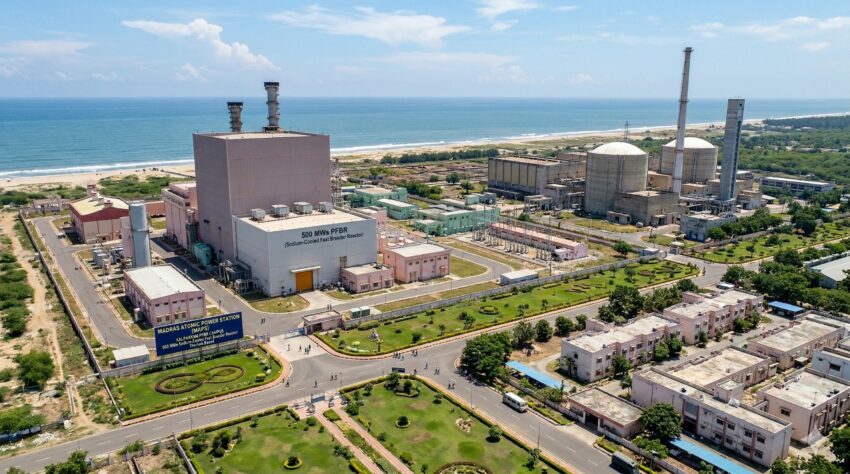
Madras Atomic Power Station (MAPS) campus near Kalpakkam, Tamil Nadu is a 500 MWe sodium‑cooled fast breeder reactor.
It converts “fertile” material (e.g., Uranium‑238 or Thorium‑232) into new fissile fuel (e.g., Plutonium‑239 or Uranium‑233), so it produces more usable fuel than it consumes over its lifetime.
It runs on Uranium‑Plutonium Mixed Oxide (MOX) fuel with a Uranium‑238 blanket around the core; fast neutrons transmute this blanket into new Plutonium‑239, effectively “breeding” fuel.
It is obvious that this geek details will not make sense to anybody not from physics. So here is a cow analogy.
The Cow Story
Think of breeder like a cow which gives milk every day. Consider the milk as electricity. But this cow also gives birth to calves, more than one per year. Those calves grow up and each becomes another milk-giving cow that also produces calves. After some years there is a herd of cows. There is no need to buy another cow in future.
The reactor at Kalpakkam is fed with nuclear fuel and it produces electricity. But while producing that electricity it is simultaneously creating fresh fuel in the material surrounding it, more fuel than it consumed. That fresh fuel goes into the next reactor, which creates still more.
The sodium is just the cooling system, the equivalent of the water you give the cow. It carries the heat away efficiently without slowing down the particles doing the breeding work, because fast particles are what trigger the fuel-making reaction in the surrounding material.
The blanket of uranium-238 surrounding the core is like dry grass sitting next to a fire. On its own it cannot burn. But the intense activity inside the core transforms it into something that can burn, which is plutonium-239, the new fuel.
Presently only second stage has just become operational. There is a third stage too.
Stage One
India mines natural uranium and runs conventional reactors. These produce electricity and as a byproduct they produce plutonium. This plutonium is being accumulated for future use.
Stage Two
The accumulated plutonium is fed into the breeder reactor. The breeder produces electricity and simultaneously creates more plutonium than it consumed, using the uranium-238 blanket. This is currently being done in this reactor.
Next step will be that Thorium can be put in the blanket instead of uranium-238, and the reactor transforms it into uranium-233, which is the fuel for stage three. This is likely to be achieved in next 5-10 years.
Stage Three
Now there is enough uranium-233 to run reactors that operate entirely on the thorium cycle. Alternatively this uranium can be used as fuel in old, water based other reactors or new simple reactors can be built based on this fuel.
But as it may have been noticed, Thorium is new fuel used in India. What is so special about it?
Thorium
In India Thorium is easily available in monazite sands along one of the longest coastlines in the world, roughly 7500 kilometres, from Gujarat around the peninsula to Bengal. Yes, it is literally sprawling on the beaches of India.
The concentration is particularly rich along the Kerala coast, in places like Chavara, and along parts of Odisha and Andhra. The extraction is not exotic. Monazite is separated from beach sand through relatively straightforward mineral processing that India has been doing for decades through the Indian Rare Earths Limited.
Easy availability makes capital cost of fuel acquisition rather negligible when compared to drilling offshore oil fields or operating deep uranium mines.
It is a poetic justice after thousands of years of invasion into India. India’s coastline was for centuries the entry point of colonial extraction, the place where foreign ships arrived to take things out. That same coastline turns out to be the storage deposit for the fuel that makes India permanently energy sovereign.
Thorium is not widely distributed. The United States has some, Australia has some, but no other country has the reserves this scale and accessibility as has India. So a thorium-based energy future disproportionately benefits India.
The Abandoned Projects
France, United Kingdom, United States, Japan, Germany, Italy, Kazakhstan, and others, worked on prototypes of breeder reactors but abandoned it. Their experimental models did not inspire the policymakers to go for commercial prototype.
Their small‑scale or experimental breeder reactors ran for relatively short periods, with frequent technical problems. It never reached the steady, full‑scale, long‑term operation needed to validate long‑term economics. They are stuck with paper models that work only in laboratories.
There is another reason why the countries like France, Japan, and the US walked away from this breeder technology apart from being expensive and complicated.
Uranium-based reactors produce weapons-grade plutonium as a byproduct, which means the entire civilian nuclear programme carries a dual-use purpose.
The thorium cycle produces uranium-233, which is laced with uranium-232, a fierce gamma emitter that makes weaponisation extraordinarily difficult and dangerous. A mature thorium economy is therefore a civilian energy economy that cannot easily be militarised.
The countries that built their entire strategic doctrine around nuclear weapons’ threat, a proliferation-resistant fuel cycle is not desirable.
Commercial Advantage
The distinction between “will last longer than any conceivable human economic planning horizon” and “perpetual” is purely academic.
The known Indian reserves of Thorium, by most serious estimates, represent thousands of years of supply at scale. No oil field, no gas basin, no coal seam comes remotely close to that number.
For all practical purposes it means, India has a free fuel forever. Well almost free, when compared to what we pay for crude oil we import. India imported 243 MT of crude oil last financial year (2024–25) at a cost of $137 bn. What happens if there is no import?
The entire geopolitics of the world is built around oil and gas, simply becomes irrelevant to India once Thorium cycle matures. It will be a different arena. It will be India’s exit from the game, the world is playing for last 100 years.
Self Reliance
The beauty of this entire project is that it is indigenous technology of India. There is no dependence on anybody. Sheer hard work of many generations of Indians who worked on it for over five decades.
The work is an ode to Homi Jahagir Bhabha, who dreamt of it. He conceived the three stage programme in 1954. His vision finally came true.
Defying Sanctions
India achieved this in spite of the sanctions on India to seek technology which started in 1974, after India’s first nuclear test. The world’s nuclear powers effectively shut the door on India. The Nuclear Suppliers Group was formed specifically to deny India access to nuclear technology, equipment, and fuel. For the next three decades India could not buy, borrow, or partner its way to nuclear technology.
In practice it meant that every metallurgical problem, every sodium coolant challenge, every fuel fabrication difficulty, every engineering question that arose during the development of PFBR had to be solved inside Indian institutions, by Indian scientists, with Indian industry.
IGCAR at Kalpakkam became one of the most sophisticated nuclear research establishments in the world, entirely unacknowledged.
Sanctions denied India a seat on the table of nuclear nations. India built its own table. A table where breeder reactor will be discussed.
This could be India’s moment, like when oil was first discovered in the Gulf. Except this time, the resource belongs to India.
References: