What Is Reserve Bank of India Waiting For?
In the monetary policy announcement today, February 6, 2026, RBI Governor Sanjay Malhotra delivered a speech. He detailed the Monetary Policy Committee’s (MPC) decision to maintain a steady course. This follows the recent Union Budget.
The central bank decided to keep the Repo Rate unchanged at 5.25%. It maintained its “Neutral” stance. This follows a significant easing cycle. Rates were cut by a cumulative 125 basis points over the past year.
CPI inflation for FY26 is projected at a benign 2.1%. The Governor mentioned that future decisions will be guided by a new data series. This covers both GDP and inflation. It is expected to be released within the next two days.
He noted that the Indian economy remains a “bright spot”. Real GDP growth is projected at 7.4% for the current year.
Rupee is stronger after the announcement of USA-India trade deal. Yet there is no change in rate. Thus, the interest rates stand as under:
| Rate Type | Current Value |
|---|---|
| Repo Rate | 5.25% |
| SDF Rate | 5.00% |
| MSF / Bank Rate | 5.50% |
| CRR | 3.00% |
First a placeholder budget and now a placeholder monetary policy. Every department looks like waiting for something to happen to react to?
There is a clear “Wait-and-Watch” theme. In his speech, Governor Sanjay Malhotra essentially admitted something. The central bank is waiting for a few specific “triggers” before making its next big move.
The Governor explicitly mentioned that the RBI is deferring full-year projections until April. A new GDP and CPI series (base year 2024) is being released in just a few days. Mid-February is the timeline. They don’t want to commit to a path using “old” math. The yardstick is about to change.
The Governor noted that the potential India-US trade deal provides a “structural buffer”. However, the fine print is still being ironed out. Until the tariff impact is fully clear, the RBI is playing it safe.
The US Fed hit a pause in January. So the RBI has less pressure to keep cutting rates. By keeping the Repo Rate at 5.25% and a Neutral stance, they’ve left the door open. They can move in either direction once the global dust settles.
Possibilities
The growth is strong (7.4%) and inflation is very low (2.1%). Yet Reserve Bank chose to defer any rate change.
There are essentially two possibilities. First is that Reserve Bank is in the “maintenance mode.” They have already cut rates by 125 basis points over the last year. So today was more about absorbing those changes than starting a new chapter.
Second is that Reserve Bank is bracing for a possible shock. It anticipates some big move or happening.
There is room for liquidity in the system. This is obvious from the fact that last week Bank had a large auction. The purpose was to infuse liquidity.
Last week and into this week, the RBI launched a blitz. Over ₹2.15 trillion was injected into the system. This included:
- A 90-day Variable Rate Repo (VRR) of ₹25,000 crore on January 30. This gave banks longer-term cash.
- A massive $10 billion (approx. ₹91,000 crore) USD/INR buy-sell swap. It settled today (February 6). It was specifically designed to swap dollars for rupees to ease the crunch.
- Open Market Operations (OMO): The first tranche of ₹50,000 crore in bond purchases happened just yesterday. That was February 5. Another ₹50,000 crore is coming next week.
The reason they are doing this is clear. Bank loans are growing much faster (13.1%) than deposits (10.6%). Banks are effectively “running out of gas” to fund new loans. This is why they’ve been begging the RBI for relief.
If the Governor admitted the system was in a painful deficit, bond yields would spike. This would make it even more expensive for the government and corporations to borrow.
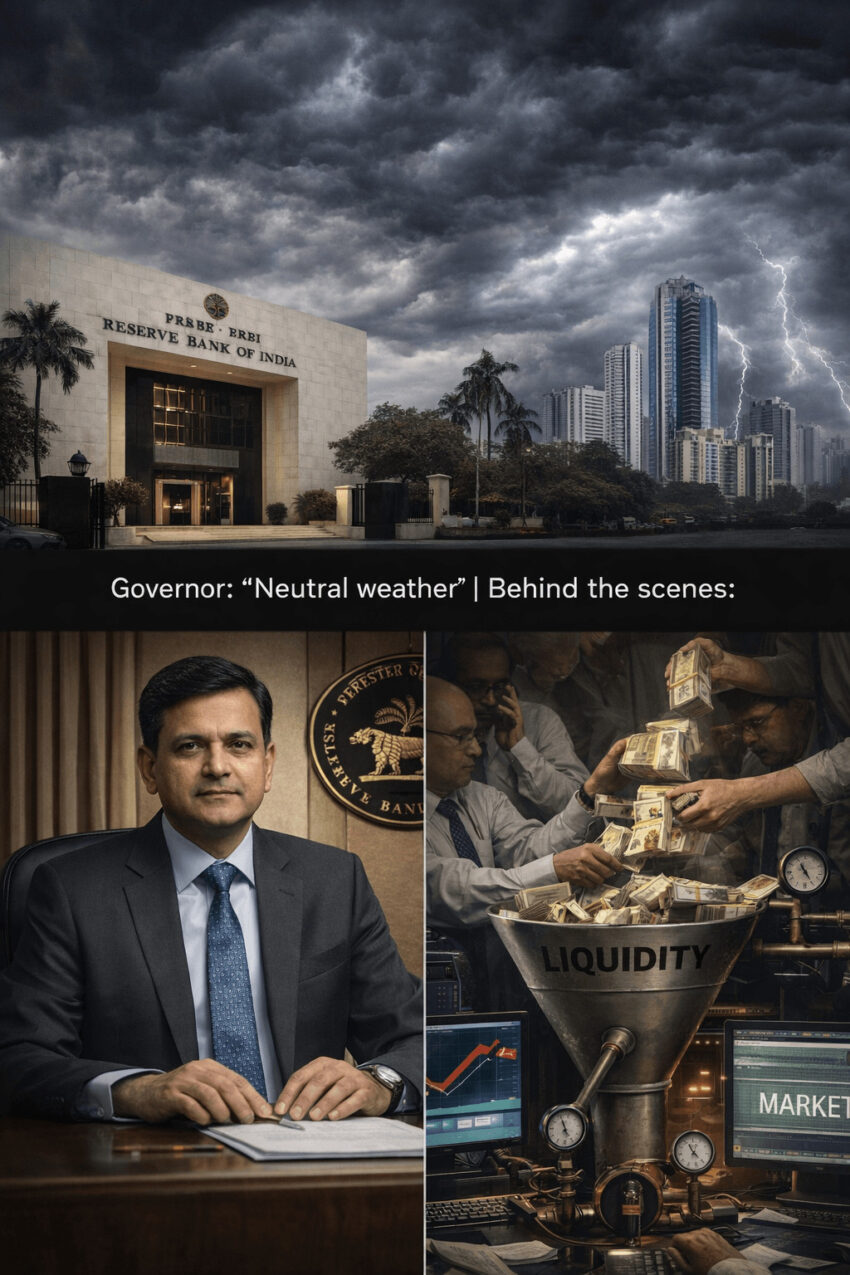
When do you open emergency rain drainage? In Monsoon.
You don’t wait for the streets to be waist-deep in water to pull the lever. You open the drains when the clouds look heavy. You open them when the first drops hit.
By injecting over ₹2.15 trillion right now, the RBI is effectively opening those “emergency drains”. This is ahead of a seasonal storm. Even if they call the current weather “neutral,” their actions suggest something else. They see a liquidity flood (or rather, a drought) coming.
Lower Bank Deposits
The RBI keeps official rates high. Meanwhile, banks are struggling to attract deposits. The tax treatment makes bank FDs look like the “bad deal”. Bonds or equity appear more attractive.
TDS is a psychological and procedural barrier. The government raised the TDS threshold for bank deposits to ₹50,000 recently. For seniors, it is ₹1 lakh. Still, the friction remains. This number makes no sense in terms of purchasing power.
When a bank deducts 10% TDS, that money is “gone” from the compounding cycle. The investor must file a return and wait months for a refund. For a small depositor, managing Form 15G/15H to avoid TDS is often more “expensive”. The time and effort exceed the tax itself.
Hold a listed bond for more than 12 months. You pay 12.5% LTCG (as per the new 2026 rates). For someone in the 30% income tax bracket, this is attractive. Paying 12.5% on a bond gain is much better. Compare this to paying 30% on bank interest.
Most modern bonds are issued at a deep discount. The investor doesn’t get “interest” (which triggers TDS). They get a “capital gain” at maturity. This bypasses the annual TDS headache. The money compounds uninterrupted.
By keeping TDS on small deposits, the government is essentially punishing someone. The most “loyal” bank depositors suffer. These are the middle class and seniors. Meanwhile, sophisticated investors move their money into the bond market. They avoid the “TDS headache”. They enjoy better post-tax yields.
It was high time for the Government to correct this anomaly. RBI cannot infuse liquidity forever. The Government should have done this in the budget itself. But it did not.
Rupee and FII
Right now, the Rupee is extremely sensitive. It recently hit record lows. It has been see-sawing between ₹89 and ₹92 per dollar.
If the RBI cuts the Repo Rate, the “spread” shrinks. The spread is the difference between Indian interest rates and US interest rates.
FIIs have already pulled out nearly $4 billion this fiscal year. They would find Indian debt even less attractive. A rate cut would likely accelerate that exodus. This would put even more downward pressure on the Rupee.
Bank is sacrificing the “growth stimulus” of a rate cut. The goal is to ensure the Rupee doesn’t go into a freefall. It also ensures that FIIs don’t pull the plug entirely.
Remember the “Off-Cycle” shock of May 2022. The RBI hiked the repo rate by 40 basis points in a surprise meeting. This happened just a few hours before the US Fed was expected to deliver its own hike. It highlights the RBI’s “Pre-emptive Strike” philosophy. When the Rupee is under threat, the RBI would rather act early. It prefers to surprise the market than react late and look “behind the curve.”
In 2022, the RBI used a rate hike to prevent a freefall. Today, they are using a “rate pause” for the exact same reason.
Good Lender / Bad Lender Game
Reserve Bank is essentially playing a classic good lender/bad lender game. It’s just like the good cop and bad cop game played by police.
The Governor (the “Bad Lender”) takes the stage to stay firm. He talks about “neutrality.” He refuses to drop the official price of money (the Repo Rate). Meanwhile, the RBI’s Desk (the “Good Lender”) is working the back alleys. It’s pumping trillions of rupees into the system. This ensures the “Bad Lender’s” high rates don’t actually break anything.
RBI is trying to have its cake and eat it too. Keep the Rupee stable with high “official” rates. Keep the economy moving with high “actual” liquidity.
Strategic Autonomy
The “cat and mouse” game with the Fed only works as long as the Dollar is the only exit door. With the recent flood of Free Trade Agreements (FTAs), things are changing. The shift toward local currency settlement is happening. The RBI is trying to build a world where a Jerome Powell press conference doesn’t automatically cause panic. Panic in Mumbai should not be automatic.
The RBI is currently pushing to link Digital Currencies (CBDCs) across BRICS nations. Consider this scenario. A Mumbai merchant can settle a deal with a Brazilian or Emirati supplier. They use a direct digital “Rupee-to-Local” bridge. The need to buy Dollars as an intermediary disappears.
India-EU FTA deal was concluded recently. It covers 99% of trade value. It includes frameworks for faster remittances and streamlined settlements. These bypass traditional dollar-heavy routes. By shifting trade toward the Euro and Rupee, the “Dollar-Rupee” exchange rate becomes less critical.
Reserve Bank is building a domestic “fortress”. When the next Fed storm hits, India can simply close the windows and keep working.