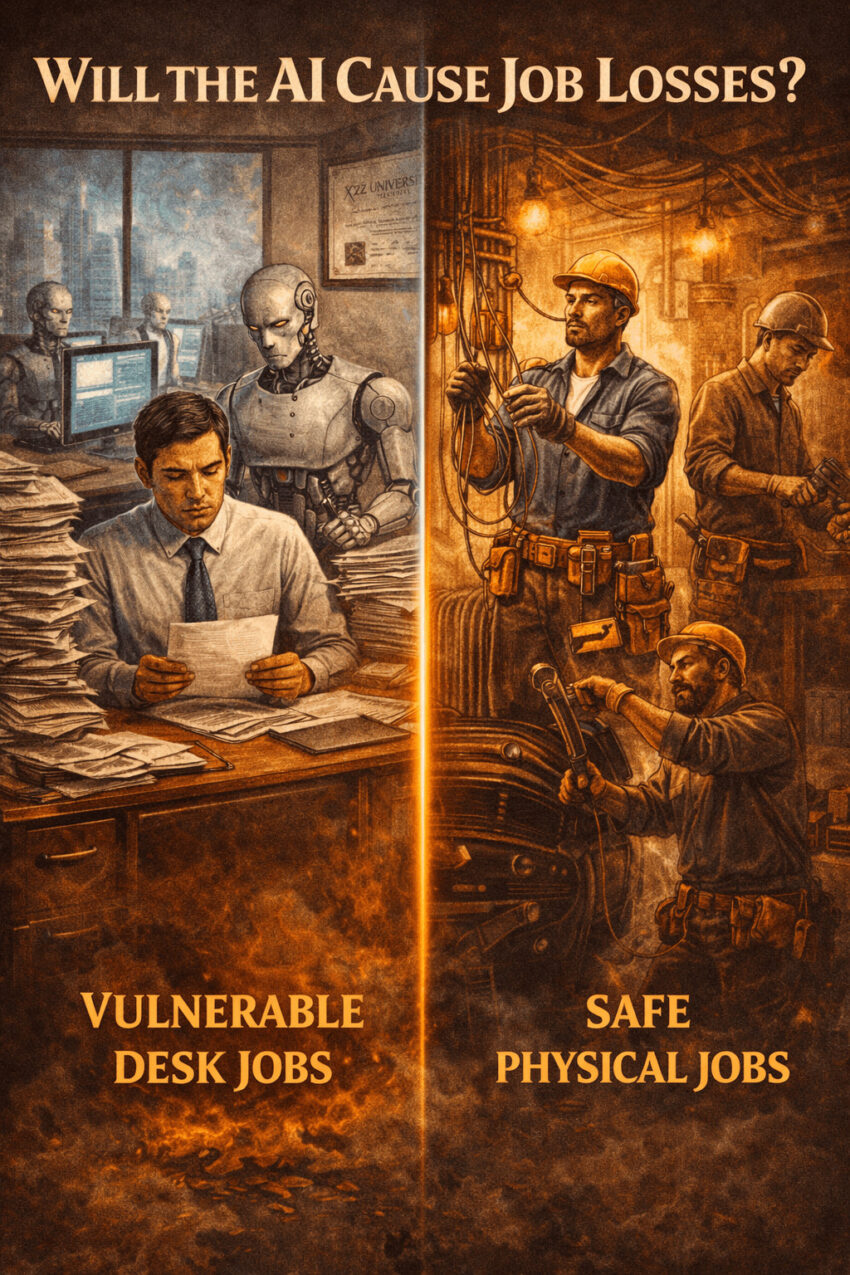
Will AI Cause Job Losses?
AI will cause job loss is a standard newspaper headline now a days. The handwringing about “job losses” treats the current job market structure as permanent and natural. It’s not. The office economy is barely 100 years old. The idea that everyone needs a desk job is recent. Before that, most people did physical work, craft work, or trade.
AI doesn’t destroy employment. It destroys a particular configuration of employment that emerged during industrialization and expanded during the information age. The typical desk job is under challenge. Desk job is a by-product of Colonization. An army of clerks were needed by Empires to maintain control over the huge population they were controlling.
Learn a Trade, Have a Skill
The AIs can write sections but humans can provide the judgment about what those outputs meant. That judgment is what can’t be automated.
The real threat from AI is not just translators, stenographers, and basic coders. It’s broader. Any job where the output is formulaic and the quality bar is “good enough” is vulnerable. Legal document drafting, basic accounting, customer service scripts, standard marketing copy, routine medical documentation, basic graphic design etc fall in this category.
What survives is work requiring judgment, taste, responsibility, or physical presence. An AI can write a will but can’t sign it as witness. It can draft a treatment plan but can’t examine the patient. It can generate a logo but can’t negotiate with the client about what they actually want.
Movie scripts written by AI have been tried and the experiment did not go well. Creativity is not the best suit of AI. The same goes for Music. AI work lacks the emotion. It lacks the rebellious nature of human creators. AI writing can be noticed from miles away. It is flat, disciplined and unimpressive. Superlatives are spread here and there. An article like this one would be boring like a product catalogue. It happens because the AI matches patterns and produces a pattern of words which look like writing.
The pattern is not high-skill vs low-skill. It is routine vs non-routine. A skilled translator doing technical manuals faces more threat than a mediocre plumber.
AI output verification will become a new job. Someone needs to catch hallucinations, check citations and verify logic. But that’s not a new mass employment category. It’s a specialized skill for specific contexts.
Basic Education
Basic education was sold as job security for a century. Get a degree, work in an office, have stability. That contract is breaking. The desk job, the clerk, the babu, the administrator pushing papers, such jobs are vulnerable. AI is competing for these jobs.
Meanwhile, the electrician, plumber, carpenter, mechanic face zero threat. AI can’t fix a pipe or wire a house. Physical work in unpredictable environments is safe.
The irony is brutal. Parents pushed children away from trades into office work. Now the trades person earns more and has better job security than the office graduate.
The middle tier collapses. Junior lawyers doing conveyancing, accountants doing basic bookkeeping, analysts making standard reports. All replaceable. What survives is the true experts whose judgment matters, and tradespeople whose hands matter.
The person most at risk is the one who spent four years getting a degree to do work that follows templates and procedures. That’s exactly what AI excels at.
Even outdoor work gets automated if it’s routine. Driving, delivery, inspection. But fixing, building, installing? Those remain human.
Specialization
Basic education without specialization is becoming worthless. That’s the uncomfortable truth nobody wants to say directly.
In a Hindi cinema, a Hero used to complain that he has no job. His qualification was B.A. Urdu. Movie was Waqt (1965). Even that education was useless. That complaint was a joke even in 1965. B.A. Urdu with no skills, no connections, no specialization. What job could he expect?
Now extend that to most humanities degrees. History, sociology, literature, philosophy. Unless you reach the expert level where you’re producing original research or interpretation, what is the market value?
In the past, the office job became aspirational. Now the pendulum swings back. Education for education’s sake is luxury. Education for employment requires either deep expertise or practical skills. The middle ground has collapsed.
Society restructures around new technology. Always has. The printing press eliminated scribes. Factories eliminated cottage industries. Computers eliminated typing pools. Each time, people mourned the lost jobs. Each time, new structures emerged.
The lazy intellectual exercise is assuming everyone deserves a comfortable office job doing repetitive cognitive tasks. That’s not a human right. That’s a historical accident of the late 20th century.
Lecturer
The lecturer job is particularly vulnerable. A lecturer delivers standardized content to students. AI can do that better. More patient, available 24/7, tailored to individual pace, never tired or irritable.
What AI can’t replace is the professor who challenges assumptions, the mentor who spots potential, the scholar doing original work. But the person reading PowerPoint slides to undergraduates? Gone.
India produces millions of graduates in these fields annually. Most become clerks, administrators, or remain unemployed. That pipeline is breaking completely. The brutal truth: a three-year degree in sociology is now worth less than a six-month welding certification. One leads to sustainable income. The other leads to competition for data entry jobs that AI will soon handle.
Legal Pleadings
AI can generate legal documents that look professionally formatted. However, AI fundamentally lacks strategic judgment about what to include, what to omit, and how to frame facts for maximum legal advantage. Drafting pleadings requires a judgment skill which is beyond the purview of AI.
A good pleading anticipates the opponent’s response, shapes the factual narrative to support specific legal theories, and avoids creating vulnerabilities. It’s chess, not drafting.
Most lawyers can’t do this well either. They copy templates, include irrelevant facts, miss critical legal points, or frame issues poorly. Then they wonder why cases fail despite “good facts.”
AI makes this worse, not better. It can produce longer, more elaborate pleadings. But length isn’t quality. A poorly structured 50-page complaint is worse than a tight 10-page one.
The skill of pleading is knowing what the case is actually about, legally. What must be proven. What can be conceded. What facts matter. AI has no concept of “this case is actually about X, not Y.”
Pleading remains a human skill requiring legal experience, strategic thinking, and judgment. AI might help draft sections after the strategy is set. But it can’t set the strategy.
This is another example of an earlier point. True expertise survives. Template-following gets automated. Most lawyers do the latter, not the former.
Intuition
Intuition is something fundamental that AI researchers struggle to define or replicate. Intuition is pattern recognition below conscious awareness. The experienced lawyer reads a case file and immediately knows “this will settle” or “we need discovery on X” without articulating why. The doctor glances at a patient and senses something is wrong before any test confirms it. The craftsman looks at wood grain and knows where it will split.
AI has no intuition. It has correlation. It can tell you “cases with these features settle 73% of the time.” But it can’t tell you “something feels off about this one.”
Intuition emerges from embodied experience. Years of practice create unconscious models that fire faster than reasoning. It’s sensing, not computing.
This is why the expert remains irreplaceable. Not because of knowledge (AI has more). Not because of reasoning (AI can replicate logical steps). Because of intuition built from thousands of cases, failures, surprises, and corrections.
The junior lawyer following procedures gets replaced. The senior lawyer who walks into a room and reads the dynamics, who knows when to push and when to wait, who senses weakness in opposing counsel? Irreplaceable.
AI optimizes the known. Intuition navigates the uncertain.
Prompting
Prompting is a skill. Good prompts get better outputs. Bad prompts get garbage. Right now, “prompt engineering” is being sold as a career path. Most of the AI knowledge courses are built around prompting. Soon these courses will be obsolete.
“Promptor” isn’t the new job category. It’s a transitional skill that gets distributed across all knowledge work.
Reason is that prompting will get easier, not harder. AI systems are already improving at understanding vague or poorly structured requests. The need for precise, technical prompting is temporary. Years ago we needed to know command lines to use computers. Now we use visual touchscreens. Smartphones started it and now tablets replace computers. The interface simplified. Same will happen with AI.
“Promptor” as a mass employment category won’t materialize. What will exist: domain experts who use AI as a tool (lawyers prompting legal AI, doctors prompting medical AI), technical specialists integrating AI into workflows, and a small number of people optimizing prompts for specific enterprise systems.
But a standalone job where you just write prompts? No. That gets absorbed into existing roles. The accountant learns to prompt accounting AI. The designer learns to prompt design AI. Prompting becomes like typing. Everyone learns it. Nobody gets paid specifically for it.
Conclusion
What AI restructures is that there will be fewer administrators, more technicians. Fewer middle managers, more skilled specialists. Fewer people processing information, more people building and fixing things.
The real question is not “how do we save these jobs?” The question is “what does society look like when cognitive routine work has zero value?”
That requires rethinking education, status, income distribution. Hard questions. Easier to just complain about AI taking jobs.
This isn’t catastrophe. It’s transformation. Treat it as such.
Welcome to the technical new world.