The Call for Return of Empire
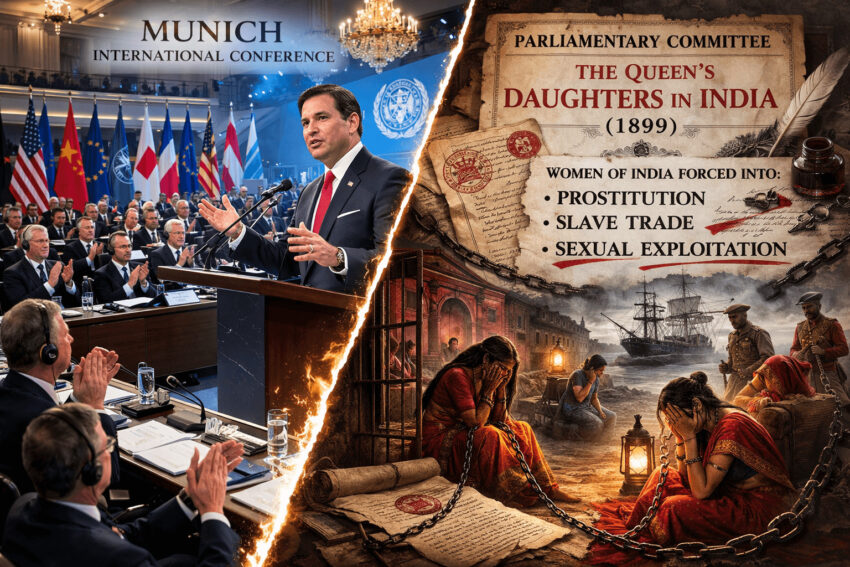
On February 14, 2026, U.S. Secretary of State Marco Rubio stood before the Munich Security Conference. He spoke with a measured, almost soothing tone. The room gave him a standing ovation. But beneath the diplomatic polish lay a specific and deliberate argument.
“We are part of one civilization,” Rubio told his audience. “Western civilization.” He spoke of America as “a child of Europe,” bound by “Christian faith, culture, heritage, language, ancestry.” He said the West was “the greatest civilization in human history.” He warned against forces of “civilizational erasure.” He called for a Europe no longer “shackled by guilt and shame,” proud of its culture, proud of its heritage, unwilling to be “caretakers of the West’s managed decline.”
The speech was aimed to repair the USA and European relations which nosedived after Greenland claims of USA. The politics of USA has becomes a child’s play. They say one thing and strain relations. Next day there is a pep talk to please the scorned nation.
The speech was widely praised in Washington. It was called reassuring in Brussels. It was called historic by supporters. What it was not called, in any of those rooms, was what it actually was: a celebration of white imperial supremacy dressed in the vocabulary of civilization.
Golden Age of Colonization
Later in speech Rubio dropped the pretense and said:
For five centuries, before the end of the Second World War, the West had been expanding – its missionaries, its pilgrims, its soldiers, its explorers pouring out from its shores to cross oceans, settle new continents, build vast empires extending out across the globe.
But in 1945, for the first time since the age of Columbus, it was contracting. Europe was in ruins. Half of it lived behind an Iron Curtain and the rest looked like it would soon follow. The great Western empires had entered into terminal decline, accelerated by godless communist revolutions and by anti-colonial uprisings that would transform the world and drape the red hammer and sickle across vast swaths of the map in the years to come.
The logic was identical. While Marco Rubio did not explicitly use the phrase “Golden Age of Colonization” but it was implicit.
The British Empire did not merely seize land and extract wealth of 45 trillion dollars from India. It built a systematic apparatus to destroy existing knowledge and replace it with the version of reality that served the colonizer. It distorted the Sanskrit Language itself which was repository of ancient knowledge through its Operation Sanskrit Mill. After the decline of the British Empire, the Operation Sanskrit Mill moved across Atlantic to USA.
It dismissed thousands of years of Indian mathematics, medicine, astronomy, and philosophy as superstition. It replaced the Gurukul system with schools designed, in Macaulay’s own words, to produce people who were “Indian in blood and color, but English in taste.” It called the erasure of a civilization’s self-understanding an act of enlightenment.
When Rubio calls his civilization “the greatest in human history” and warns against its erasure, he is not making a neutral observation about architecture or philosophy. He is invoking a hierarchy. He is saying that what came before European contact was lesser, that what was displaced was worth displacing, that the civilizations now rising again in Asia, Africa, and South America represent a threat to an order that should never have been questioned.
This is not a matter of interpretation. It is the logical content of the words he spoke.
May be Rubio should visit Britain and persuade it to pay the loan it owed to India for war time purchases from India. It is in addition to 45 trillion it looted through extraction in its about 200 years of rule. Rubio may also ask the KIng about the report of British Parliamentary Committee titled The Queen’s Daughters in India (1899) and discuss the glory British empire brought to the women of India who were forced into prostitution by its army.
Rubio, so enamored by the great western empire may personally discuss with the British King about the slave trade his ancestors were personally conducted. He may also discuss with the King as also the members of his cabinet as to why that great civilization did not know what to do with dead bodies and were preserving these in a vault.
Physical Manifestation of Imperialism
The consequences of that colonization were not abstract. They were biological. Colonization shrunk people physically.
For multiple generations, the population of India could not attain the height that nutrition and genetics would have naturally produced. This was not coincidence. Colonial taxation forced peasants to grow cash crops instead of food. Colonial trade policy destroyed local textile industries. The Bengal Famine of 1943 was not a natural disaster. It was the result of policy that prioritized imperial war supply over the lives of millions.
In 1947, the British robbed India of its sources of food. East Pakistan was India’s rice bowl and West Pakistan was wheat bowl. In 1950’s Nehru admitted in a speech in Parliament that Pakistan was selling wheat to Korea but not to India. India was living on “Ship to Mouth” dependent on American cattle-feed quality wheat.
In the 1960s, America’s Public Law 480 program shipped surplus grain to India. The flour, made from hard red winter wheat designed for industrial bread-making, was unsuitable for the roti that Indian households had made for centuries. It would not knead. It was, in the plainest terms, cattle feed for human beings. President Lyndon Johnson personally controlled the shipments, using them as leverage to force India to change its foreign policy positions. Hunger was a diplomatic instrument of the new Imperial power.
At political rallies of that era, the bones were visible in people’s cheeks. This is not a metaphor. This was the biological signature of what Rubio calls a civilization worth being proud of. Those video exist on YouTube to verify the consequences of glorious civilisation.
A True Macaulay Progeny
There is a particular irony that Rubio himself embodies. He is of Cuban descent, a heritage rooted in a people colonized by Spain and later managed as a strategic asset by the United States. He stands in Munich, claiming membership in a civilization whose architects would historically have placed his ancestors several rungs below the table he now sits at.
He is the product of the very system he celebrates. A man made fluent in the language, values, and self-perception of the colonizer. A man who now defends that system more zealously than many of its original beneficiaries. He is not exceptional in this. The empire always produced such graduates. It was, in fact, the whole point of the enterprise.
The same society that receives Rubio’s defense employs Indian doctors in nearly every rural hospital that cannot attract its own graduates. Its universities are staffed by scholars from the regions he calls a vacuum. Its elderly are cared for by workers from Latin America. Its technology companies are run, in extraordinary proportion, by people from the subcontinent he would define as peripheral to great civilization.
To call these regions a vacuum is not a geographical error. It is an act of erasure performed in the present tense.
Implications
When a sitting U.S. Secretary of State stands before a global audience and describes the end of Western empire as a contraction caused by “anti-colonial uprisings,” and calls for rebuilding that civilizational order, any nation that lived under that order has just received its strategic signal clearly.
India does not need an intelligence briefing. The speech is public. The nostalgia is explicit. The word “uprisings” is in the transcript.
Fifty billion dollars spent annually on defence is not paranoia, it is pragmatism. It is an uprising against Colonization 2.0.
Good-bye
The speech of Rubio betrays a nervous Zamindar who lost his land in gamble of wars and is facing decline of his wealth and power. He spoke for an empire built on paper currency, after its crack-down failed. It was exactly as predicted by me in my book Accidental Empire.
The people who lived under that colonial rule do not need a Munich speech to understand what it was.
The West did not bring light to the world. It brought a particular kind of darkness and called the destruction of what existed before it an act of illumination.
That is what the ovation in Munich was for. Yearning of declining powers that were.
References:
- An Era Of Darkness by Shashi Tharoor (2016): https://archive.org/details/an-era-of-darkness
- Rubio Speech: https://www.state.gov/releases/office-of-the-spokesperson/2026/02/secretary-of-state-marco-rubio-at-the-munich-security-conference
- Patnaik, Utsa. “Revisiting the ‘Drain,’ or Transfers from India to Britain in the Context of Global Diffusion of Capitalism.” Research Gate, documenting $45 trillion drain from India (1765-1938).
1 thought on “Marco Rubio’s Speech in Munich is an Eye-Opener.”