
(Chapter 11)
Secularism may ordinarily mean separation between Church and State in the west but Islam has its own version of secularism in which people of multiple faith can coexist albeit subject to certain conditions.
This is the reason of conflict between Western States and its Muslim groups. While Muslims are ambivalent to state the kind of secularism they want, western governments are in epistemological collapse to understand what they want. The Muslims want a return to the State which existed under Rashidun Caliph, Umar ibn Khattab.
The Pact of Umar
The Pact of Umar, also known as the Covenant of Umar or Laws of Umar, is a treaty governing the lives of non-Muslims under Islamic rule. It establishes supremacy of Muslims over non-Muslims. The Pact is traditionally attributed to the second Rashidun Caliph, Umar ibn Khattab, who ruled from 634 to 644 CE. Some historians attribute it to the Umayyad Caliph Umar II. Others believe 9th-century Islamic scholars composed it and attached Umar’s name for greater authority.
The pact originally emerged from Muslim conquests of Syria, Mesopotamia, or Jerusalem. It later gained canonical status in Islamic jurisprudence and shaped dhimmi law for over ten centuries.
Harbi and Dhimmi
Dhimmi or Zimmi is a unique tradition if not law of Islam. All persons who are not followers of Islam are Kafir whose only destiny is death but an Islamic State may grant them protection by accepting such people as dhimmi or zimmi.
Dhimmi is an Arabic word shortened for ahl ad-dimmah/dhimmah “the people of the covenant”
The harbi is a non-Muslim who does not live under the protection (dhimma) of an Islamic state. This person is considered outside the treaty or peace agreements and may be regarded as an inhabitant of the “dar al-harb” (house of war). A harbi has no inherent rights within the Islamic territory unless granted safe conduct (aman) to enter. They are essentially viewed as outside the protection and obligations of the Islamic community.
The musta’min is a non-Muslim who has been granted temporary safe conduct by an Islamic state, typically allowing passage or stay for a specific purpose without hostility. This status entails protection during their presence in Muslim lands, often in contexts such as trade or diplomacy, under a guarantee or agreement.
Restrictions Imposed on Non-Muslims
The pact placed sweeping restrictions on Christians, Jews, Zoroastrians, and Samaritans. These covered worship, architecture, dress, sound, and social conduct.
- Prohibition against building new churches, places of worship, monasteries, or cells.
- Prohibition against rebuilding destroyed churches, by day or night.
- Worship places of non-Muslims must sit lower in elevation than the lowest mosque in town.
- Non-Muslim houses could not be taller than Muslim homes.
- Prohibition against hanging a cross on churches.
- Muslims must be allowed to enter churches at any time, day or night.
- Church bells and gongs had to remain low in volume.
- Non-Muslims could not raise their voices during prayer times.
- Prohibition against teaching non-Muslim children the Quran.
- Christian books and symbols could not be displayed on public roads or in markets.
- Palm Sunday and Easter parades were banned.
- Funerals had to be conducted quietly.
- Prohibition against burying non-Muslim dead near Muslims.
- Prohibition against raising pigs next to a Muslim neighbor.
- Christians could not sell alcohol to Muslims.
- Christians could not provide shelter or cover for spies.
- Prohibition against telling lies about Muslims. (Read as no criticism or debate about Islam)
- Non-Muslims had to rise from their seats when a Muslim wished to sit.
- Prohibition against preaching to Muslims or attempting to convert them.
- Prohibition against preventing anyone from converting to Islam.
- Non-Muslims had to wear distinct clothing. Christians wore blue belts or turbans. Jews wore yellow. Zoroastrians wore black. Samaritans wore red.
- Hair had to be cut differently from the Muslim custom.
- Arabic bynames and Muslim titles of honor were forbidden.
- Prohibition against riding horses with saddles.
- Prohibition against carrying weapons.
- Non-Muslims could not lead, govern, or employ Muslims.
- Non-Muslims had to host a Muslim traveler for at least three days.
- Prohibition against buying Muslim prisoners.
- Prohibition against taking slaves allotted to Muslims.
- If a non-Muslim struck a Muslim, his protected status was immediately revoked.

Entitlement of Non-Muslims
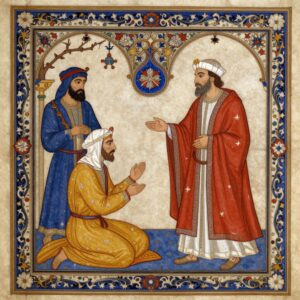
In exchange for following these rules, the Islamic state offered protection of life and property. Non-Muslims retained the right to practice their faith privately. They also paid a special tax called the jizya in place of military service.
This is the extent of peace offered to non-Muslims in dar ul Islam.
Duration and Decline of Pact
The pact’s framework remained the dominant legal standard across Muslim-ruled lands for over a thousand years. Enforcement varied by region and ruler. Some applied it strictly. Others largely ignored it.
The Ottoman Empire dismantled this system under European pressure through the Tanzimat reforms.
_Islâhat Hatt-ı Hümâyûnu (_Modern Turkish: Islâhat Fermânı) was a February 18, 1856 edict of the Ottoman government and part of the Tanzimat reforms. This decree issued by Ottoman Sultan Abdulmejid I promised equality in education, government appointments, and administration of justice to all regardless of creed. The jizya tax was also abolished around the same time.
The Civilizational Baseline
Thus Muslim dominance over non-Muslims was a legal, institutionalized, divine order in Arabia and Persia region for roughly a thousand years. It was not an ambition or ideology. It was practices discrimination.
It was the Non-Muslims stepped aside. Non-Muslims paid extra. Non-Muslims stayed quiet, small, and visually subordinate. That was simply how the world was supposed to work. It was written down, enforced, and theologically justified.
Then it was taken away. Not through internal reform or willing surrender. It was dismantled under direct European colonial pressure on the Ottoman state.
No theological reckoning happened. No collective acknowledgment was made that equality with non-Muslims was now the new norm. The legal structure disappeared. The civilizational memory is reinforced through stories, sermons, TV shows and films celebrating that era of Muslim dominance.
Analysis
Today’s Muslims do not understand that it was a different time and different civilisation. They hear the stories and feel offended by equal rights for all.
How can Quwwat-e-Islam or Might of Islam can be sidelined.
The demand for special accommodations in secular countries is the pact reasserting itself in a new context. Demands for separate legal treatment, pressure against criticism of Islam, insistence on public religious accommodation, resistance to integration. These are attempts to undo historical ‘wrong’ against Muslims.
This framework explains Muslim political behavior more completely than any other lens. Poverty does not explain it. Colonialism alone does not explain it. Identity crisis does not explain it. The pact explains it.
In India, a similar glorification of Mughal rule is used for same effect. It was the worst rule for common man including the converted Muslims. But it is glorified and Muslim leaders tell the crowd “We have ruled India for centuries.”
We shall discuss the Mughal rule in the next Chapter 12.
See all chapters on Modern Jihad: https://sandeepbhalla.in/tag/modern-jihad/
2 thoughts on “Islam and Its Secularism”