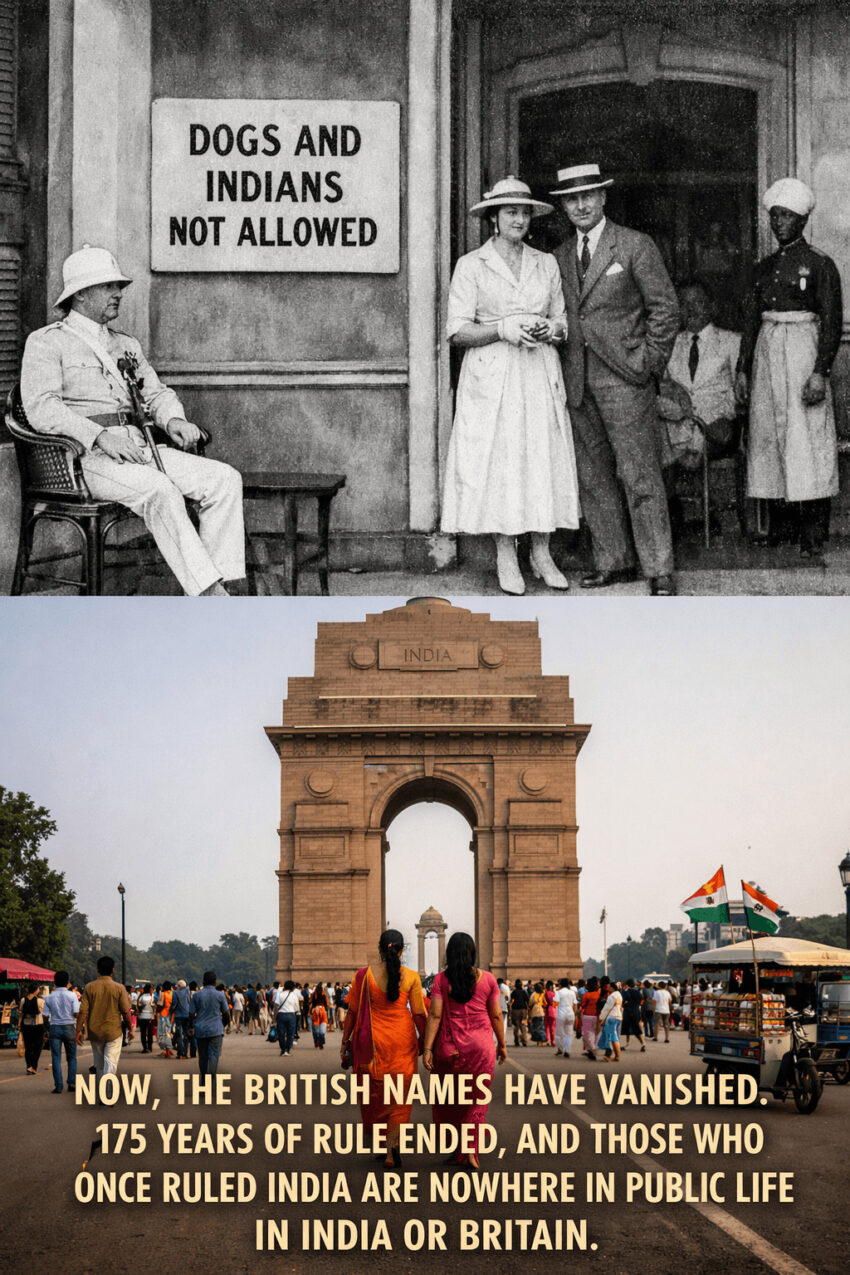
The Vanishing British Names from Public Life.
British ruled India for approximately 175 years. There Officers created townships like Dalhousie and Lansdowne named after their surnames. The people behind those names vanished not just from India but also from public life of England. What happened to them?
There was a time when signboards outside British-owned estates in India read: “Dogs and Indians Not Allowed.”
It was brut display of racism by which British declared their racial superiority.It created a permanent hierarchy. A statement that certain peoples were, by nature of their birth, beneath consideration. It was the distilled philosophy of an empire that had convinced itself that its dominance was a moral condition, not a historical accident.
Three generations later, British workers clock in every morning at Tata Steel in Port Talbot, Wales. They drive to work in Jaguar Land Rover vehicles, owned by Tata Motors. They bank with institutions that depend on capital flowing from Mumbai. The Prime Minister of Britain itself was, until recently, a man whose grandparents came from the very land those signboards once excluded. British society is worried that Lakshmi Mittal has decided to move to Dubai due to higher taxation in Britain.
The signboard is gone. The hierarchy has inverted. And it happened without a single act of revenge or violence.
The Men on the Signboards
To understand the inversion, one must first understand the men whose names were carved into the streets and squares of India.
James Broun-Ramsay, the Marquess of Dalhousie, governed India from 1848 to 1856. He annexed kingdoms, built railways, and expanded British territorial control with the efficiency of a corporate auditor. His name was given to a hill station in Himachal Pradesh and a central square in Calcutta. His direct male line died with him. He had no sons. The square in Calcutta is now called B.B.D. Bagh, named after three young freedom fighters: Benoy, Badal, and Dinesh.
Henry Petty-Fitzmaurice, the Marquess of Lansdowne, served as Viceroy of India from 1888 to 1894. He gave his name to a cantonment town in Uttarakhand. His descendant, the current 9th Marquess of Lansdowne, lives at Bowood House in Wiltshire and opens it to tourists to pay the heating bills.
Prince Arthur, the Duke of Connaught, was Queen Victoria’s son. Connaught Place in New Delhi, the grand commercial centre built in his honour, is now officially called Rajiv Chowk. Locals still call it CP, a habit of memory that even nationalism cannot fully erase.
Victoria Terminus in Mumbai, named for the Queen-Empress, is today Chhatrapati Shivaji Maharaj Terminus. The name of a Maratha warrior king replaced the name of a British monarch on the very building the British built.
The pattern is clear. The names are being erased from the land. And the families behind those names have faded into the English countryside, managing estates that cost more to heat than they earn, selling rooms to film crews and opening their gardens to summer tourists.
The Gentlemen: A Mirror in Fiction
Guy Ritchie’s television series The Gentlemen, with Eddie Horniman as the central character, is a comic entertainment show. It is also an accidental documentary about the Karmic condition of the British aristocracy.
Eddie inherits a vast estate. He holds an ancient title. The house is beautiful. The walls are hung with paintings acquired during the peak of empire. And the bank account is empty.
The only way to keep the estate alive is to rent the land to a drug empire. The Duke becomes a facilitator of crime simply to pay the taxes on what his ancestors looted. The means of acquisition were Adharmik. The wealth had no roots. And so it is withering in real time, on screen, for the world to watch.
This is not satire. Badminton House, used as a filming location for the series, is the real seat of the Dukes of Beaufort. The sport of Badminton itself was named after this house, but the game was developed by British Army officers serving in Pune, India, in the 1860s. India gave Britain its sport. Britain named it after an English estate. And now that estate survives by leasing itself to Netflix.
The Rebels Who Chose India
Not all British men and women of that era chose the signboard. Some chose conscience.
Allan Octavian Hume, a British civil servant so disillusioned with colonial cruelty that he founded the Indian National Congress in 1885. The organisation that eventually dismantled the empire he served was created by a British officer. His descendants are private citizens in the United Kingdom. In India, his legacy is written into the Constitution. But descendants have no role in public life.
Annie Besant, an Irish-British woman, became President of the Indian National Congress. She did not return to England. She died in Adyar, Chennai, in 1933, having chosen India as her home. Schools and streets in India carry her name. The British establishment has largely forgotten she existed.
Madeleine Slade, daughter of a British Admiral, left a life of aristocratic comfort to live in Gandhi’s ashram. Gandhi called her Mirabehn. She wore khadi, spun thread, and worked in rural villages. She never returned to high society. After independence, she moved to Austria, where she spent her final years studying Beethoven. She is remembered in India. She is nearly invisible in England.
These figures made a different choice. Their means were rooted in Seva or service. And their memory has outlasted the Viceroys who governed alongside them.
The American Who Planted India’s Apples
Perhaps the most complete story of Dharmik means is that of Samuel Evans Stokes, a wealthy American from Philadelphia whose family founded the company that became Otis Elevators.
He came to India in 1904 to work in a leper colony in Himachal Pradesh. He fell in love with the land, converted to Hinduism, married a local woman named Agnes, and changed his name to Satyananda Stokes. In 1916, he imported Red Delicious apple saplings from America and taught the farmers of the Shimla hills to grow them.
That single act created the apple industry of Himachal Pradesh, today worth thousands of crores, employing hundreds of thousands of families.
He was the only American ever jailed by the British for participating in the Indian independence movement.
His descendant Vidya Stokes became Speaker of the Himachal Pradesh Vidhan Sabha and a senior Minister in the state government. His grandson Dr. Vijay Stokes recently donated fifty bighas of orchard land to establish a knowledge hub for the people of Kotgarh.
The Viceroys built monuments to themselves. Satyananda Stokes planted trees. The monuments are being renamed. The trees are still bearing fruit.
The Tata Mirror
No story illustrates the Karmic principle more precisely than that of the Tata family.
Jamsetji Nusserwanji Tata was a descendant of the migrants to India from Iran or Persia. Hence, he is referred as a Parsi businessman from Mumbai who dreamed of building a steel plant in India. The British actively obstructed him. They feared Indian industrial competition. They used every bureaucratic and legislative tool available to prevent the plant from being built.
He died in 1904 before his steel plant was completed. His son Dorabji Tata saw it through. The Tata Iron and Steel Company was established in Jamshedpur in 1907. Today Tata group is largest multinational business group from India.
The wealth of Jamsetji Tata was not extracted from anyone. It was created with enterprise. He built the Taj Mahal Palace Hotel in Mumbai, reportedly because he was turned away from a European hotel on racial grounds. He established the Indian Institute of Science in Bangalore. He funded scholarships. He created infrastructure. Every rupee was earned through production, not extraction.
Today, Tata Steel owns what was formerly British Steel in Port Talbot, Wales. Jaguar Land Rover, acquired by Tata in 2008, employs tens of thousands of British workers. The family that was blocked from building a steel plant in their own country now sustains the steel industry of the country that blocked them.
The British preached free markets and the dignity of enterprise to the world. The people they excluded took the lesson seriously. The preachers forgot to practice what they preached.
The Bhogi and the Rakshak
Indian philosophy draws a distinction between the Bhogi, one who consumes, and the Rakshak, one who protects and sustains.
The British Raj was Bhogi in its purest form. It extracted from the land, from the people, from the culture, and from the future. When extraction ceased in 1947, the connection was severed. There was no social capital, no emotional bond, no root. The wealth evaporated because it had no foundation in value creation.
The Indian dynasties that survived the post-independence transition did so because they had Rakshak relationships with their people. The descendants of Chhatrapati Shivaji Maharaj remain prominent in Maharashtra politics today. Udayanraje Bhosale is a Member of Parliament. The connection endures because Shivaji was not merely a ruler. He was a protector of his people, his land, and his culture.
Even the descendants of Mir Jafar, who betrayed Bengal to the British, remain known figures in the region. The memory is not always flattering. But the roots are there. The story is woven into the soil.
The British Viceroy’s power was a job assignment. Once the company went out of business, the job title became a footnote.
The Macro Karma of Nations
The principle scales beyond individuals and families.
The United Kingdom in 2026 is an island struggling to provide basic healthcare to its citizens. The National Health Service, once the pride of the nation, has a waiting list of millions. Dental appointments are a luxury. Hip replacements require years of waiting. The wealth that built the empire is gone, drained by the very debt and inequality the empire generated.
France, which maintained a financial grip on fourteen African nations through the CFA Franc system long after formal colonisation ended, is now facing a pension crisis and sovereign debt pressure. The extraction from Africa funded the French quality of life for decades. That system is now being dismantled by a new generation of African leaders. And the bill is arriving.
Meanwhile, India is becoming the pharmacy of the world. Indian doctors staff the NHS. Indian engineers run Silicon Valley. Indian conglomerates employ British workers. The country that was once the object of extraction is now a provider of solutions to the very nations that extracted from it.
This is not revenge. It was never revenge. It is simply the logical conclusion of Dharmik versus Adharmik means.
The Finale: The Symmetry of Karma
The law of Karma does not require a judge. It does not need a court. It operates through the simple, relentless logic of cause and effect.
The means are the end. They are not two different things separated by time. They are the same thing, seen from different points in the story.
The British Empire built its wealth on extraction, exclusion, and the deliberate suppression of Indian enterprise. The end of that wealth was guaranteed from the moment it was accumulated. Money with no roots cannot stand.
Rishi Sunak sat in 10 Downing Street, the grandson of people who could not eat in the same restaurants as their rulers. Sundar Pichai runs Google. Satya Nadella runs Microsoft. They rose to the ranks through sheer hard work and enterprise. No violence was used unlike British rulers in India.
The “Dogs and Indians Not Allowed” sign has been replaced by a different sign, written in the language of market capitalisation and national GDP, and it reads something quite different now.
The Indian families British excluded in India, are buying homes, companies, and brands in Britain.
Three generations. That is all Karma needed.
It did not arrive with thunder. It arrived quietly, through education and enterprise. The signboard is gone. Ledgers are still being balanced.
The only lesson from history is that nobody learns from it. But Karma is not a lesson. It is a law. And laws do not require our understanding to operate.
Notes:
- Patnaik, Utsa. “Revisiting the ‘Drain,’ or Transfers from India to Britain in the Context of Global Diffusion of Capitalism.” Research Gate, documenting $45 trillion drain from India (1765-1938).
- The Parsi community migrated from Persia to India roughly a thousand years ago, around the 8th to 10th century. Jamsetji Tata was born in Navsari, Gujarat in 1839.