Air Strike and War in Iran.
After waiting for several weeks, Israel and USA have attacked Iran, yesterday the 28th February 2026. Israel said that over 200 fighters jets participated in the attacks on Iran. The attack struck some 500 targets that included air defenses and missile launchers.The Israeli military said it was the largest “military flyover” in its air force’s history.
Israeli officials told media that top Iranian regime and military leaders, including Iran’s supreme leader Ayatollah Ali Khamenei and president Masoud Pezeshkian, were targeted in the attacks.
Apparently, United Nations and other international bodies have failed to prevent conflict and have become dysfunctional puppets of powerful nations.
The war was already on for decades with financial sanction of Iran, leading to its economic collapse. Now the attack on key installations and key personnel aims to decapitate the regime. It can be speculated that it will be followed by attacks on seaports to decapitate Iran completely. Without ports, it is a squeeze.
The British did exactly this to the Ottoman Empire between 1914 and 1918. They did not conquer Constantinople. They cut the supply lines, seized the ports, and let the structure collapse from within. The regime fell without a single British soldier entering the capital.
Assuming that regime in Iran will fall but the problem is that destruction without occupation creates a power vacuum. Therefore, the question would be what next, after dust of war settles? We will deal with it but first, the question:
“Whether this war can turn into a World War?”
To answer this question let us see where the major powers stand on this war and what is their relationship with Iran.
Russia and China
The distinction between “allies” and “tacit allies” is fundamental. It differentiates a security pact (like NATO) from a marriage of convenience. Whatever fears may be projected about China and Russia in the Senate of United States. They may be global players economically though consumer goods and oil respectively but they do not enter into territorial wars of the USA. Except for mild criticism and occasional supply of arms, they do nothing worth mentioning in geopolitics. Russia and China are more interested in Iran as a geographic disruptor than a military partner they would bleed for. Both regime can not ally with a theological state inimical to ‘whole world’. Needless to remind that different Iranian Leaders have sent letters to western leaders to convert to Islam. There is a near certainty the if Iran grows stronger enough, such letters will land in Moscow and Beijing too.
Proxies of Iran
Hezbullah in Lebanon, Hamas in Gaza and Houthis in Yaman and red sea are the proxies of Iran in its war unleashed on West and Israel. But a historical look at World War I or II shows that true alliances require shared economic systems or deep ideological alignment. Iran’s “Axis of Resistance” (Hezbollah, Houthis, etc.) are not sovereign allies. In a global war, proxies are often the first to be sacrificed or “de-linked” when the primary state comes under existential threat.
Gulf States
USA has 11 military bases in Gulf Kingdoms in West Asia, they call it middle east. Iran in retaliation hit US bases in Kuwait, Qatar, Bahrain, UAE. Iran’s Islamic Revolutionary Guard Corps (IRGC) reportedly launched attacks on multiple US military bases in Kuwait, Qatar, Bahrain, and the UAE, according to FARS News Agency. But Iran’s missiles have landed in civilian areas not on military bases. It is well known the Iran lacks precision strike capability.
Entire World has massive investment in Gulf and that includes China. No country will support Iran in attacking gulf states for long. This attack may fizzle out soon.
USA and Israel
The 2026 National Defense Strategy of USA (published just last month) explicitly shifts away from “nation-building” and large-scale ground invasions.
The current buildup in the Middle East, include massive warships like the USS Gerald R. Ford and the USS George H. W. Bush. But it shows that attack is almost entirely air and naval. They are prepared to “degrade” and “destroy” Iran from 30,000 feet, but they have zero appetite for the bloody, decade-long occupation that a ground war in Iran would require.
While the Israel’s IDF is masterclass at short, high-intensity ground maneuvers (as seen in the “Operation Roaring Lion” strikes earlier today), they are a small nation. They cannot sustain a “World War” level ground occupation far from their borders. They rely on “Standoff” weapons and air superiority. They lack capacity to mobilize the infantry of the 1940s to occupy Iran.
Europe is staying away from this war, a response justified by feeling betrayed on Ukraine. USA can not survive the domestic political fallout of 10,000 body bags coming home.
Instead of “boots,” they use “bits” (cyberwar) and “bots” (drones) but a territory can not be occupied with a drone. Without the 2.5 million Indians who fought in the 1940s, a “World War” today is no more a war of attrition. Now wars are high-tech skirmishes that end in economic collapse rather than territorial conquest.
India
A view is that India cannot remain an “island of peace” if the world goes to war because our economy is deeply integrated with global energy markets. This view also fears that a global distraction (a World War involving the US and Europe) provides a “window of opportunity” for regional adversaries like Pakistan and China to act against India.
The Indian Army is now the largest standing army in the world with 1.25 million active troops, they are an independent force. They are deployed on the LAC and LOC. It is not available as expeditionary infantry for Western geopolitical goals. That is impossible. India is under no treaty alliance with the West or any country to place boots on the ground.
Indian politician, Subramaniyam Swamy has hinted in one of his speeches on youtube that India has a secret treaty with Israel and that is the only country, to place boots on ground if it ever needed but it remains unverified.
Therefore, no boots. No occupation. No World War. Just a slow, methodical removal of every instrument of state power.
World War Hype
In World Wars I and II, the sheer mass of the British Indian Army provided the “boots on the ground” that held the lines in North Africa, Italy, and Burma. It had over 2.5 million recruits in WWII alone, the largest army ever assembled in the history of the world.
In World War II, the United States alone mobilized 16 million people. As of February 2026, the entire active-duty U.S. Army stands at just 452,000 personnel. In 1944, the U.S. had over 12 million active personnel at any given time. The total U.S. Armed Forces (including Navy, Air Force, and the new Space Force) is roughly 1.3 million. The modern West lacks the industrial and social infrastructure to put millions of men into foreign sand. The “boots” simply do not exist in the quantities required for a global land war.
Therefore, any fear of World War can be safely ruled out.
The post-War Iran
The question of who fills the vacuum after the ports fall and the regime collapses is the one gap that every analyst of this conflict conveniently ignores. The answer may already exist in a quiet, undocumented conversation that by its very nature cannot be spoken publicly.
Consider the sequence of Indian actions in the months preceding February 28, 2026. Iran seized an Indian vessel. India retaliated by seizing three Iranian ships. That is not a diplomatic protest. That is a boundary being drawn.
Gwadar is the monkey on India’s shoulder. Chabahar port in Iran, is India’s answer to that monkey. Yet the Chabahar port staff was wound up after final payments were settled. You do not make final payments unless you know with certainty that the chapter is permanently closed. Indians in Iran received an advisory to leave. Governments issue such advisories only when they possess specific intelligence about coming events, not general nervousness.
This is not a pattern of reaction. This is a pattern of preparation.
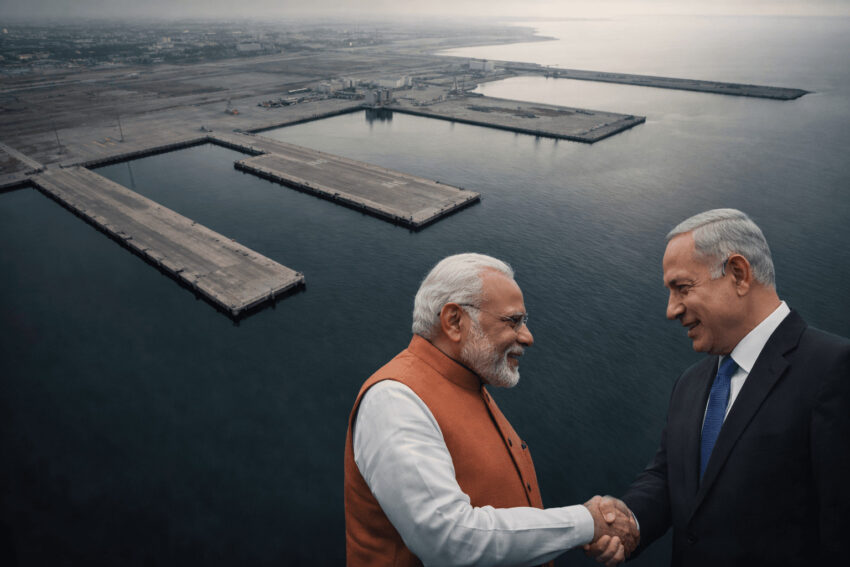
Prime Minister Modi made a hurried visit to Israel. The strikes began within 24 hours of his departure. Israel and the United States had been posturing for weeks. The question worth asking is simple. What were they waiting for?
India is the only country that maintained functioning backchannel diplomatic ties with Iran through the entire sanctions period. Indian diplomats carry human relationships inside Tehran that no Western intelligence service can replicate or purchase. That relationship has a value in a post-regime transition that no military asset can substitute.
The documented sequence of Indian disengagement, the timing of the Modi visit, and India’s unique position as Tehran’s last functioning backchannel together suggest a possibility that will never be confirmed in any press briefing. That post-war Iran may already have a quiet architecture. That the ports, the energy corridors and the North-South trade route connecting India to Central Asia through Iranian territory may have been the subject of a conversation that happened before the first missile was fired.
India’s strategic interest in Chabahar port as a bypass of Pakistan has been documented and funded for years. A post-regime Iran that honors those investments serves India’s interests more completely than the current theological state ever did. Iran’s regime was not kind to India in its final months. The ship seizure, the Chabahar exit and the evacuation advisory all confirm that the estrangement was mutual and deliberate.
History rarely records the quiet agreements made before wars end. It records only the wars themselves. What India negotiated, if anything, in the backchannel before February 28 belongs to that category of history that surfaces only decades later in declassified documents.
What can be said with confidence is this. A nation that settles final payments, evacuates its nationals and times a Prime Ministerial departure with surgical precision does not do so by accident. It does so because it already knows what comes next.
Common-Sense
This article was not written by a journalist. It was written by a lawyer with no military background, no press credentials and no television channel. The dots were connected using publicly available facts, historical precedent and the simple discipline of asking obvious questions that apparently no one in a newsroom thought worth asking.
Across television channels and digital platforms, experienced journalists called this a World War without once asking who would actually fight it. Journalism is not dying from lack of talent. It is dying from lack of incentive to be accurate when being alarming is more profitable.
The oldest obligation of a journalist is to ask the question that is sitting in plain sight. When that obligation is abandoned, the newsroom becomes a theater.
References: