Analysis of Budget 2026-27
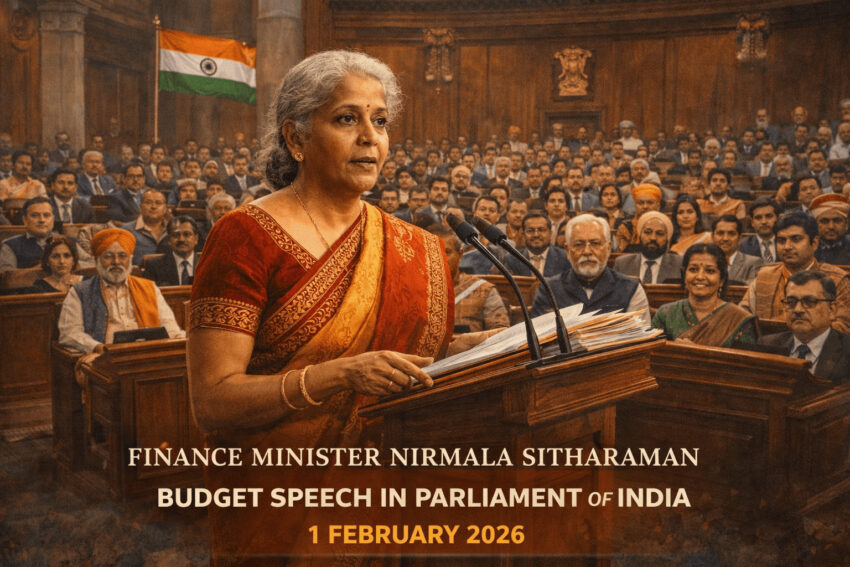
India’s Union Budget 2026-27 was presented by Finance Minister Nirmala Sitharaman today at 11 AM (1 February 2026). The speech covers a broad range of policy areas. It moves from MSME support and infrastructure to financial sector reforms, taxation changes, and customs policy. The sheer breadth signals an ambitious agenda, not a narrow focus.
Key Features of Budget
Aviation Sector: Exemption of basic customs duty on components and parts required for the manufacture of civilian training and other aircraft and on raw materials imported for the manufacture of parts of aircraft to be used in maintenance, repair, or overall requirements by the defence sector.
Financial Sector Modernization: A high-level banking committee for “Viksit Bharat” is proposed. Corporate bond market reforms, municipal bond incentives, and FEMA rule changes point toward deeper capital market development. STT tax on securities has been slightly increased. Explanation is that it was done to discourage speculation in the financial markets.
Infrastructure as a Growth Driver: Capital expenditure is raised from 11.2 lakh crore to 12.2 lakh crore. The focus is on Tier 2 and Tier 3 cities. New freight corridors, waterways, and high-speed rail corridors between major cities reflect a long-term connectivity strategy.
MSMEs and Liquidity: The government is pushing hard to improve credit flow to small businesses. The TReDS platform is being positioned as a central tool. Linking GEM with TReDS and introducing asset-backed securities on that platform are meaningful steps toward deeper MSME financing.
Pharma and Medicine: Exemption of basic customs duty on 17 drugs or medicines relating to cancer and seven more rare diseases.
Services and Human Capital: A strong emphasis on health, tourism, education, and skilling is visible. Medical tourism hubs, allied health professional training, and university townships near industrial corridors show a focus on building domestic capacity.
Sustainability and Green Transitions: Carbon capture gets a 20,000 crore allocation. Incentives for inland waterways, coastal shipping, and lithium-ion battery manufacturing reflect a climate-aware policy direction.
Tax Simplification: The new Income Tax Act 2025 takes effect in April 2026. Several TDS and TCS rate cuts are announced. The one-time foreign asset disclosure scheme targets small taxpayers like students and relocated NRIs.
Viksit Bharat
The budget frames nearly every measure as part of the “Viksit Bharat” vision. This gives it political coherence but also makes it hard to distinguish urgent priorities from aspirational ones. The fiscal consolidation section is brief but confident, noting the debt-to-GDP ratio is declining.
Direct mentions of rural distress or agrarian reform are limited. The agriculture section leans heavily on specific crops and schemes rather than structural changes. Defense spending and geopolitical concerns are largely absent from the speech.
Fiscal Framework
- Union Budget 2026-27 presented with focus on Viksit Bharat vision
- Fiscal deficit targeted at 4.3% of GDP (down from 4.4% in RE 2025-26)
- Commitment to reach below 4.5% fulfilled from 2021-22 target
- Debt-to-GDP ratio: 55.6% in RE 26-27 vs 56.1% in RE 25-26 with target: 50±1% by 2030-31
- Total expenditure: ₹53.5 lakh crore
- Non-debt receipts: ₹36.5 lakh crore
- Net tax receipts: ₹28.7 lakh crore
- Capital expenditure: ₹12.2 lakh crore (increased from ₹11.2 lakh crore in RE 25-26)
- Massive growth from ₹2 lakh crore in 2014-15
- Net market borrowings: ₹11.7 lakh crore
- Gross market borrowings: ₹17.2 lakh crore
- 16th Finance Commission: Vertical devolution retained at 41%
- ₹1.4 lakh crore allocated to states as Finance Commission grants
Focus Areas
The speech is heavily front-loaded with timelines like “over the next five years” or “by 2030” or “by 2047.” Strip those out and what remains is mostly announcements of committees, reviews, and proposals.
There are very few immediate, concrete actions. The new Income Tax Act taking effect in April 2026 is one of the rare near-term deliverables. The capex increase to 12.2 lakh crore is another. But most other measures are framed as intentions or roadmaps.
India has a long history of ambitious budget announcements that lose momentum once the political moment passes. Proposing a committee to review banking; a committee for education-to-employment; a mission for sports; a scheme for coconuts, and so on creates a wide but shallow coverage. Each one demands institutional capacity to follow through.
The “challenge mode” financing mechanism mentioned for city economic regions is interesting precisely because it tries to build accountability into the process. But still it is just a proposal.
The speech is more like a vision document than an action plan. The gap between what is announced and what can actually be measured in the near term is quite wide. That gap is where Indian budgets often lose credibility over time.
Placeholder Budget
A vote on account is a legal necessity during election years. It is a stopgap to keep government running. This budget is not that. It was presented with full parliamentary authority and a stable majority. So the government had every reason to be bold and specific.
Yet the texture of the speech does feel placeholder-like in spirit. The repeated use of “propose,” “set up a committee,” and “over five years” creates a sense that the heavy lifting is being deferred. Almost nothing here demands urgent action this quarter or this fiscal year.
There are many possible explanations. The government may be deliberately pacing itself. After years of heavy capex and large fiscal deficits, there is pressure to consolidate. The debt-to-GDP target of 50% by 2030-31 constrains how aggressively new spending can be announced.
Managing schemes via five-year plans proves difficult. By results due date, political context shifts entirely. Critics cannot pin down failures. The timeline always extends beyond now. The Planning Commission failed for this reason. Its slow-paced five-year plans forced revamp.
Global Instability
There is no mention of global instability. However, in the press conference that followed, the Minister admitted the challenge and assured that it is keeping a close watch.
Thus, budget is not a placeholder in the technical sense. It is more like a budget that uses ambiguity as a shield. It protects the government from being judged too quickly while still allowing it to claim a big vision on the floor of Parliament.
Early 2026 has been dominated by trade war escalation, tariff on India and tensions between the US and China. The ripple effects of tariffs on global supply chains. Any honest reading of the global situation would demand at least some acknowledgment in a national budget speech. The silence is conspicuous.
In 2020, the government initially presented a normal budget in February. Then COVID hit and everything was thrown off balance. The government responded with supplementary grants and ordinances outside of Parliament. The idea was to keep the formal budget vague enough that there is room to maneuver later without looking inconsistent.
This budget seems to follow that same playbook. By not naming global risks directly, the government preserves optionality. If trade wars worsen, it can announce emergency measures and frame them as a fresh response. If things stabilize, the five-year schemes proceed as planned. The budget becomes a flexible canvas rather than a firm commitment.
Parliamentary Strategy
There is a democratic cost to this silence. Parliament is precisely the space where the government should be honest about the risks facing the economy. Ignoring global instability in a budget speech does not make it go away. It just means the public and the opposition are not given a chance to debate the government’s preparedness. This theory is good, but the politics of the day determine how it will be implemented.
When the opposition has turned Parliament into a disruption machine, the ruling party learns fast. Why give them ammunition? Why name a risk you cannot fully answer for? The rational response is to say as little as possible that can be seized upon and turned into a headline attack.
So the budget becomes less about informing Parliament and more about surviving it. The vagueness is not laziness. It is a political survival tactic born out of a broken institution.
In every session opposition shout and disrupt. It is not negotiation. It is extortion dressed up as parliamentary procedure. The pattern is now so predictable it has become a ritual. Opposition disrupts. Speaker warns. Disruption continues. Eventually the guillotine comes down. Bills pass with minimal or zero debate. Everyone goes home. Next session, same thing repeats. What makes this worse is that both sides have accepted it as normal. This is not unique to India though. Many parliamentary democracies are seeing this erosion.
Flexibility
Three consecutive Lok Sabha victories and dominance across 18 states is not by accident. It is a picture of a machine that understands how power actually works. Not how textbooks describe it. How it operates on the ground, in the backrooms, in the numbers game.
The budget speech is not written for political scientists or journalists. It is written for a specific ecosystem of actors. State governments that need funds. Bureaucrats who need schemes to implement. Business lobbies that need signals. Media that needs headlines. Each line is calibrated for a particular audience. The vagueness is not weakness. It is flexibility. Games are played with the rules in action not the rules in book.
India has given the response of tariff by and FTA with Europe. The budget is awaiting the other shoe to fall. Meanwhile, the nation has this placeholder.
Reference:
Budget 2026-2027: https://www.indiabudget.gov.in/doc/budget_speech.pdf