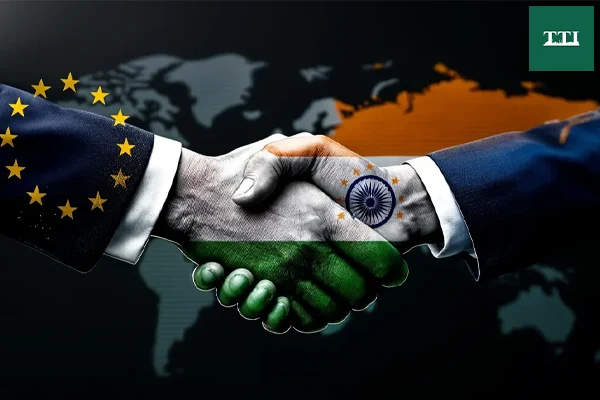
India and Europe Forging the New World Order
India and Europe entered into a trade deal. As an add-on they entered into a security deal. Promised reciprocal maritime security to the trade voyages on the high sea. European Commission President Ursula von der Leyen stood in Delhi and declared that “India’s success holds the prosperity, security and employment opportunities of the entire world.”
A man asks a philosopher “Should I get married?” The philosopher says “Sure. If marriage is successful, you’ll live happily and contribute to society. If not, you’ll be enlightened and contribute to epistemology.”
Europe was happily married to America. Now they’re getting divorced. Through this painful process, Europe is being enlightened about what real sovereignty means. For the past hundred years or so, Europe did what it was asked to do. It jumped when asked without asking how high. Its media judged former colonies and sermonized them about human rights, gender equality and wars. Never bothering to look at its own past.
Europe needed this enlightenment, like yesterday. Now they have an opportunity to contribute to international relations showing they can actually have a foresight. Above all they will have to show that Western powers can break free from Western hegemony and survive.
Mother of all deals
The EU-India deal isn’t the “mother of all deals” because of its size. It’s the mother of all deals because it births a new world order where:
- Dependencies create mutual friendship not vulnerabilities;
- Predictability has a value of dependability;
- Strategic autonomy is non-negotiable;
- Delivery matters more than declarations;
- Trade does not mean monopoly or extraction.
India, Europe and 18 other countries already tied in a trade deal form a new block away from USA or China, the two largest economies. The new block is larger than both.
Delhi is the new destination
The Scramble for India: “Deal De De, Deal De De” (Give me Deal)
The January 2026 Europe followed the UAE to sign the trade and security agreements with India. France’s Macron is coming in February. Canada’s team is her negotiating. Its Prime Minister is coming in March. Brazil’s President Lula is coming in February. The trade deal between Brazilian multinational aerospace corporation Embraer S.A. and India’s Adani Defence is formalized. Adani will manufacture Embraer planes in India. Israel has decided to be part of arms manufacturing in India to avoid flip flop policy of USA.
World is rushing to Delhi like supplicants to a new prophet, chanting the modern mantra: “Deal de de, Deal de de” (Give us a deal, give us a deal). They all want to be part of a new promising block which promises not to exploit and manipulate. Which will act on mutual cooperation. It has no name as yet.
In 2025 the destination was Washington. In 2026 it is New Delhi. Why? We have the advantage of two views. One from Europe and one from India.
The European Confession
Kaja Kallas, EU Vice President, speaking at Ananta Centre, New Delhi on January 27, 2026, revealed Europe’s existential crisis with unusual candor:
On why Europe needs India: “Every dependence you have is also your vulnerability. Make sure you’re dependent on friends because the other side might hurt you. But in a world where you don’t know actually who are your friends, then let’s diversify.”
On American unilateralism: She described feeling “uncomfortable” when then-Defense Secretary Pete Hegseth told Europeans to “stay out of the Indo-Pacific” at Shangri-La Dialogue. “It sounded very much so that, you know, we do here and we don’t really care what you think.”
On weaponization of trade routes: “We both face weaponization of trade routes, weaponization of supply chains. This is in our mutual interest that it doesn’t go that way.”
On predictability vs. chaos: The EU values being “predictable” versus the “constant threat of tariffs in the air” where agreements can be “changed by executive order the next day.”
The Indian Analysis
Bhau Torsekar, Veteran Journalist from Mumbai analysed the situation in his own way. Speaking on January 28, 2026, Torsekar dissected Trump’s strategic collapse.
On Trump’s approach: “He’s running America’s presidency like Sanjay Raut. No logic, no reasoning, no decorum. This isn’t how things work.” (Raut is member of Maharashtra’s defeated and split party Shiv Sena)
On the dollar crisis: “America created trillions of dollars in debt which exceed the size of economy. They made paper bonds and sold them in dollars. Now countries are selling those bonds back. It’s like demonetization on a global scale.”
On Modi’s response: “Modi isn’t even answering Trump. Just ignoring him. Let Trump drown himself. The more an insect struggles in a spider’s web, the more trapped it becomes.”
On who really needs whom: “Small countries know: if anyone will come running like God to help us, it’s India. Not America. India sends vaccine, wheat, flour, medicine, doctor delegations during disasters. Who does UN’s work now? India does.”
On the shift to Delhi: “Washington used to be the destination. Now everyone’s eyes are on New Delhi. Canada, France, Brazil, all coming to Delhi, not Washington.”
The Features of New Order
1. Currency Independence as Sovereignty
Kallas confirmed: The EU-India trade will bypass the dollar, saving billions in conversion fees and escaping Federal Reserve volatility.
Torsekar explained: “Countries holding dollar bonds are selling them. America’s paper empire is collapsing. India and EU trading in INR-EUR means if a future US administration weaponizes the dollar, the India-EU corridor stays open.”
Gold has crossed $5600 mark. The distrust in Dollar is accelerating. USA is not ready to acknowledge. Dollar is at lowest since pandemic but President of USA says it is good.
2. Maritime Security
Kallas emphasized: “Maritime security” was the first cooperation area she mentioned. “Weaponization of trade routes” is a mutual concern. The phrase “mutual interests” appeared repeatedly.
Torsekar connected it: “Europe’s economy depends entirely on sea lanes through the Indian Ocean. Without their own Blue Water navy stationed there, they’re hitching to the Indian Navy. India has the carriers (Vikrant, Vikramaditya), the bases, the knowledge.”
The word “reciprocal” in von der Leyen’s speech wasn’t diplomatic courtesy. It was acknowledgment that India is now the larger security partner in that geography.
3. The Death of Subsidy Diplomacy
Kallas admitted explained: European industry can’t deliver alone. They need India’s “competition” to make European industry “work faster.”
Torsekar argued: “Trump withdrew from 70+ international organizations to stop subsidy payments. World Health Organization didn’t have money during Corona. China ran it. Now these organizations are begging. Who feeds them? India, Russia, China. Not America.”
The old order ran on American subsidies. When Trump cut them, the scaffolding collapsed. India stepped in, not with subsidies, but with actual delivery of goods and services. Soon it will be the time to take to stock of the inventory of institutions. Which ones to keep and which ones to discard.
4. Strategic Autonomy as Non-Negotiable
Kallas’s discomfort with Hegseth telling Europe to “stay out of Indo-Pacific” explain the breaking point. Europe realized their supposed protector was telling them their survival interests didn’t matter.
Torsekar’s argument: “Modi declared security independence when India hit Kirana Hills during Operation Sindoor. UAE chose India for security a few days back. Europe is doing the same now.”
From Vassalage to Partnership
As stated above, the Europe was happily married to Pax Americana. They enjoyed prosperity, security umbrella, and predictability. But the divorce is teaching them what real sovereignty costs.
Kallas’s statement about “not putting all eggs in one basket” wasn’t about hedging risk. It was about escaping vassalage. When she said “make sure you’re dependent on friends,” she was acknowledging America had stopped being one.
India’s Rise
Torsekar noted Modi has been on the same path since Vibrant Gujarat. “Make people self-reliant. This is the path. Now he’s showing this to the world.” India didn’t seek leadership. It just kept doing what worked:
- Maintaining strategic autonomy under pressure
- Delivering actual help during crises (not just statements)
- Building capabilities (Satellites, carriers, manufacturing, demographics)
- Refusing to be anyone’s pawn
When G20 gave India presidency, Modi declared: “I will be the voice of the voiceless.” He brought African Union into G20 as full member. Half of Africa suddenly had someone powerful speaking for them.
The BRICS Factor
Torsekar: “Countries like Canada are saying ‘we want to join BRICS.’ What does this mean? BRICS is becoming the new UN. And Modi is leading it, even though he wasn’t elected to lead. He’s just… leading it.”
The old UN ran on American money and Western consensus. The new architecture runs on actual delivery and genuine multipolarity.
The Maduro Moment
Torsekar: “The only achievement was Venezuela. But that wasn’t Trump alone. The population was in the streets against the president. When a government loses its people and a foreign military shows up, the president loses. Circumstances defeated Maduro, not America.”
Kallas (implicitly): The EU watched America seize ships on high seas, proving that using US financial systems or shipping lanes makes sovereignty “conditional.”
Gaza Peace Board failed. Trump invited 50+ countries, only 20-22 showed up. India stayed silent. China and Russia backed away. Brazil wasn’t even invited. The emperor had no clothes.
The Spider’s Web
Torsekar’s metaphor captures the entire dynamic: “Trump is like an insect caught in a spider’s web. The more he struggles to escape, the more trapped he becomes. Modi just waits. Let him drown. We’ll keep doing our work.”
India signed FTAs with 19 countries since Trump started threatening. Russia, UAE, now the entire European Union (covering 200 crore people when you include Norway, Switzerland, Britain). Meanwhile, Trump’s dollar keeps falling, BRICS nations keep selling dollar bonds, and gold replaces dollar banking.
What the Press Missed
Both Kallas and Torsekar gave away the game. But English-language press was busy with:
- Trade deal tariff percentages
- Mobility pact visa numbers
- Green transition funding amounts
What they missed:
- This wasn’t a trade deal. It was a security pact disguised as commerce.
- Europe didn’t just want market access. They wanted an escape route from dollar dependency.
- The “jubilation” wasn’t about textiles and wine. It was relief at finding an alternate block away from USA and China.
- India didn’t just become a trade partner. It became Europe’s naval protector in the Indian Ocean.
Torsekar’s explanation: “Our journalists eat leftovers from Western media’s plate and serve it to us. They miss what’s actually happening.”
The G20 As Replacement of UN
One thing that even seasoned observers like Torsekar missed: BRICS is the distraction. G20 is the actual replacement for the UN, and it’s happening in plain sight while America watches helplessly.
The irony is that G20 was created by the West itself to manage global financial crises. India simply repurposed it. When Modi brought the African Union in as a full member during India’s G20 presidency, he didn’t ask permission. He just did it. Suddenly, half of Africa had a seat at the table that matters. The UN Security Council with its colonial-era veto system frozen in 1945 is obsolete. It is G20, where economics reality determines power. It is run on consensus, without any veto.
America faces an impossible choice. Abandon G20 (like it skipped South Africa’s hosting) and prove its own irrelevance. Or stay in G20 and watch India lead it toward genuine multipolarity. Either way, America loses. The UN becomes a talking shop where speeches happen. G20 becomes where actual decisions get made. And India holds the narrative as the voice of the Global South within a forum that includes both developed and developing nations.
The beauty of this strategy is its legitimacy. BRICS can be dismissed as “anti-West.” But G20? It includes USA, EU, China, India, and the major economies. You can’t call it a rival bloc when you’re sitting at the table. You can’t veto economic gravity. When G20 speaks, it represents 85% of global GDP. When the UN Security Council speaks, it represents 1945.
This is the real architectural shift. Not BRICS replacing the West. But G20 replacing the UN, using the West’s own tool against the West’s own institutional monopoly. Modi isn’t breaking the UN through confrontation. He’s making it obsolete through irrelevance.
Primary Sources:
- Kaja Kallas interview at Ananta Centre, Delhi, January 27, 2026
- Bhau Torsekar analysis, January 28, 2026
- EU-India Free Trade Agreement signing, January 27, 2026
- Israel: https://organiser.org/2025/12/22/331431/world/israel-explores-defence-manufacturing-in-india-backed-by-make-in-india-reforms-amid-tightening-eu-regulations/