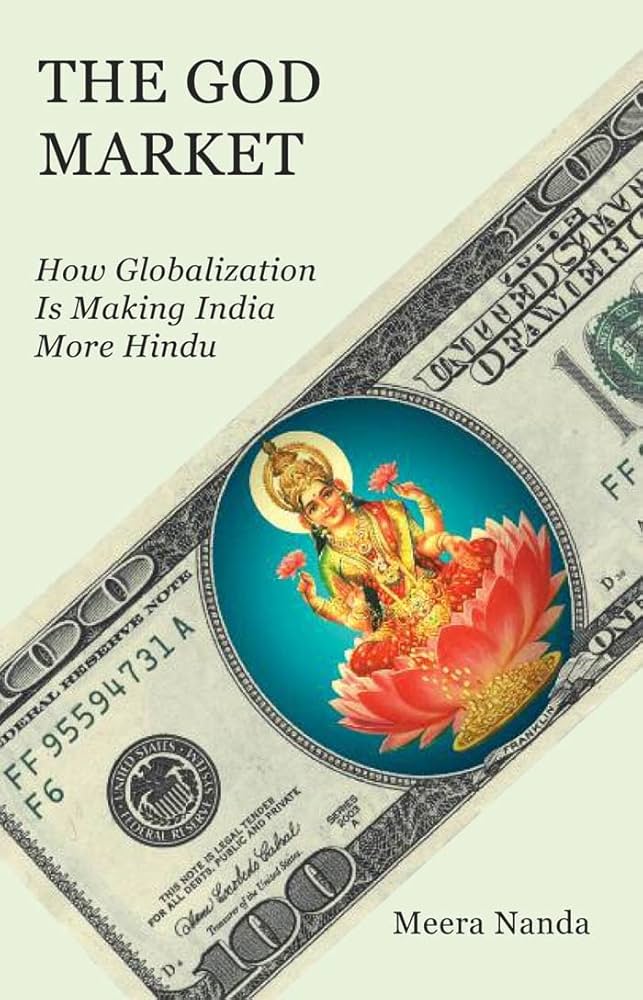
Meera Nanda’s The God Market: Imaginary India, Partisan Lens, and Scholarly Disqualification
Meera Nanda has a basic authorial disqualification. Nanda presents herself as an expert on Hindu religiosity and the political implications of ritual practice, yet her work betrays a fundamental lack of grounding in the tradition she critiques. What she offers is an imaginative India, projected through a lens of fear and minority anxiety, rather than a careful study of lived civilizational practices.
Who Is Meera Nanda?
Meera Nanda, born 1954 in India, is a biologist-turned-science-studies scholar whose career trajectory explains her Westernized critique of Hindu dharma.
Academic Biography:
- Indian Roots: MSc Microbiology (Punjab University, 1978); PhD Biotechnology (IIT Delhi, 1983)
- US Retraining: PhD Science & Technology Studies (Rensselaer Polytechnic Institute, 2000) – dissertation critiques postmodernism/Hindutva’s anti-science stance
- Career: Science journalist (Indian Express), then academic at IISER Mohali (2009-2017), IISER Pune (2019-2020); fellowships from Templeton Foundation, ACLS
Key Works & Ideology:
- The God Market (2009): Claims globalization commercializes Hinduism, creating “insidious fundamentalism”
- Science in Saffron (2016): Attacks Vedic science pseudohistory
- Consistent Target: Hindutva + postmodernism erode scientific rationality through a about 30 papers published on Academia.edu after 2005.
Nanda as Hindu
Self-identification is the ultimate marker of Hindu identity, not Western or academic definitions. There is no single doctrine, book, or authority that can draw the outer line of Hindu identity for all time. The one unbroken principle is the freedom of proclamation. Every person holds a right to identify as Hindu, regardless of whether he/she satisfy someone else’s traditional, doctrinal, or legal criteria. See here.
This is what makes Nanda a Hindu if she chooses to call herself or if she has not converted to some other religion already. The position remains unchanged even after her criticism.
But this broad definition does not make her an authority on Hindu religion, tradition, practice, or politics.
Career Shift at 50
In 2004, Nanda completed two decades as a biologist, and suddenly decided to rebrand herself as a fierce critic of Hindutva. Ordinarily, career shifts are commendable but the problem here is that she knows almost nothing about Hinduism itself.
She jumped headfirst into critiquing the faith and its social expressions without laying any scholarly foundation. She ignores the work of practicing Hindus and scholars and instead relies exclusively on fellow Western scholars to perpetuate circular logic. The result is a narrative built on preconceptions, assumptions, and political bias, rather than evidence.
Election Propaganda
Just before the crucial 2009 elections, she pivoted to become a self-styled expert on Hindu–Muslim relations. Her book is saturated with references to Muslims, framing them as anxious and imperiled by the supposed rise of Hindu religiosity. This sudden disciplinary leap, timed with a political cycle, raises serious questions about her scholarly judgment, expertise, and the motivations behind the work. It reads less like a study and more like a politically engineered narrative, crafted to stoke minority fear rather than illuminate historical or contemporary realities.
Nanda’s political partiality is transparent. She opens her book with a quote from Mani Shanker Aiyer, a controversial Congress leader with openly pro-Pakistan leanings. She repeatedly casts Hindu religiosity as a monolithic threat while treating minority anxieties as natural and unquestioned. Her purported scholarly neutrality collapses under the weight of evident advocacy. In effect, Nanda is not a researcher analyzing a society; she is a gun-for-hire, deploying academic framing to influence public perception and electoral narratives.
Meera Nanda’s The God Market is not an academic exploration. It is a politically timed, ideologically driven project masquerading as scholarship. Works like Nanda’s attempted to provide an academic veneer to these discrediting campaigns, yet the Bharati have continued to secure electoral victories, including in Kerala.
The most glaring flaw of Nanda’s text is its conceptual ignorance of Hinduism itself. She repeatedly frames ordinary household pujas, temple donations, and festival celebrations as evidence of triumphalist nationalism and intolerance.
Any serious understanding of Sanatan Dharma reveals the opposite. Unlike Christian Churches, historically, Hindu temples had no armies, rituals emphasize ethical action over accumulation, and charity is widespread, overflowing, and open to everyone regardless of faith. Her Hinduism is imaginary; she cites no scripture, no ritual manual, no historical precedent. The text is a castle built on sand.
Hindu Politics
Nanda may have accepted the brief, but she seems clueless about the Hindu politics. Politics of India is divided in two groups who can be named as Globalist and Bharati.
Globalist accept the foreign invaders/rulers as genuine rulers. They identify with global left. They name the country as India or Hindustan but never call it Bharat.
Bharati take opposite position. They believe in ancient name of India as “Bharat”. They want to reclaim Indic civilisation. This group is what Nanda and her fellow writer call Hindu Nationalist. Read more about this distinction here
Globalists are losing ground in the power politics of India. The losing streak started over 3 decades ago and coincided massive electoral reforms in India by Election Commission duly backed by judiciary.
This is when the global support came pouring in. Instead of convincing the voters, globalists sought to discredit the Bharati by media management. In this work, the academics like Nanda were deployed who wrote invented inflammatory terms to criticize. It did not work.
On the contrary it helped the Bharati even more. They win elections in state after state. Now they win in Kerala, too.
Muslim Filter
The lens Nanda applies, essentially a “shirk filter”, is alien to the Hindu tradition she claims to analyze.
Nanda’s framing also relies on Western secular and minority-centric interpretive frameworks. Anxiety for Muslims and other minorities is treated as the default fate, producing a narrative in which Hindu confidence equates to oppression. But empirical evidence tells a different story.
India’s pluralism is lived, not theoretical. Jews, Parsis, Christians, Muslims, and atheists have participated in civic, economic, and ritual life seamlessly for centuries. Modern India demonstrates competence-based inclusion: A. P. J. Abdul Kalam (Muslim) became President; Harish Salve (Christian) argued high-profile constitutional cases; Sridhar Vembu (Christian) led major technological projects. Grassroots participation mirrors this pattern, with devout Christians contesting elections on BJP tickets while maintaining religious commitments. Hindu self-assertion in this context is civilizational confidence, not supremacist imposition.
Linguistic Ignorance
The book’s methodological bankruptcy is compounded by language and textual ignorance. Nanda writes as if the Hindi–Sanskrit–Punjabi continuum, the living ritual texts, and the syncretic, pluralistic practices of India’s temples and community halls are irrelevant. She misses the nuance that Sanatan Dharma Temples, Arya Samaj halls, Gurudwaras, and Hindu temples operate on principles of open access, mutual respect, and ritual diversity. Cremations, memorial services, and marriages different Hindu faiths, all can coexist side by side, without conflict. These everyday practices render her imagined dystopia absurd.
The work also betrays a failure to situate Hinduism on its own terms. Sanatan Dharma integrates wealth, ritual, and social ethics; festivals like Diwali, household pujas, temple economies, and charitable practices demonstrate a system where prosperity, ethical action, and spiritual engagement are mutually reinforcing. Western frameworks that reduce ritual to superstition, commercialization, or political instrumentality are inapplicable. Nanda’s repeated invocation of a “God market” fueled by neoliberalism is a misreading; what she perceives as commercialized religiosity is, in reality, the scaling of ethical, participatory, and literate dharmic practices.
Ultimately, The God Market is a work of imagination masquerading as analysis. It misrepresents Hindu practice, ignores centuries of pluralistic history, and overlays politically convenient assumptions on a complex civilization. Nanda’s sudden disciplinary leap, her selective focus on minority anxiety, and her refusal to engage with primary texts all disqualify her as an authority on the subject. The book is less a contribution to scholarship than a partisan narrative intended to generate fear and advance political objectives. For anyone seeking a grounded understanding of Hinduism, Sanatan Dharma, or India’s pluralistic traditions, Nanda’s work is a cautionary tale of ideology dressed as research.
Read it as comic polemic if you must as her imagined dystopia is as hilarious as it is instructive.
Note: The ‘scholarly’ claims made by Nanda shall be dealt with in a separate academic paper.
References:
- God Delusion at Work: My Indian Travel Diary https://www.jstor.org/stable/40278070?
- The God Market: https://www.academia.edu/65857600/The_God_Market_How_Globalization_is_Making_India_More_Hindu