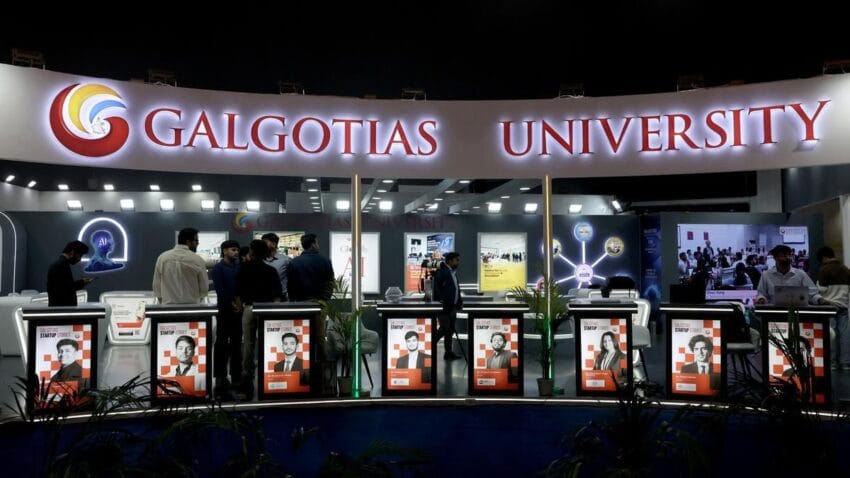
A critical investigation into a pattern of institutional deception at Galgotia University.
Claims of Galgotias University:
Galgotias University is a private institution located on the Yamuna Expressway in Greater Noida, Uttar Pradesh. It was founded in 2011 by Suneel Galgotia and operates under the Galgotias Education Group. With over 40,000 enrolled students and more than 200 academic programs, it positions itself as one of the largest educational hubs in North India.
The university holds a position in the 1201 to 1400 band of the QS World University Rankings 2026. It is ranked 43rd among all Indian universities, both public and private, and 15th among private universities nationally. In the Times Higher Education World University Rankings 2025, it placed in the 1001 to 1200 global band. It has also featured in NIRF rankings, particularly in innovation and professional categories like Pharmacy and Law.
The institution loudly promotes its alignment with national missions. Its Chancellor Suneel Galgotia has publicly stated the university remains committed to Prime Minister Modi’s vision of making India a global knowledge leader and to Chief Minister Yogi Adityanath’s dream of UP as a global knowledge superpower. Its patent filing claims are equally dramatic. Between 2017 and 2024, the university claims to have filed a volume of patents that marginally exceeds IIT Madras’s entire output since 1975.
These are impressive numbers on paper. The reality behind them is a different story entirely.
The Antecedents: A History of Fraud and Misconduct
Galgotia University may be managed through a facade of Trust and Societies, it is essentially and for all practical purpose, a family affair.
The Galgotias family’s legal troubles did not begin recently. Between 2010 and 2012, founder Sunil Galgotia is accused of using forged documents to secure loans totalling over Rs 120 crore. The loans were taken through the Smt. Shakuntla Educational and Welfare Society (SSEWS), the parent body of the university. The society allegedly submitted fake balance sheets and misrepresented its institutional affiliations, claiming ties to Dr. APJ Abdul Kalam Technical University when it was actually affiliated with Uttar Pradesh Technical University.
In August 2014, CEO Dhruv Galgotia and his mother Padmini Galgotia were arrested on charges of forgery, fraud, and loan default. A Chief Judicial Magistrate in Agra ordered 14 days of judicial custody for both. Sunil Galgotia evaded immediate arrest through a stay order from the Allahabad High Court. Other family members including Jugnu Galgotia were also implicated.
The pattern of student exploitation runs parallel to the financial fraud. In 2011, students admitted on the promise of hostel facilities were placed in accommodation 14 kilometres away from campus.
In 2020, during the COVID-19 pandemic, the university was accused of charging full fees alongside additional levies.
In 2024, it allegedly used students for a political rally outside the Congress party headquarters. When journalists interviewed those students, they had no idea what the protest was about. That same year, the university was accused of fabricating a placement offer of Rs 1.5 crore for a student.
This is not a university with an occasional compliance lapse. It is an institution with a documented record of acting first and constructing explanations later.
The Rs 350 Crore AI Announcement: Credibility or Sales Pitch?
On February 4, 2026, Galgotias University issued a press release announcing an investment of over Rs 350 crore in artificial intelligence. It declared this the largest AI investment ever made by any private university in India. It provided no source of funding.
The announcement mentioned deployment of NVIDIA’s DGX H200 supercomputing platform and the establishment of multiple Centres of Excellence in collaboration with NVIDIA, Tata Technologies, IIT Mandi, and HCLTech, supported by partnerships with Tech Mahindra, Cisco, Vivo, and Wipro.
CEO Dr. Dhruv Galgotia was quoted saying: When Indian institutions invest at this scale, India’s global leadership in AI is no longer an ambition. It becomes inevitable.
The announcement was released as a paid advertorial through NewsVoir and carried by ANI, Tribune India, The Wire, and others. It was not an independently reported story. It was a press release written and distributed by the university itself. It was an advertisement which did not look like a paid advertisement.
There is also a fundamental technical problem with the timeline. A DGX H200 cluster at this scale requires months of infrastructure preparation. Power delivery at that wattage demands dedicated electrical planning and commissioning. Liquid cooling systems need civil work, precision plumbing, and thermal load calculations. High-speed InfiniBand networking between nodes requires expert configuration. The software stack, including CUDA environments, cluster orchestration, and security hardening, adds further weeks of work.
The announcement was made on February 4, 2026. The AI Impact Summit began on February 16, 2026. It is technically impossible for a data center of this described scale to have been fully operational within twelve days of its announcement. The infrastructure did not exist in working form at the time of the summit. This makes the announcement look far more like an enrollment marketing strategy timed to coincide with India’s most high-profile AI event than a genuine operational milestone.
The Fraud at the India AI Impact Summit 2026
The India AI Impact Summit 2026 was held at Bharat Mandapam in New Delhi from February 16 to 20. It was inaugurated by Prime Minister Narendra Modi. The scale of the event was genuinely international. Twenty heads of state attended, including French President Emmanuel Macron, along with over eighty government delegations. Present at the summit were Sam Altman of OpenAI, Satya Nadella of Microsoft, Dario Amodei of Anthropic, and Sundar Pichai of Google. These are the architects of the very technology Galgotias was about to claim as its own.
At the university’s stall, Professor Neha Singh, head of the Communications Department, told media on camera that robots and drones on display had been developed at Galgotias University. The robotic dog was presented as an in-house innovation named Orion, built at the university’s Centre of Excellence for AI.
Chinese media outlets were the first to identify it. The robot was the Unitree Go2, a commercially available quadruped robot manufactured by Chinese company Unitree Robotics and sold in India for approximately Rs 2 to 3 lakh. The drone presented on the same day was identified as the Striker V3 ARF, a commercially available product from South Korea, available in India for around Rs 40,000. A third exhibit at the stall, originally meant to showcase drones, turned out to be a thermocol model held together with tape and wire.
The summit organizers cut power to the Galgotias stall and asked them to leave. When they refused, security was called to remove them. IT Secretary S. Krishnan stated publicly that the government did not want exhibitors showcasing items that were not their own.
The university’s initial response blamed Professor Singh for being ill-informed and said she had spoken without permission in the excitement of being on camera. This defense was immediately criticized. Singh is the head of the university’s Communications Department. If anyone should know what the university has and has not built, it is the person responsible for communicating that to the outside world.
This deception was not committed at a local college exhibition. It was committed on the world’s most visible technology stage, in front of the people who built the actual technology Galgotias was pretending to replicate. The damage to India’s global technology reputation is real. The damage to the university’s credibility is irreparable.
The Confession of Reverse Engineering
What Galgotias modeled at the India AI Impact Summit 2026 was not innovation. It was not research. It was a sticker on a Chinese robot dog at an Atmanirbhar Bharat summit.
When the stall removal drew national attention, Registrar Nitin Kumar Gaur offered a linguistic defense. He claimed it was a jumble of words. The university, he said, had not developed the robot but was working on its development, meaning research. This was presented as a clarification. It is, in fact, a confession with far more serious legal implications than the original deception.
Development as a research activity means beginning from theory, from design, from first principles. It does not mean purchasing a finished commercial product and studying it. What the Registrar described is reverse engineering. Using a commercially sold product to replicate or study its proprietary internal sensors, motor controllers, firmware, or software crosses into legally hazardous territory.
Under Section 52(1)(aa) of the Indian Copyright Act, reverse engineering is permitted only for the narrow purpose of interoperability, meaning making one software program work with another. Using it to engineer such technologies, as the university’s own statement claimed, falls entirely outside that exemption. Their stated objective is not covered by the law.
The Unitree Go2 is also sold under a commercial End User License Agreement. Most such agreements for commercial robots explicitly prohibit decompilation and reverse engineering. By admitting publicly that they are conducting development work on this product, the university has potentially confessed to a contract breach. The Registrar’s statement is on record. It requires no further investigation to establish intent. They provided that voluntarily.
What makes this particularly indefensible is that Galgotias runs a law college. IP law, contract law, and technology law are part of their curriculum. Someone in that institution knew or should have known the legal weight of those words before the Registrar spoke them publicly. Either nobody reviewed the statement, which signals complete institutional dysfunction, or they knew and said it anyway, which signals something worse.
A first-year law student reviewing that press statement could identify the exposure. The institution that is training those students could not. It speaks about the recklessness with which Galgotia operate.
Consequences and Conclusion
The closure of the stall was the minimum possible response. It addressed the immediate embarrassment and nothing more. It is not a consequence. It is a logistical correction.
What is required is proportionate institutional accountability. The UGC must launch a formal inquiry into academic misrepresentation at a national summit. NAAC accreditation must be reviewed in light of the documented pattern of misconduct. The law college specifically should face scrutiny from the Bar Council given the Registrar’s legally compromising public statement. The Rs 350 crore AI investment announcement must be independently audited to determine whether it reflects operational reality or fabricated credibility.
The summit was attended by twenty heads of state and the founders of the world’s leading AI companies. India’s regulators now have every reason to act visibly and swiftly. A soft response will signal to every other private university in India that the ceiling for institutional fraud is a stall closure and a press apology.
Galgotias is not unique in its approach. It is an extreme example of a systemic problem in Indian private higher education, where perception has been allowed to consistently outpace substance. The 2014 forgery case was resolved with bail. The student exploitation cases produced no visible regulatory consequence. The pattern continued precisely because each episode ended without structural accountability.
The students enrolled at Galgotias are the real victims here. They are paying significant fees to an institution whose leadership committed this fraud on the world’s most watched technology stage. They deserve more than public embarrassment on their university’s behalf. They deserve regulatory protection and honest institutional leadership.
When the leadership of a university prioritizes optics over honest inquiry, it sets a corrosive precedent for everyone involved. Students learn what they observe. Galgotia offers deception as lesson.
The consequences must match the scale of that act.
References:
-
Zee News: Galgotias University controversy explained: https://zeenews.india.com/india/galgotias-university-controversy-explained-how-a-chinese-robot-ended-up-being-called-an-indian-innovation-at-countrys-biggest-ai-summit-3018480.html
-
Inventiva: Galgotias University in a Hot Soup: https://www.inventiva.co.in/trends/galgotias-university-in-a-hot-soup-this-is-not-the-first-time-when-galgotias-university-is-into-troubles/
-
News24: Who is the owner of Galgotias University? https://news24online.com/india/who-is-the-owner-of-galgotias-university-how-founder-suneel-galgotia-build-an-education-empire-now-at-centre-of-chinese-robot-controversy-at-ai-summit/751595/
-
India.com: Who is Suneel Galgotia?https://www.india.com/news/who-is-suneel-galgotia-owner-galgotias-university-ai-impact-summit-2026-chinese-robot-controversy-orion-unitree-noida-news-neha-singh-8312841/
-
Newslaundry: The making of Galgotias: https://www.newslaundry.com/2026/02/19/the-making-of-galgotias-an-expansion-powered-by-land-deals-and-media-blitz
-
Newsblare: Galgotias AI Spiral from Rs 350 Crore to Robodog Controversy: https://newsblare.com/technology/galgotias-ai-spiral-from-%E2%82%B9350-crore-investment-to-robodog-controversy-in-12-days/
-
Tribune India: Galgotias University Rs 350 Crore AI Investment: https://www.tribuneindia.com/news/business/galgotias-university-places-a-inr-350-crore-bet-on-artificial-intelligence-2-2
-
ANI: Galgotias University Rs 350 Crore AI Press Release: https://aninews.in/news/business/galgotias-university-places-a-inr-350-crore-bet-on-artificial-intelligence20260204164000/
-
NewsBuzz: Galgotias Wife and Son Arrested for Forgery: http://newsbuzz.esy.es/organisation/galgotias-wife-son-of-galgotias-university-arrested-for-forgery/
-
Business Standard: https://www.business-standard.com/video-gallery/general/india-ai-impact-summit-day-3-wrap-big-tech-compute-push-galgotias-robodog-row-shape-headlines-178441.htm
-
Reputation of Galgotia: https://www.moneycontrol.com/news/trends/gurgaon-techie-and-galgotias-alumnus-says-won-t-mention-university-in-resume-or-at-work-13835755.html/amp