Why American Businesses Fail in India?
India is a difficult place to do business as the consumer here is not only informed but also smart. The consumer in India can smell an unfair price like a carnivore smells blood. Only scrupulous businesses that optimize supply chains, treat customers honestly, and compete on genuine value will thrive. Corporations that depend on information asymmetry, brand premiums, and platform lock-in will fail. That is the most simple definition of success in India. Let me explain further through a real story.
Ancient Trading Logic Vs. Modern Business Extraction
In the chaotic aftermath of the 1947 Partition, a refugee trader stood at a crowded crossroad in New Delhi, shouting an impossible offer: sugar at ten rupees per kilogram, the exact wholesale price. To the uninformed observer, this appeared to be commercial doom. Where is the profit? Yet this merchant understood something profound about value creation that eludes many modern corporations. He was not selling sugar.
The trader was selling the journey to the market, the certainty of supply, and most importantly, he was making his profit on the empty jute bag that remained after the sugar was sold.
This story reveals a timeless principle that separates sustainable commerce from extractive capitalism. The story tells that business is not just profit. It is the cycle which must move incessantly. The refugee trader’s model rested on a simple premise. The genuine profit comes from efficiency and intelligent asset utilization, not from inflating prices through brand premiums or advertising taxes.
While traditional shopkeepers were adding margins to cover their overhead and greed, this trader moved volume. He bought one hundred kilograms of sugar in a sturdy gunny bag for perhaps one thousand rupees and sold it at cost. The bag itself, essential for storage and transport in that era, could be resold for a few rupees.
More sophisticated versions of this strategy involved negotiating volume discounts with wholesalers. By promising to purchase massive quantities and payment in immediate cash, the trader received sugar at 9.80 rupees per kilogram rather than the standard ten rupees. When he sold five hundred kilograms in a single afternoon at the wholesale price, his twenty-paisa margin per kilogram generated one hundred rupees in profit. The shopkeeper who hoarded stock and added a two-rupee margin sold only ten kilograms in the same period, earning twenty rupees. The refugee understood velocity over margin. This is the principle which works in a marketplace so large that it has 1.4 billion customers.
India-Europe Trade Deal
The India-EU trade agreement accelerates the transition from extraction to utility precisely because it removes the tariff barriers that protected inefficient business models. This trade agreement, finalized on January 27, 2026, creates conditions that favor the gunny bag philosophy over the extraction model. The agreement slashes import duties on 99 percent of Indian exports to Europe and reduces European import duties to India from rates as high as 110 percent down to eventual levels of zero to ten percent. With the 2026 FTA, India is slashing import duties on European cars from a massive 110% down to 40% immediately, and eventually to 10%.
The trade agreement creates a level playing field where efficiency defeats extraction. It also brings competition to Indian automobile manufacturers who were competing with BMW and Mercedes but were protected due to 110% duty. They will have to upgrade.
But first another story of scale.
Reliance Jio Example
The model of scale and enterprise was used by Reliance Jio when it launched its 5G mobile data and phone service. Jio was called names by other service providers, but they could not compete. The entire market had to change the model. It employed a fixed tariff for 1 GB data daily, and unlimited phone calling and 1000 daily SMS. Until now each service was charged a’la carte or separately. The consumer who was paying 300 rupees per month for 5 GB data suddenly had all services for that amount. This was not it. For more than a year Reliance gave free service on the pretext of trial. This enabled people to test it and trust it. When launched with a tariff of 300 per month, people ported en masse.
The philosophy of scale stands in stark contrast to what might be called the extraction model, exemplified by modern multinational corporations operating in India. In the cellphone sector, Airtel adapted and survived, others bankrupted. The third player Vodafone is now nearly a Government company as its license fee payments have been converted into equity. The rest of the players folded up. Now let’s look at consumer goods market.
Extraction Model
Now consider the case of Kellogg’s corn flakes. The multinational sells a 900-gram pack at the retail price of 313 rupees. Meanwhile, Flipkart’s private label brand Delish offers an 875-gram pack for 127 rupees. The quality of both brands is indistinguishable. There are cheaper brands also available with less toasted cornflakes.
The manufacturing process for corn flakes has been standardized for nearly a century. The difference in price represents not superior technology or ingredients, but the accumulated weight of corporate overhead, television advertising, celebrity endorsements, distribution fees, and brand premium.
Industry analysis suggests the actual raw materials and processing for corn flakes cost roughly 60 to 75 rupees. If Flipkart can profitably sell at 127 rupees, this proves the functional value of the product sits closer to 100 rupees than 300. The additional 210 rupees that Kellogg’s charges represents what might be called a brand tax, money extracted not for superior product but for decades of marketing that convinced consumers to equate the red K logo with quality.
Kellogg’s did not introduce corn flakes to India. Mohan Meakin, the company famous for Old Monk rum, dominated the corn flakes market in North India for decades before the American multinational arrived in 1994. Local brands and cooperatives sold the product at honest prices reflective of actual production costs. Kellogg’s brought superior marketing, not superior flakes.
Kellogg’s spent millions attacking traditional Indian breakfasts and positioning their fortified cereals as scientific nutrition. This propaganda campaign allowed them to inflate prices from the modest rates charged by Mohan Meakin to the current premium levels. The irony is that Kellogg’s successfully convinced a generation that an American brand represented progress, when in fact they were simply extracting rent from a market that had functioned efficiently for years.
Flipkart, though now owned by Walmart, retains its entrepreneurial identity rather than functioning as a trading platform. By launching private labels like Delish for groceries, SmartBuy for electronics, and Perfect Homes for furniture, Flipkart captures both the manufacturer’s margin and the retailer’s margin. They remove the brand fat and pass savings to consumers while still generating healthy profits. Their cornflakes sell for 127 rupees because they contract directly with factories, skip celebrity endorsements, and use their existing logistics infrastructure.
Amazon, by contrast, has become a pickpocket operation. Their innovation is limited to fee optimization. They inject advertisements into search results, making it progressively harder for consumers to find the best product rather than the most profitable one. Read more about Amazon, here. Things are going to undergo a major change soon.
The American Cars
Ford & Chevrolet tried to sell old global models with expensive parts. Indian consumers calculated the “Total Cost of Ownership” (Resale + Maintenance) and rejected them. The result was that Ford eventually had to pack its bags and leave India in 2021. They treated the Indian market like a “clearance sale” for their older global technology, while Tata and Suzuki were treating it like an “innovation hub.” In the automotive world, this is called Product Dumping, and the Indian “carnivore” consumer saw right through it.
The Ford Ikon was based on the Mark 4 Fiesta (a hatchback from 1995 Europe). By the time it was being sold as the “Josh Machine” in India in the early 2000s, it was already an aging platform. They added a boot to an old hatchback and marketed it as a “luxury sedan.” While it was fun to drive, the maintenance was a nightmare. The parts were expensive, and the engine technology was a generation behind what the Japanese were bringing.
Ford (and GM/Chevrolet) made a classic mistake assuming they were “Global Giants,” and the Indian consumer would be grateful for their 10-year-old technology. Early Fords even kept the indicator stalks on the left side (American style), while Indian cars are right-hand drive. They couldn’t even be bothered to flip the switches for the Indian driver! As stated earlier, the Indian consumer is a “carnivore.” They don’t want leftovers. They want the latest tech at the lowest price. Ford tried to sell “history” to a country that was looking at the “future.” Compare this with successful business models.
Maruti Suzuki launched fresh models like the Swift and DZire almost simultaneously with global cycles, ensuring parts were cheap and available at every street corner. Their big cars do not do well but this did not prevent them from trying. Baleno was launched just before Y2K, and it had air-conditioning which could put Mercedes to shame. Now, it has launched Invicto. Actual popularity of Suzuki remains in commercial vehicles and middle class.
Mahindra is another successful business model that is doing well. It offers a level of customization that no car manufacturer offers. Its XUV 700 has about 27 variations if not more. For brevity this detail has to be kept short.
TATA built the Indica and later the Nano and Nexon from scratch for Indian roads. They didn’t “import” an old model. They studied Indian potholes, Indian heat, and the Indian “miser” mindset (mileage).
Rumours have it that Ford is trying to come back in 2026 with high-end imports (like the Endeavour/Everest) instead of trying to compete in the mass market again. Endeavour has some presence because of its size. It is huge. It is a fuel guzzler. But Ford can forget it. First the Endeavour (Everest) is largely an American/Thai product. Since it doesn’t benefit from the EU FTA, it will still be taxed at the higher rates unless Ford localizes it to 100%. Second reason Toyota Fortuner which is ‘Resale King’ in India. Third is competition from Europe.
Tata Motors recently acquired the Italian truck manufacturer Iveco for 3.8 billion dollars, making Tata the world’s fourth largest commercial vehicle maker. This acquisition brings European van platforms that offer three times the space of traditional SUVs at lower running costs.
When these vehicles enter the Indian market at competitive prices due to reduced duties, the American extraction model exemplified by Ford’s fuel-guzzling Endeavour becomes untenable. The carnivore consumer can decide easily. Ford offers cramped seven-seater SUV priced at fifty lakh rupees with running costs of fifteen rupees per kilometer. Tata will offer a spacious European van at thirty-five lakh rupees with superior efficiency. This dooms the calculations of the extraction player. Needless to say, it will attract no more than 40% duty.
French and Italian Coffee
Consider the luxury coffee market in Delhi. Currently, consumers with imported espresso machines pay upwards of fifty rupees per coffee capsule. At five grams per capsule, this translates to ten thousand rupees per kilogram for coffee that costs six hundred rupees per kilogram in raw form. This represents a markup exceeding 1,500 percent, extracted purely through proprietary capsule formats and brand prestige.
The trade agreement changes this equation fundamentally. While India has wisely protected coffee beans on its sensitive list to safeguard Karnataka and Kerala farmers, the machinery to produce coffee and fill capsules will see tariffs drop from 44 percent to zero. An Italian espresso machine currently priced at forty thousand rupees due to import duties will soon cost twenty-eight thousand rupees. As these machines proliferate in Indian households, demand for capsules will explode. Giving the Chinese machines run for their quality if not money.
This creates an opening for entrepreneurs who apply the refugee trader’s logic. Rather than importing expensive French capsules, they will import zero-duty Italian capsule-filling machines, source high-quality Indian Arabica coffee, and sell compatible pods for 25 to 30 rupees instead of one hundred. The naive consumer will continue buying branded capsules from Amazon. The applied-mind consumer will get European-quality coffee at a price that reflects actual value rather than extraction.
The buyers in India are shaped by 5,000 years of trading DNA who refuse to pay extraction taxes. This consumer calculates total cost of ownership, researches ingredients, compares unit prices, and migrates to platforms offering honest value.
Conclusion
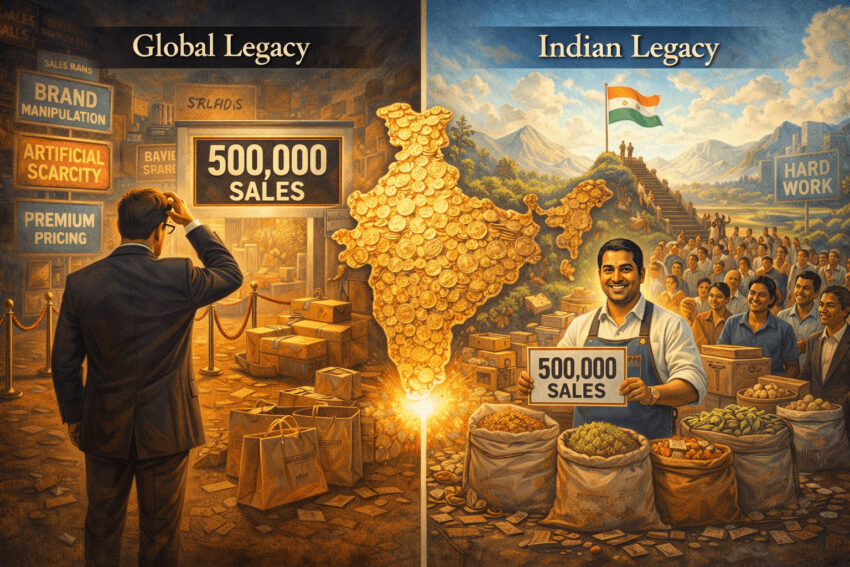
Sustainable profit comes from solving real problems efficiently, not from layering costs through brand manipulation and artificial scarcity. The companies used to extract from naive customers cannot assume that they will find that type of consumer all over the world. Certainly not in India. Denigrating the consumer of India as ‘price conscious’ will not make you successful. Actually taking that fact into account in constructing the business model for India will be helpful.
Global Legacy will not work in India. Local legacy has to be earned by hard work. A beginner gets excited with real number of sale. In a pool of 1.4 billion, a sale number of half a million is nothing. This much in sales is a trial number. Do not think of it as success. This is a trial and it can continue for decades.
P.S.: There is another problem which is not discussed here. It is tax terrorism and compliance of laws. The government frequently states that it has eased the compliance but the process of easing is slow and has yet to meet an optimum level.