A Critical Review of Meera Nanda’s “The God Market: How Globalization is Making India More Hindu”
Meera Nanda’s 2009 work presents a provocative thesis. It states that economic liberalization has paradoxically strengthened rather than weakened Hindu religiosity in India through what she terms a “state-temple-corporate complex.” While the book offers a sweeping critique of contemporary Indian society, it suffers from five fundamental logical and methodological failures that undermine its core arguments.
The Infrastructure Fallacy:
Governance Is Majoritarianism
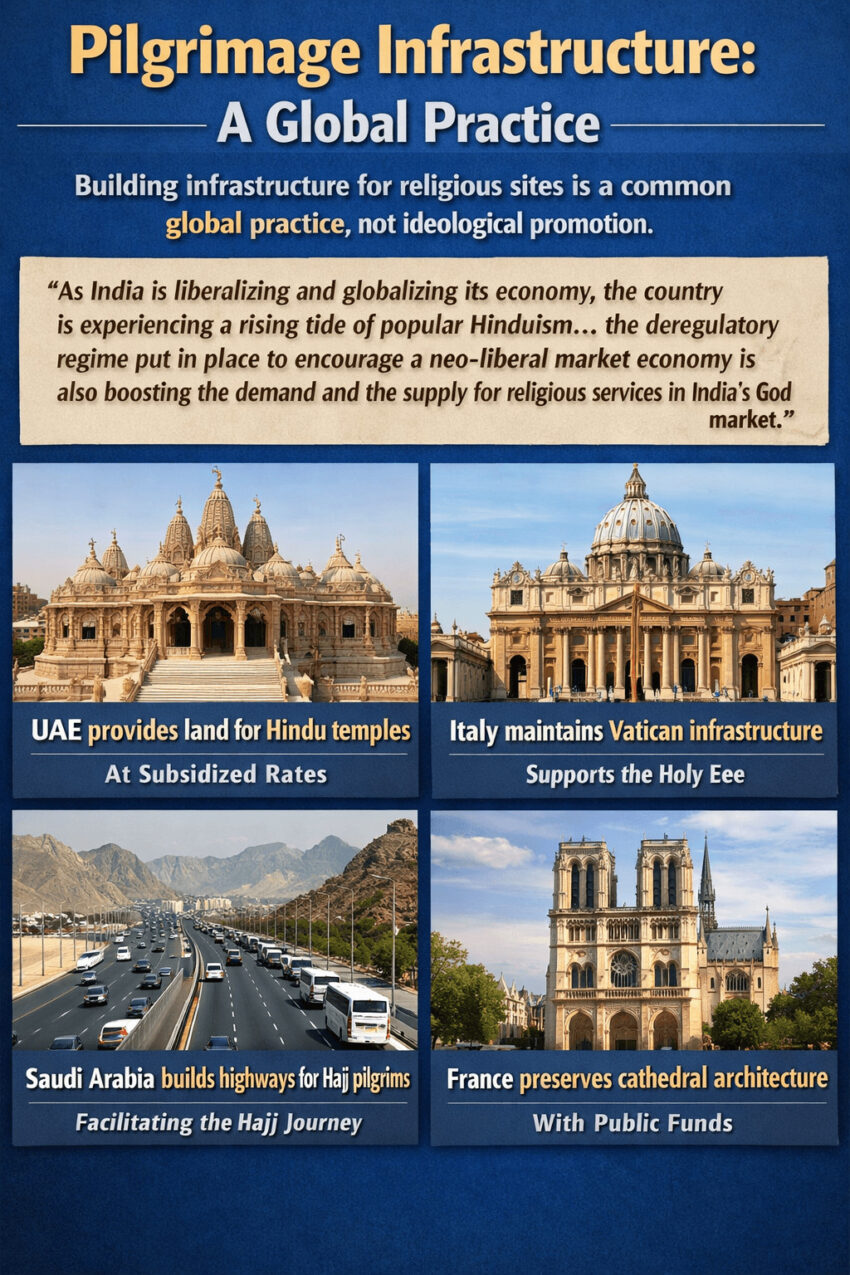
Nanda treats standard state functions as evidence of Hindu nationalism. She writes extensively about state investment in pilgrimage infrastructure but fails to recognize this as universal governmental practice. This is an extract from the book’s introduction:
“As India is liberalizing and globalizing its economy, the country is experiencing a rising tide of popular Hinduism which is leaving no social segment and no public institution untouched… the deregulatory regime put in place to encourage a neo-liberal market economy is also boosting the demand and the supply for religious services in India’s God market.”
This passage conflates two separate phenomena: (1) citizens choosing to be more religious, and (2) the state promoting religion. Building roads to sites where millions travel is infrastructure management, not ideological promotion. Above all it is a standard Global Practice. These are the examples:
- UAE provides land for Hindu temples at subsidized rates
- Italy maintains Vatican infrastructure
- Saudi Arabia builds highways for Hajj pilgrims
- France preserves cathedral architecture with public funds
In her framework, these would all constitute “religious majoritarianism,” yet she applies this label exclusively to India’s Hindu infrastructure. This is her own admission of the principle:
“The opening chapter is titled ‘India and the Global Economy: A Very Brief Introduction’. This chapter provides an extended introduction to the phenomenon of globalization as it pertains to India.”
Yet nowhere in this “extended introduction” does she provide comparative data on how other globalizing nations handle religious infrastructure.
The Absence of Quantitative Evidence
Nanda makes assertions without data. Nanda makes sweeping claims about state resources being “diverted” to Hindu causes without providing a single budget figure, percentage, or ratio. This is her methodological claim:
“Like any work of contemporary social history, this book tries to connect the dots between many diverse sources of information. It uses material obtained from the mass media, opinion polls, scholarly studies, government reports, research reports of think tanks, and websites of temples/ashrams.” (emphasis added)
Despite claiming to use “government reports,” she provides:
- No budget allocation data for “Hindu projects” vs. other infrastructure
- No comparative spending per capita on Hindu vs. minority religious facilities
- No quantification of the alleged “asymmetry” in state support
- No cost-benefit analysis of projects she criticizes
Yet she claims:
“As the Indian state is withdrawing from its public sector obligations, it is actively seeking partnership with the private sector and the Hindu establishment to run schools, universities, tourist facilities, and other social services.”
This could describe 0.1% or 50% of state partnerships. Without numbers, it’s unfalsifiable assertion, not analysis. It is a rhetoric in writing, at best.
Silence on Hajj Subsidy:
Most tellingly, Nanda never addresses the direct state subsidy for Hajj pilgrimage (which existed until 2018) or the entire Ministry of Minority Affairs with its multi-billion rupee budget. If state support for religion is the problem, these should be equally problematic. Their absence reveals selective application of her own principle or faith.
The Double Standard
Nanda makes selective moral judgment with a blindness to historical facts. Nanda’s framework contains a glaring internal contradiction regarding land and state support. She critiques the State provision of infrastructure for Hindu pilgrimage sites in contemporary India. But she ignores the vast tracts of prime urban land granted to churches under colonial-era 99-year and 999-year leases, continually renewed at nominal rates. This represents far more direct state subsidy than building a public road. Position of Mosques are not much different as most lack details of land title. This is her introduction to the book:
“At the end of it all this book poses this question: What room does this India that dreams saffron-tinged superpower dreams have for non-Hindu minorities?”
The Logical Inconsistency
If the question is genuine concern for secular governance, it must apply consistently. But this is the result:
| State Action | Nanda’s Treatment |
|---|---|
| Colonial land grants to churches (ongoing), Absence of land title of Mosques | No mention |
| Hajj subsidies (existed 2009) | No mention |
| Ministry of Minority Affairs budget | No mention |
| State Funding of Madarsa for Islamic Teaching | No mention |
| Infrastructure for Hindu sites | Proof of “state-temple-corporate complex” |
She rather unabashedly writes:
“This book will focus exclusively on the changing trends in popular Hinduism, the majority religion of the country. Changes in India’s minority religions will be acknowledged where and when needed, but not investigated in any detail.”
This methodological choice conveniently avoids examining whether the state shows similar “entanglement” with minority religions, which would undermine her thesis of unique Hindu favoritism.
The Nowhere Nation
Perhaps the most devastating critique is that Nanda cannot point to a single functioning democracy that practices the pure secularism she implies is both possible and necessary. Her missing model is a kind of Utopian Secularism with no real-world reference. Her position requires:
“Can the country deliver on the promise of secularism without cultivating a secular culture and a secular polity?”
What She Cannot Explain:
- USA: “In God We Trust” on currency, presidential God-talk, massive tax exemptions for religious institutions
- France: Authoritarian laïcité that bans religious symbols (which Indian secularists reject as anti-minority)
- The UK: Official state religion (Anglicanism), bishops in Parliament
- Germany: State-administered church tax
- Canada: Active state funding for multicultural/religious community events
This is her framework in practice:
“Instead, it will treat religiosity as any other cultural phenomenon which ebbs and flows, and changes with changing time.”
But she provides no example of a diverse democracy where state-religion separation is absolute, making her critique a philosophical ideal rather than a political blueprint.
The Kerala Paradox (2025 Update)
Since the book’s publication, the BJP has achieved breakthrough success in Kerala through Hindu-Christian alliances. Dr. Annie Stephy, a devout Christian IT professional, contested on a BJP ticket. This real-world coalition-building contradicts Nanda’s prediction of inevitable religious polarization.
Terminological Obfuscation
She has made it a technique by using undefined loaded language to reach the conclusion without any argument. It is pronouncement of judgement without trial. For example she uses the term “Hindu Pseudo-Science” but never explains it. Throughout her work and subsequent papers, Nanda deploys terms that function as argument-substitutes rather than analytical categories.
From her Academia.edu profile (2025 paper):
“India remains democratic… But one thing Indians can no longer brag about is that they live in a secular country…”
And in her title: “Vasudhaiva Kutumbakam and the Way of the Jackal”
These are all undefined but damning terms she has used in her various works:
- “Hindu pseudo-science”
- “Scientific temper” (undefined standard)
- “Banal Hindu nationalism”
- “Gentrifying the gods”
- “Hindu triumphalism”
- “Saffron-tinged superpower dreams”
Read this extract from the book and tell what is neo-vedantic:
“The newly prosperous middle classes are turning away from the more philosophical, neo-Vedantic form of religiosity and embracing a more ritualistic and superstitious form of popular Hinduism centred on temples, pilgrimages, and popular saints or god-men/women.”
This is an analytical failure. It is a collapse of argument even before it begins. What makes a religious practice “superstitious” vs. “philosophical”? By what standard? She never specifies. This allows her to:
- Label any Hindu practice she dislikes as “pseudo-science” or “superstition”
- Avoid defining what “true” or acceptable Hinduism would look like
- Dismiss practitioners’ own understanding of their faith
- Claim authority to determine authentic vs. inauthentic religiosity
This is a circular logic. Its premise is that modern Hindu practices are becoming more “ritualistic and superstitious.” Her evidence is that people are doing more rituals. Her conclusion is that this proves they are becoming superstitious. This is tautology masquerading as analysis.
The Mysterious “Complex”
Her central concept of the “state-temple-corporate complex”is similarly elastic. It does everything. This is her Grand Conspiracy Theory which explains everything. She writes:
“This book will argue, is bringing the state, the religious establishment, and the business/corporate elite in a much closer relationship than ever before.”
But she never establishes:
- What degree of relationship constitutes the “complex”
- How this differs from normal civil society interactions
- What the baseline comparison is (closer than when?)
- Whether similar “complexes” exist for other religions
The term becomes a catch-all explanation that can absorb any evidence. A politician visits a temple (complex!), a company sponsors a festival (complex!), the state builds a road (complex!).
The Meta-Problem of Citation Circle
She uses self-reinforcing validation. She writes in her introduction:
“This book is not an academic report on a specific research project. But neither is it a book of polemics or ideological argumentation.”
Yet examining her Academia.edu profile reveals a pattern:
- She publishes the provocative thesis (2009)
- Sympathetic scholars cite it
- She publishes new papers citing those citations as validation
- The original thesis is now “established scholarship”
Her 2025 paper: references “Hindu nationalism” and “secular crisis” as established facts, citing works that cite her original book.
The Political Failure
People of Belief are never disappointed. The most damning real-world test of her failing belief is:
- 2009: Book published
- 2014: Congress loses, BJP wins majority
- 2016: She publishes “Science in Saffron”
- 2019: BJP wins larger majority
- 2024: BJP wins third term
- 2025: BJP breaks through in Kerala with cross-religious alliances
From her introduction:
“This book aims to explore the changing religious landscape of India as it globalizes.”
If the landscape was truly moving toward the dangerous majoritarianism she warned against, one might expect electoral rejection. Instead, the democratic verdict has been consistently opposite to her predictions.
A Critique Disconnected from Reality
Meera Nanda’s work suffers from a fundamental disconnect between its theoretical apparatus and empirical reality. Her own words reveal the weakness:
“This book is an unplanned by-product of a much bigger enterprise… precisely because it emerged so unexpectedly, and yet made a lot of sense when it did come together, this book is all the more dear to me.”
It “made sense” within a particular ideological framework and academic ecosystem. It has not, however, made sense to the Indian electorate across three national elections and growing cross-community political alliances. The book’s most revealing admission:
“I took leave of absence from my original research project. The research and writing of this book was done entirely on my own time…”
This explains much. It reads like a scholar’s passionate political intervention rather than systematic social science. The passion is evident. The science is absent. The ultimate question Nanda poses:
“What room does this India that dreams saffron-tinged superpower dreams have for non-Hindu minorities?”
The answer, from Kerala 2025 where Christians campaign for BJP, appears to have more room than her framework predicted. The real India has proven more complex, pluralistic, and democratically resilient than her theory allowed.
A work that cannot account for Hindu-Christian political alliances, that provides no quantitative evidence for its central claims, that holds India to standards met nowhere else, and that has been systematically rejected by the electorate it sought to enlighten, cannot be considered serious social science. It is, at best, a valuable historical document of a particular elite western anxiety during India’s transformation. An anxiety that, by 2026, appears increasingly disconnected from democratic reality.
References:
- Meera Nanda “God Delusion at Work: My Indian Travel Diary” Economic Political Weekly 2008: https://www.epw.in/journal/2008/42/commentary/god-delusion-work-my-indian-travel-diary.html
- Fight faith based Politics: https://independent.academia.edu/MeeraNanda
- God Delusion at Work: My Indian Travel Diary https://www.jstor.org/stable/40278070?
- The God Market: https://www.academia.edu/65857600/The_God_Market_How_Globalization_is_Making_India_More_Hindu