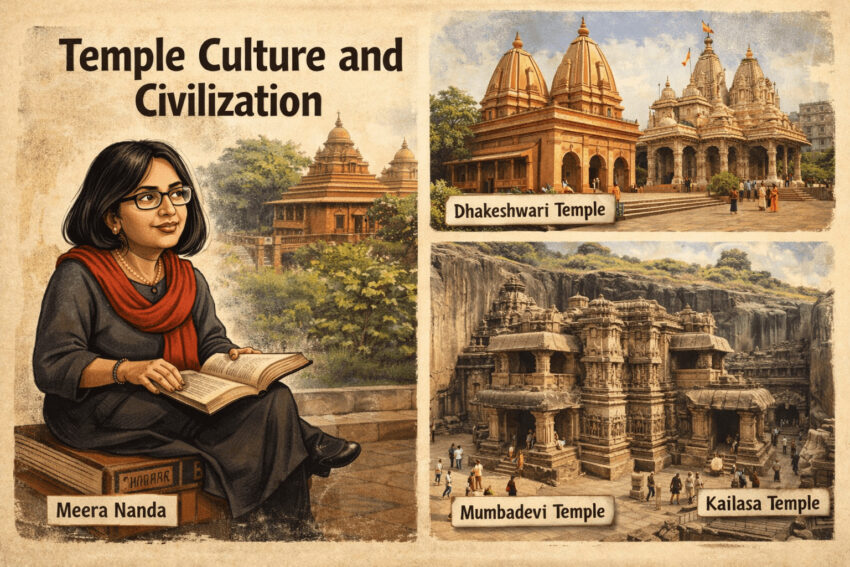
Meera Nanda as the Prophet of Rationality
Meera Nanda, while denouncing Hindu traditions, still advocates for a particular sect of Hindus. Thus, she condemns Hinduism as a whole while privileging a subset of Hindus. The subtlety of her deception is admirable. Even her Protestant admirers are deceived.
Her Sponsors
Nanda is candid about her sponsors. She writes about them in the book itself. Read:
In 2005, I was awarded a fellowship by the John Templeton Foundation to work on a book-length study of the relationship between modern science and Hinduism in contemporary India.
Apparently, her relationship is ongoing and she has been re-launched as a Prophet of Rationality to save the heathen masses of Hindus, as British used to call them in their Parliament. Though she distanced herself from her sponsors in a later paragraph.
Nanda’s Favorite Sect
Arya Samaj is a Hindu reform movement founded in 1875 by Swami Dayanand Saraswati in Mumbai. It emphasized a return to Vedic principles, monotheism, and rejection of idol worship, rituals, and caste discrimination. But the movement gained acceptance in Punjab which has long been influenced by Arya Samaj reformism. As stated earlier, iconic temple worship is minimized or absent, but Vedic mantras, fire rituals, ethical discipline, and communal gatherings remain central. It may be noted that Meera Nanda hails from Punjab and still maintains close connections with her relatives there, as stated by her in an EPW article.
Arya Samaj creates a ritual culture that is recognizably dharmic yet structurally distinct from deity-centric temple worship common elsewhere in India. If this regional variation is treated as normative Hinduism, image-based ritual traditions may be prematurely characterized as “market religion” or “ritual spectacle,” rather than as legitimate strands within the broader dharmic tapestry. Meera Nanda seems to be propagating the Arya Samaj branch of Hinduism and is calling it as Neo-Vedantic form of religiosity. She articulates:
The newly prosperous middle classes are turning away from the more philosophical, neo-Vedantic form of religiosity and embracing a more ritualistic and superstitious form of popular Hinduism centred on temples, pilgrimages, and popular saints or god- men/women.
But she does not mention Arya Samaj in her book because it will make it a religious debate not a western rationalism, it is couched to be. Unique feature of Arya Samaj is that they do not follow deity worship. But unlike Abrahamic faith followers they do not go out and resort to violence or seek its uniform application. They have a way and they respect those who choose not to follow their way.
There is another reason for concealing Arya Samaj. It is a simplified and less ritualistic version for a reason. It was used for ‘Shuddhi’ programs. Shuddhi, meaning “purification,” is Arya Samaj’s reconversion ritual to bring back Hindus who converted to Islam or Christianity, involving Vedic chants, holy water, and oaths.
The first recorded shuddhi of a born Muslim was reported in 1877, when Swami Dayanand Saraswati performed the shuddhi of a Muslim man from Dehra Dun, The first attempts by the Aryas at mass conversions of Muslim groups dates back to 1908, when Arya missionaries began touring certain areas of India calling upon newly converted to Islam to renounce Islam which had been forcibly imposed on them. Arya missionaries found that many converts who claimed to be Muslim but still followed several Hindu customs and beliefs, their ‘ancestral religion’.
Swami Dayanand Saraswati said that the Destiny of India lay in the revival of the Vedic religion, and gave the slogan “Back to the Vedas”. Shuddhi gained momentum under leaders like Swami Shraddhanand in the 1920s, targeting Punjab and sparking communal tensions.
Arya Samaj happened to be the only missionary sect of Hindus and it was ended by the killing of Swami Shraddhanand. He was bedridden with pneumonia at his Naya Bazar residence in Delhi when Abdul Rashid, a Muslim fanatic opposed to the Shuddhi movement, posed as a potential convert seeking religious advice and gained entry. Rashid then shot him at point-blank range in the chest with a pistol on 23 December 1926.
Therefore, mention of Arya Samaj and active promotion was likely to unsettle the promoters of Meera Nanda who happened to be protestant Christians that is the Middleton Foundation. It will also unsettle the Muslims who have a special place in Nanda’s writing as we shall explore soon.
Hindu
The concepts of Dharma, Artha, Kama, and Moksha represent the four main Purusharthas, or objectives of human life, as described in Hindu philosophy.
Nationalism and wealth are integral parts of Hindu tradition. Any genuine scholar can discover this by consulting books sold on the counter of Gita Press Publications which are available on every railway station in India. A book on rituals is called Sanskar Prakash (Gita Press, ₹75).
The philosopher Charvak who denounced Vedas and mocked the concept of afterlife was called Rishi in Hindu tradition. But Nanda need not have known about him as it is not relevant for her crusade. In Hindu tradition, one may live life without performing any rituals at all. There is no authority like Pope to kick out or excommunicate a Hindu. Charvak remained a Hindu nonetheless. Nanda will not be denied her last rites if she wished to be cremated as per Hindu traditions. Free speech and debate is permitted in Hindu traditions. All is forgiven on death. Unlike certain Abrahamic doctrines, dead body is not punished.
But Nanda chose to overlook all of this. The facts and principles do not matter to her. Let me explain why.
Truth and Immunity to Lie.
An ordinary person will be surprised to know that in India, lying and prostitution are not criminal offences per se or by itself. A truthful statement can also land you in trouble if you say it in public. For example, if you put out hoarding with certain sentences of the Old Testament or Al Quran, you can land in prison.
Meera Nanda may not be a lawyer but understands the legal position fully. She has no scruples for lying through her teeth or pen. She remains unrepentant even when confronted by experts. She genuinely believes herself to be the Last Prophet of Rationality on the planet.
In 2016 she wrote an article for Frontline in which she claimed that the origins of Pythagoras and zero were exaggerated by Hindu Nationalists and denied Hindu origin. Professor Michel Danino refuted this claim by writing an article in New Indian Express but that article has mysteriously disappeared from the official website. Unfortunately for Nanda, some other websites had anticipated it and preserved it on their website.
Lying is a subtle art. A habitual liar often overdoes it and exposes the stretch of an argument based on lies. For example, I can either have apples or I don’t but it cannot be both ways. Nanda pleads both ways. It is her cognitive dissonance that keeps her going unabated.
Origin of “the God Market”
In her book, in the first paragraph of the ‘A Personal Note’ section of the Introduction, she writes:
This book is an unplanned by-product of a much bigger enterprise that I have been engaged with for the last few years. But precisely because it emerged so unexpectedly, and yet made a lot of sense when it did come together, this book is all the more dear to me.
But in paragraph 5 of the same section she states:
My attempt to understand the religious beliefs and practices of middle- class Indians resulted in a long essay I called ‘The Rush Hour of the Gods’. This essay became the nucleus for the present book.
In next paragraph she states again:
Well, once I began to place religiosity in the changing political economic context, one bit of evidence led to another discovery and soon a picture began to emerge. I began to understand better how liberalization had increased both the demand and the supply of religious services in the private and the public sphere. Before I knew it, I had developed a thesis that could stand on its own.
Yet again, in the following paragraph she states:
I took leave of absence from my original research project. The research and writing of this book was done entirely on my own time and without any financial support from the Templeton Foundation. The Templeton Foundation bears no responsibility either for the existence of this book or for the ideas it expresses.
This is called jugglery of words. She is an accomplished narrative writer. She is taking the readers to different scenario to establish three narratives. First that she is not an unknown writer for this first book and she is part of a grand project. That was in 2009. As of 2026, no such grand project has materialized in any visible or coherent form. Secondly she is also telling how she actually developed the idea of the book. But it has been explained in the earlier article, the printed book is half developed by editors of Random House. Third she is maintaining a distance from Templeton Foundation. They were sponsoring the non-existent grand project, not this book and that relationship with Templeton was casual.
Temple Culture and Civilization
Nanda has a special grievance against temples. She hates to see the new temples coming up all over India. She writes:
“Without consciously intending to, secular India’s elected rulers seem to be re-enacting the premodern Hindu political system in which it was the duty of the king to sponsor temples and protect dharma. All temple building and kumbhabhishekas are not political, however. Joanne Punzo Waghorne describes a great surge of consecrations of new temples in the middle-class colonies of Chennai. Temples have become sites for ‘educated people, intellectual people, to retain the old values’, as a devotee explained to Waghorne. This attachment to tradition, however, does not rule out innovation within it. Waghorne describes the installation ceremony of a unique idol in the Madhya Kailash temple in Adyar, an affluent colony close to the campus of the Indian Institute of Technology in Chennai and patronized by the faculty, staff, and students. The idol represents a brand new hybrid god, half Ganesha, with his familiar elephant head, and half Hanuman, with his familiar ape-like features. the consecration ritual was equally innovative: unlike the traditional ceremony, the devotees consecrated the idol themselves without the help of the priests. The devotees saw it as an affirmation of democracy and equality.”
But she does not visit any place. She relies on a book written by a western visitor and uses it to promote her Arya Samaj views as rational. There is a long tradition of building temples in India. It is part of the teachings of Srimad Bhagwat Gita as Bhakti Yoga. She has to live with it.
When she dismisses those expressions as irrational, invented, or dangerous without first engaging Krishna’s own framework, she is implicitly asserting a superior epistemic position. This is why she is referred to as Prophet of Rationality.
Now that we know that she is a serious researcher on Hindu Civilization, one can only wonder how she missed the ground reality of ancient temples that surpass any modern temple in grandeur. She should visit Madurai to witness a few in person. My personal favourites are following three examples.
Who named Dhaka, the capital of Bangladesh? The word Dhaka came from the Dhakeshwari Devi temple there and it was established long before Hindu Nationalists were even conceived.
Mumbai was renamed as Bombay by the British. What is Mumbai? It is derived from Mumba Devi temple. It existed long before the RSS was even thought of.
Kailasa Temple near Chhatrapati Sambhajinagar, is the only temple which was carved out of mountain from top down. It is estimated that many generations of workers worked their entire lives to build it. Nanda can rest assured that it happened long before even Chugtai Turk aka Mughal thought of Bharat.
The list is long but for that one has to travel from city to city or research on DuckDuckGo. It is not possible to do it from a seminar hall.
There are several more examples of cognitive dissonance in the book, which I will demonstrate in the next article.
References:
- Shuddhi Movement by Arya Samaj:
https://www.aryasamaj.com/enews/2012/jan/4.htm - Posthumous Execution of Oliver Cromwell:
https://www.thebristorian.co.uk/the-past-today/s78tjhnz267x47gxbw66yxg3awdwxw
Illustrative video:
-
Pythagoras’ Theorem and the Zero Claim (Michel Danino, 2016):
https://asc.iitgn.ac.in/assets/publications/popular_articles/In_Defence_of_Indian_Science__Gainsaying_Ancient_Indian_Science_M_Danino_2016.pdf Also available at:In defence of Indian science – Michel Danino
-
Shrimad Bhagwat Gita, Chapter 12 on Bhakti Yoga.
-
Unlike most rock-cut caves excavated sideways from a cliff face, this Rashtrakuta-era temple (c. 756–773 CE under King Krishna I) was excavated vertically downward from the basalt cliff’s summit, removing around 200,000–400,000 tons of rock through trenches that isolated a central monolith: https://www.inheritage.foundation/blog/heritage/kailasa-temple-ellora
-
Fight faith based Politics: https://independent.academia.edu/MeeraNanda
-
God Delusion at Work: My Indian Travel Diary https://www.jstor.org/stable/40278070?
-
The God Market: https://www.academia.edu/65857600/The_God_Market_How_Globalization_is_Making_India_More_Hindu