(Part 9)
Exceptions to the Jinx
Pakistan’s tragedy is not only political or institutional. It is conceptual. Pakistan is not merely a state; it is an idea that constantly outlives, outgrows, and finally consumes the people who attempt to define it.
Individual Choices
It is not that individuals make poor choices; it is that the structure itself behaves like a living organism, absorbing, consuming, and discarding anyone who attempts to guide it.
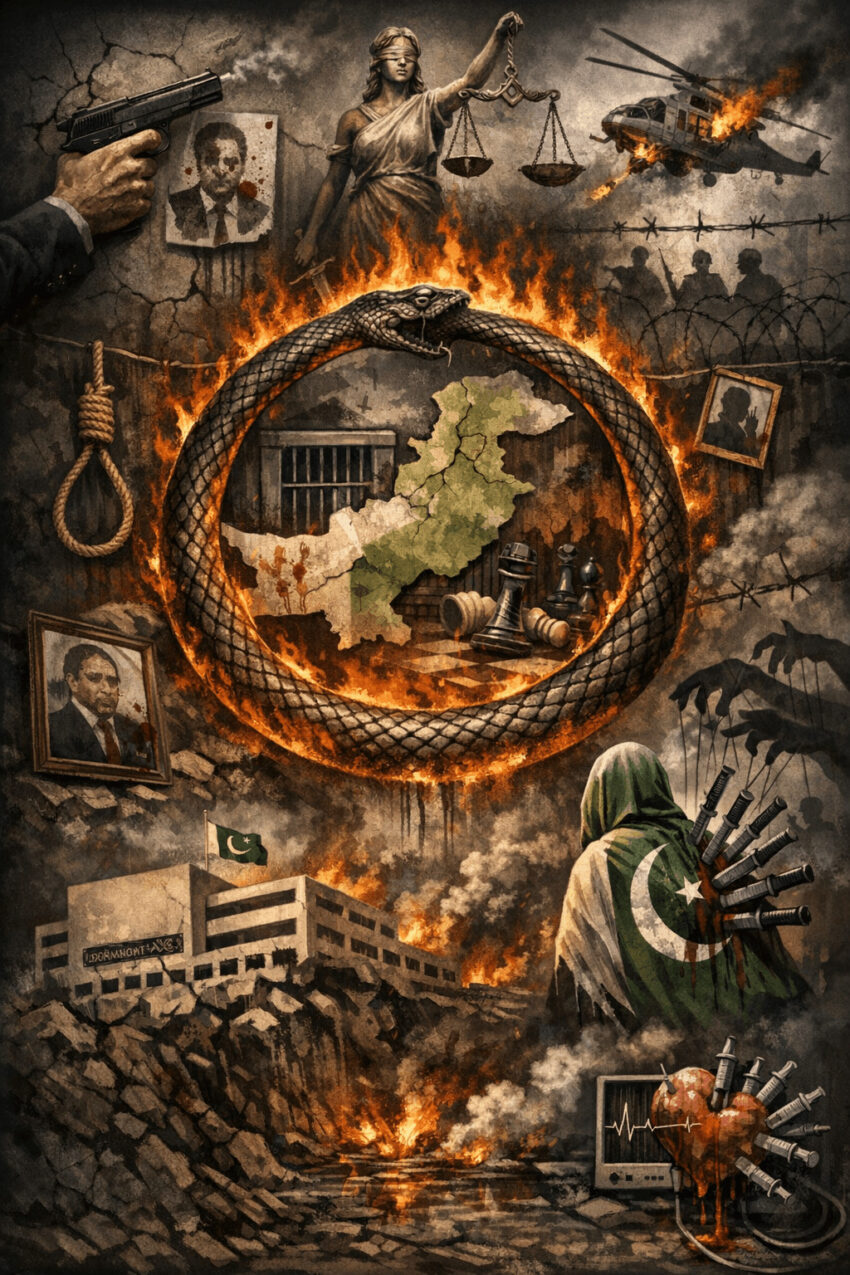
Every state has crises. Pakistan has recursion. The same events repeat across decades with different names but identical outcomes: assassination, exile, judicial killing, mysterious crashes, institutional betrayal. No reformer survives, no visionary prevails, no stabilizer leaves office intact. The state requires enemies, and when external enemies cannot be reached, internal ones are manufactured. It is an autoimmune state: it attacks its own organs.
This is what distinguishes Pakistan from failed states or fragile states. It is not collapsing because of external assault, it is collapsing inward because the machinery of power treats stability as a threat. Pakistan’s ecosystem does not permit prolonged leadership without eventual destruction.
Idea of Pakistan
The idea is the Two-Nation Theory. That theory created Pakistan. That theory justified Partition. That theory is the core of its identity. And that theory is also the reason Pakistan can never be a stable, single-nation state. You cannot build unity on a doctrine that begins with division. A country created through separation cannot magically convert into a cohesive whole. It will fracture again and again until it mirrors the logic that birthed it.
It was torn once in 1971. It is being torn again along Pashtun, Sindhi, Baloch, and Punjabi lines. It must remain a multi-nation state because its founding principle forbids unity. The Two-Nation Theory cannot coexist with a one-nation reality.
Example of Survivors
In the previous article we considered a range of Pakistan’s Army Chiefs and had shown that all did not meet the same fate. Some escaped the fate of the jinx. There is a clear pattern. The idea of Pakistan is the jinx. They carefully avoided it.
Asif Ali Zardari, built his entire political survival on anti-India rhetoric, never repeats the Two-Nation Theory. He does what the army asks but do not indulge in rhetoric of Muslim superiority. His son Bilawal Bhutto-Zardari insults Indian leaders, mocks Modi, spits venom in public rallies but does not touch the Two-Nation Theory. He visits temple and participates in Holi celebrations and thereby discards the theory in practice.
Nawaz Sharif and Shahbaz Sharif condemn India in public speeches. Yet, they never cite the theory their own textbooks glorify. They know the jinx.
This silence is not accidental. It is structural. They know invoking the theory would force them to confront the contradiction:
If Hindus and Muslims cannot live together, then why should Punjabis, Sindhis, Baloch, and Pashtuns live together?
The theory delegitimizes the very state they govern. To revive it is to self-destruct. So they attack India loudly but never touch the philosophical pillar on which Pakistan stands. As stated earlier The idea of Pakistan is itself the jinx.
Consider Husain Haqqani, once Pakistan’s ambassador to the United States and one of the most articulate defenders of Pakistan’s case abroad. When he became inconvenient, he was not just dismissed, he was accused of treason in the “Memogate” scandal and forced into exile. His loyalty to the state did not matter; the state’s suspicion mattered more. Defending Pakistan is like standing on shifting sand. Sooner or later, the ground beneath your feet decides you are the enemy. But he has survived. Why? He did not touch the jinxed core.
This pattern extends beyond leaders into the fabric of society. Intellectuals who question narratives are labelled traitors. Judges who assert independence are threatened, removed, or attacked. Business elites who attempt reform face extortion or disappearance. Journalists oscillate between silence and peril. The state does not merely repel threats; it repels attempts at clarity. Pakistan’s crisis is not about poverty or geography. It is epistemic and systemic.
And this is why Pakistan’s fate, as described across Parts 1–5, is not accidental but structurally determined.
The jinx is not superstition. It is the sum of every structural flaw documented across this series. Pakistan is not cursed by fate. It is cursed by design. And until the design is dismantled, the outcome will not change.
Pakistan is not haunted by fate. It is haunted by its founding logic.
1 thought on “How to Survive the Pakistani Jinx?”