(Part 1)
A Land Once Called India.
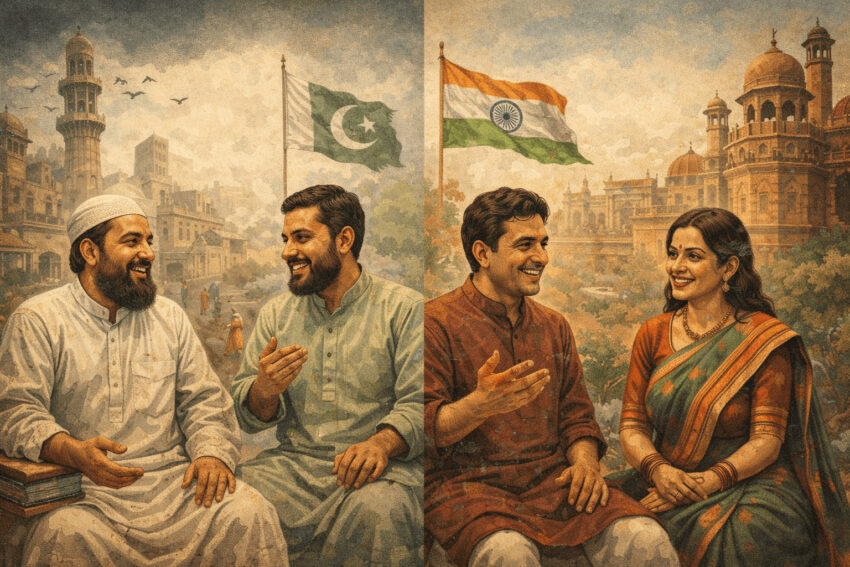
Pakistan is no longer familiar to this generation of Indians. The assumption of familiarity survives as historical reflex, not lived knowledge. India and Pakistan may share a language family, but no longer share common public culture.
For someone fluent in Urdu, Pakistan can still feel accessible. Speech patterns, idioms, humor, and emotional registers remain legible. But most Indians do not know Urdu in its spoken Pakistani form. They know Hindi, heavily Sanskritized, mediated through Indian institutions.
This gap becomes evident watching Pakistani YouTubers not addressing Indian audiences. Their Urdu is faster, denser, culturally closed. Without subtitles or prior familiarity, most Indians simply cannot follow. What was once assumed shared linguistic space has quietly fractured.
The Language
There was a time when Urdu did not ask where you were from. It assumed conversation. You could speak, and someone would answer. Across cities, across borders, the language moved without needing permission. It carried irony without apology, sorrow without melodrama, love without declaration.
For those who grew up inside that world, Pakistan was never foreign. It felt familiar because the language sounded right. The cadence was shared. The pauses were understood. When one listened to Ghulam Ali, it did not feel like listening to another country.
The poets belonged to no flag. Mirza Ghalib was not Indian or Pakistani. Meer Taqi Meer did not require footnotes. Their verses lived in speech, not scholarship. They were quoted in arguments, remembered in heartbreak, misremembered in laughter. That was how language stayed alive.
That world has receded.
The loss arrived quietly, through narrowing address. Urdu did not disappear. It withdrew. It stopped roaming. It began speaking inward, careful of tone, careful of allegiance, careful of consequence. We can still hear Urdu. But it no longer feels like it’s looking back at you.
In India, Urdu survives largely as memory and listening. People know the songs. They remember the lines. They recognize the poets. But fewer can speak back with confidence. The language remains emotionally legible but socially unsupported. It exists in ears more than on tongues.
In Pakistan, Urdu increasingly belongs to enclosed spaces. It circulates among the credentialed, the ideological, the performative. Much of contemporary Pakistani poetry exists, but it does not travel. It speaks to its own anxieties, its own politics. It does not wander into unfamiliar rooms. It does not risk misunderstanding. Poetry that avoids misunderstanding also avoids encounter.
Contrast this with Nida Fazli. His Urdu did not posture. It did not demand reverence. Lines like “Kabhi kisi ko mukammal jahan nahi milta” carried philosophy without ornament, grief without exhibition. Fazli’s language spoke as if someone was listening, not as if something was being proved.
Language does not die when poets stop writing. It dies when conversation stops expecting continuity.
What has been lost is not vocabulary or meter, but reciprocity. Once, Urdu assumed a listener who could answer in the same register, disagree without hostility, recognize irony without instruction. Today, that shared interior space has fractured. What remains are performances, beautiful and skilled, but no longer porous.
Partition did not only divide land. It divided address. One side carried the language as inheritance. The other carried it as identity. Between inheritance and identity, conversation thinned.
This is why the loss feels personal. Not because Urdu has vanished, but because there is no longer anyone to talk to in the way once, one could. You can still listen. You can still admire. You can still remember. But the expectation of reply has dissolved.
The Rupture
In the 1970s and early 1980s, Pakistani television could adapt Shakespeare into Urdu without embarrassment. Serials like Parchaiyan treated tragedy, irony, and moral compromise as universal human material. Characters like Kabacha were recognizably human, funny, compromised, ironic. The comedy show ‘Bakra kishton pe’ was just a show without nationality, like Kapil Sharma show of today. Its sequels were telecast for decades with confidence of acceptance across the continent. That confidence did not survive the Zia years.
The rupture becomes explicit during the Zia years. In his foreword to The Quranic Concept of War, Zia-ul-Haq rejected military professionalism detached from religious coloring. He declared a single Islamic pattern of warfare obligatory for both soldier and civilian. After this, ambiguity itself became suspect. Now the elites of civil society talk of Gazwa-e-Hind. Journalists, Cricketers, Actors and Politicians talk of it not as a folklore but as a destiny.
A society that teaches this logic at the level of state doctrine cannot sustain plural culture. Poetry, theater, irony, Shakespearean tragedy all presuppose moral uncertainty, divided loyalties, tragic compromise. But a worldview that divides history into weak and strong has no room for tragic ambiguity.
A society trained to see conflict as permanent does not abandon struggle when it signs agreements. It merely changes instruments. That is why peace pacts become tactical. That is why culture becomes instrumental. That is why hatred becomes identity. That is why ‘aman ki asha has no asha.
From the late 1970s onward, Pakistan gradually internalized a belief that asymmetric conflict conducted through religiously motivated non-state actors could compensate for conventional weakness against India. This belief did not emerge organically. It was cultivated, normalized, and institutionalized. But you cannot permanently outsource violence to ideology without eventually importing it back home.
A society organized around permanent mobilization cannot sustain ambiguity, irony, tragic complexity, and free cultural exchange. Then language hardens. Art becomes declarative. Poetry becomes devotional or sloganized.
This is not accidental. It is structural.
The Davis Incident
Raymond Davis was a CIA contractor operating in Lahore in January 2011. He shot and killed two Pakistani men in broad daylight, claiming they were armed assailants riding on a motorcycle. A third Pakistani was killed when a U.S. consulate vehicle speeding to assist Davis struck a motorcyclist. Davis was arrested by Pakistani police, and the incident triggered a national crisis.
What resolved the crisis was not a court trial in the modern sense, but the invocation of Islamic law. The case was transferred to Islamic Court. The families of the dead men were brought before a court and agreed, under opaque circumstances, to accept blood money. Once payment was made, the court ordered Davis’s release. He was flown out within hours.
That procedural detail is crucial. The state did not override religious law. It used it.
This incident shows how religious jurisprudence had been institutionalized into state crisis management. A matter involving espionage, sovereignty, and international law was resolved through a framework originally meant for interpersonal justice. Blood money became a diplomatic instrument.
It also exposes the contradiction at the heart of Pakistan’s jihad-era identity. Publicly, the state encouraged a moral universe in which Islamic justice was sacred and non-negotiable. Privately, the same framework could be activated, negotiated, and closed when geopolitical necessity demanded it. In other words, doctrine was not abandoned. It was cauterized with procedure.
Public Space as Operational Terrain
In his book The Contractor, Davis repeatedly describes the streets of Lahore not as spaces governed by law, but as governed by anticipation of violence. The danger he perceived was not limited to criminals. It included crowds, traffic stops, bystanders, and most tellingly, the police themselves.
Davis’s opening admission is telling. Armored vehicles were routine. Unarmored ones were deviations. Lahore was navigated not as civic space but as operational terrain. Davis starts his book with an explicit note that his fatal mistake was using a non-bulletproof vehicle.
In functioning societies, uniforms reduce uncertainty. Here, they increase it. Contractors fear that a police stop may be a militant ambush. That is not paranoia but learned behavior. When impersonation becomes plausible, legitimacy collapses.
Davis’s account repeatedly shows police functioning not as neutral arbiters but as sources of uncertainty and fabrication. This forces civilians and diplomats alike to treat law enforcement as a risk to be managed rather than protection sought.
In My Life with the Taliban, former diplomat, Zaeef from Afghanistan describes encounters with Pakistani police in which they behave not as law enforcers but as rent-seeking predators. The pattern he recounts is simple and repetitive. Police stops without cause, threats without charges, detention without process, and release only after money changes hands.
Zaeef was not a powerless civilian. He was a senior Taliban figure, an ambassador, someone embedded in Islamist networks that Pakistan itself had cultivated. If even someone like him experienced the police primarily as extortionists, something structural is at work.
When such divergent observers converge on the same experience, the problem is no longer perceptual. But we do not have to venture into imagination. A real life experience of a daughter of India makes it clear.
The Trap of Nostalgia
The nostalgia for an old India being like Pakistan, still alive in some older Indians, creates a dangerous illusion. It makes people believe the old rules still apply. That Urdu still grants access. That cultural familiarity still offers protection.
Uzma Ahmad met Tahir Ali, a Pakistani citizen, in Malaysia. She traveled to his home in Pakistan on May 1, 2017, only to find that Ali had four children from a previous marriage. What followed was a wedding at gunpoint, sexual assaults, and a subsequent escape to the Indian high commission.
“It’s easy to go to Pakistan, but tough to return. Pakistan is a well of death,” a tearful Uzma said upon her return to India.
Entering the Indian high commission wasn’t easy. In order to trick Ali into taking her there, a couple working with the embassy in Islamabad pretended to be her brother and sister-in-law. Ali waited outside while Uzma met with deputy high commissioner JP Singh.
At the high commission, Uzma was getting jittery. Ali would roam around the high commission with four aides, often flashing rifles at those guarding the building. “I don’t want to go back to him,” she told officials. “Please feed me poison instead.”
Embassy officials approached the Islamabad high court, which ordered her return after a detailed hearing. High commission officials got a certified copy of the order around 2:30 PM. Singh left with Uzma for the border at 2:30 AM on May 24, reaching Wagah around 7:30 AM.
At 9:30 AM, Uzma entered India again from Atari gate at the border in view of live television. When Uzma had crossed into India, she knelt and touched the ground, then brought her hand to her forehead. The gesture was instinctive, not rehearsed. She touched Indian soil the way one touches the feet of elders after surviving danger. For those watching, the image required no explanation.
Notice how the Indian embassy had to operate. They couldn’t simply invoke law or diplomatic protocol. They had to use deception, strategic timing, and physical protection. Singh leaving at 2:30 in the morning before sunrise, to reach Wagah early shows they were navigating hostile terrain, not diplomatic procedure. The High Court order enabled international procedure but not the protection at local level.
Conclusion
The strangeness young Indians perceive in Pakistan today is real. But it wasn’t inevitable. Pakistan was once part of the same cultural world. The language flowed freely. The poets belonged to everyone. Conversation was assumed, not negotiated.
What changed was not simply partition, but the deliberate construction of a society organized around permanent conflict. When ambiguity became suspect, when treaties became tactical, when violence was systematically outsourced to ideology, culture itself fractured.
The nostalgia that some older Indians still carry describes a place that no longer exists. Acting on that nostalgia, as Uzma Ahmad discovered, means walking into a trap.
Silence does not announce itself. It simply remains, where conversation used to be.
References:
Read about similarities of Pakistan with America here.
Part 2: https://sandeepbhalla.in/what-is-the-future-of-pakistan/
Part 3: https://sandeepbhalla.in/it-sectors-negligible-contribution-in-pakistan/
Part 4: https://sandeepbhalla.in/cognitive-decline-in-pakistan-is-shocking/
Part 5: https://sandeepbhalla.in/my-requiem-to-a-lost-civilisation-called-pakistan/