Imperial Benevolence of USA towards India: Chapter 7
When Marco Rubio sat across from Ajit Doval in May 2026, he represented an administration that had spent eighty years arming, funding, and diplomatically protecting, the only country which proclaims to be enemy of India. Yet he came to talk about partnership with India. Doval had lived in Pakistan as undercover operative for years knowing what it is up to on each day.
1947: The Choice
India was liberated and Pakistan was born on the same day in August 1947. The United States made its choice within months. Pakistan joined SEATO and CENTO, the American-designed military alliances built to contain Soviet influence. India chose non-alignment. Washington read non-alignment as hostility.
Pakistan was created by British as part of their imperial great game against Soviet Russia. USA succeeded British and its patronage of Pakistan. The logic was simple and wrong. Pakistan offered bases, cooperation, and unconditional alignment.
India offered democracy, which America confused with unreliability. More so a country that would not choose global lobbies was treated as a country that had chosen the wrong side.
Pakistan understood the transaction precisely. Alignment meant arms. Arms meant leverage against India. American benevolence was the subsidy that made every subsequent Pakistani military adventure against India financially viable. It made its dream project of Gazwa-e-Hind, possible. It launched first gazwa in 1965.
American Weapons, Indian Soldiers
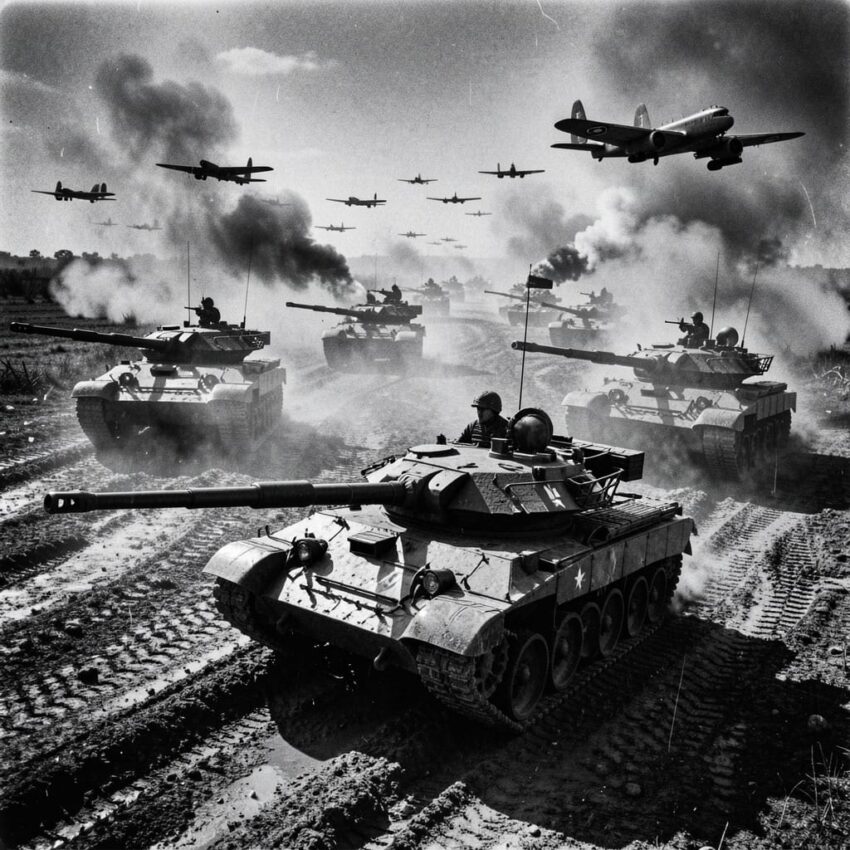
In September 1965, Pakistan launched Operation Grand Slam against India in Kashmir. Pakistani armoured columns crossed the international border using American-supplied M47 and M48 Patton tanks, American artillery, and American aircraft. The weapons had been supplied under the condition that they would only be used for defensive purposes against communist aggression.
Pakistan used them against India, with impunity. USA officials could only lick the conditions with Pakistani honey. The Patton tanks perished in flooded farming land on which Indian army had opened water a few days earlier, anticipating the attack.
The United States suspended military aid to both sides after the war began, which sounds even-handed until you understand the asymmetry. Pakistan had already received its weapons. India had not. The suspension locked in Pakistan’s American-supplied advantage and left India to fight with what it had.
India fought the war to a standstill and then signed the Tashkent Declaration. America called it a resolution. India called it a temporary respite.
The Patton tanks that Pakistan left behind are today displayed as war trophies at Patton Nagar in Khemkaran, Punjab. Forty-five Pakistani Pattons destroyed or captured in a single engagement. American benevolence and Pakistani Army’s war skills, melted into monuments by Indian Army.
1971: The Enterprise in the Bay
In December 1971, Pakistani forces were committing genocide in East Pakistan. The death toll was between one and three million Bengali civilians. Ten million refugees had crossed into India. Bengali pride rose as revolt against Paksitani Army and manifested into ‘Muktijodha’. Government of India helped it in every possible way. The trained warriors crossed over into East Pakistan to fight. The Indian Army followed.
A platoon of Indian Army surrounded Dhaka along with Muktijodha warriors. A bomb landed on Governors’s house and Pakistan army capitulated. Over 90 thousand strong Pakistani forces under A. A. K. Niazi, surrendered on December 16 in front of General Jacob and Lt General J.S. Aurora. Bangladesh was born.
USA had sent USS Enterprise carrier battle group into the Bay of Bengal to intimidate. India had signed a friendship treaty with the Soviet Union months earlier, precisely because it had read what was coming. The Soviets sent their own naval vessels into the Indian Ocean in response to the Enterprise. The Americans blinked.
The Bomb They Knew About
Pakistan began its nuclear weapons programme in 1972, immediately after the 1971 defeat. Bhutto is on record to brag at his hometown Larkana that “we will eat grass but we will build bomb’. The father of the programme, A.Q. Khan, stole centrifuge designs from a Dutch enrichment facility in 1975 and brought them to Islamabad.
The United States knew. Richard Barlow, the analyst who uncovered was not just sacked but persecuted to suppress the truth about Pakistans Nuclear plan. In Chapter 32 of my book Accidental Empire, I have narrated the complete story of Richard Barlow.
The Pressler Amendment of 1985 required the American President to certify annually that Pakistan did not possess a nuclear device before aid could continue. Every President certified. Every intelligence assessment said the opposite. The certification was a legal fiction that allowed the aid to flow while maintaining the appearance of compliance.
When the fiction became too expensive to maintain after Pakistan’s 1990 nuclear test disclosures, aid was suspended. Then Robin Raphel lobbied for the Brown Amendment in 1995, which released 368 million dollars in embargoed military equipment including F-16 components back to Pakistan despite active intelligence assessments of its nuclear programme.
The bomb Pakistan tested in May 1998 was built with technology stolen from Europe, funded by American aid, and protected by American diplomatic cover for twenty years. When Pakistan tested, the world expressed shock. The intelligence agencies expressed nothing, because they had known for two decades.
India had preemptively tested its own bomb six days earlier. America sanctioned India.
USA that had spent twenty years covering for Pakistan military’s nuclear programme sanctioned India’s democracy for responding to it. That is American benevolence in its most concentrated form. USA chose to protect nuclear garrison over civilians.
After 2001: Paying Both Sides
The September 11 attacks produced the most expensive and most cynical chapter of American benevolence toward Pakistan.
Pakistan was designated a major non-NATO ally. Coalition Support Fund payments began flowing, eventually totalling over thirty billion dollars across fifteen years. The official purpose was reimbursement for Pakistani military operations supporting American objectives in Afghanistan.
The actual result was documented repeatedly by American commanders, congressional investigators, and intelligence assessments. Pakistani ISI maintained relationships with the Afghan Taliban throughout the war. The Haqqani Network, responsible for some of the deadliest attacks on American and NATO forces in Afghanistan, operated from sanctuaries in Pakistani territory that the Pakistani military protected.
Osama bin Laden was found living in Abbottabad, a military garrison town, eight hundred metres from Pakistan’s premier military academy. America was paying Pakistan to fight a war while Pakistan was funding the other side of the same war.
India watched this from next door. Lashkar-e-Taiba, trained and funded by ISI, carried out the Mumbai attacks of November 2008. One hundred and sixty six people killed in three days. The operational planner, David Coleman Headley, was an American citizen and DEA informant whose travel to Mumbai on reconnaissance missions was apparently not flagged by American intelligence despite his known ISI connections.
America expressed condolences. Pakistan expressed condolences. The Lashkar-e-Taiba leadership continued operating from Lahore.
The Arithmetic of Benevolence
The total American aid to Pakistan across seventy years runs to approximately eighty billion dollars when military and civilian assistance are combined. The precise figure is contested because significant portions flow through channels that are not publicly audited.
Pakistan had the capability built with USA aid to fight four wars against India. 1947 in Kashmir. 1965 in Punjab. 1971 at both east and western flank. Again in Kashmir in 1999 in Kargil, where Pakistani soldiers in civilian clothes occupied Indian positions on the Line of Control in Kashmir and were removed at significant cost in Indian lives. Thirty years of terrorism in Kashmir that killed tens of thousands of Indian civilians and security personnel. The Hurriyat architecture that Robin Raphel built in 1993 and that ISI funded through the channels she helped keep open.
America did not pull any of these triggers. It just made sure the gun was always well oiled and loaded.
Operation Sindoor: The Answer
On the night of May 7, 2026, India fired Brahmos cruise missiles and deployed loitering munitions against terrorist infrastructure in Pakistan and Pakistan-occupied Kashmir. The strikes targeted nine sites. They were precise, pre-planned, and executed without warning.
The provocation was the Pahalgam massacre of April 2025, in which twenty-six tourists were killed by Lashkar-e-Taiba operatives. India had spent a year building its targeting file.
Pakistan retaliated with drone and missile strikes on Indian military installations. India’s air defence systems intercepted most of them. India then escalated, striking Pakistani air bases. Pakistan sought a ceasefire on May 14. The Director Generals of Military Operations spoke. The guns stopped.
The fact of ceasefire did not prevent President Trump from taking credit of stopping the war, again and again. He even sought Nobel Prize for it and Pakistan obliged to recommend him for that.
The final arithmetic was not ambiguous. Pakistani terrorist infrastructure destroyed. Pakistani air bases struck. Pakistani ceasefire request granted on Indian terms.
Brahmos missiles do not distinguish between Pakistani military hardware and the American technology embedded in it. Fifty years of American benevolence toward Pakistan met fifty years of Indian patience at the Line of Control, and the encounter lasted four days before Pakistan asked for it to stop. In 2026 there was no USS Enterprise travelled to Indian Ocean as India indigenous built Aircraft carriers were waiting in Arabian Sea, itself.
What Rubio Did Not Say
The State Department readout from Rubio’s meeting with Modi was three sentences. It mentioned strategic importance, a White House invitation, and the Middle East.
The response of India was curt. It omitted the invitation to white house as if it did not happen.
The treatment of USA at the hands of India reminds me of a damsel who proposed to the groom of a respectable family. She did not want to leave her paramour. She did not realize that her lowlife paramour has tainted her reputation beyond recovery.
Proposal has no prospects.
In the next chapter we shall discuss the unwanted child of USA and Pakistan. That is Bangladesh
References
Richard Barlow: Nuclear Weapons and Pakistan. Federation of American Scientists (FAS), updated 2007.