(Part 1)
A Good Idea. A Wasted Movie.
Good Fortune Directed by Aziz Ansari • 2025 • 97 Minutes
Good Fortune had a genuinely interesting premise. Wealth inequality examined through divine intervention. A heavenly messenger who swaps the lives of a struggling gig worker and a wealthy venture capitalist. That is a legitimate satirical device with a long literary tradition. The best one liner in movie was:
So I got a budget angel.
That single line is one of the few good things in Good Fortune. It is compact, surprising, and self-aware. A man so unlucky that even his divine intervention arrives budget-sized. In that one joke, Aziz Ansari shows exactly what he is: a gifted stand-up comedian with a sharp eye for irony. The tragedy of this movie is that the rest of it proves he is not yet a moviemaker.
A weak idea poorly executed is one kind of failure. A good idea poorly executed is a more interesting and more frustrating failure. Ansari did the second.
The Stand-up Act
Ansari performs in this movie the same way he performs on stage. His acts before a microphone. He is clueless when not talking. His physical presence belongs to a spotlight. His relationship with the audience is the relationship of a man who knows he is being watched and is working the room. The movie camera does not forgive this. Acting requires that only character should exist. Actor must forget that the audience exists. Actor lives in Character. Ansari barely meets the character.
Ansari’s best work, Master of None, succeeded because it was movie of personal essay. Barely fiction. The moment he attempted genuine fiction with invented characters and a fantastical premise, the absence of real craft became visible. He is a gifted observer. He is not yet a storyteller. Observers collect material. Storytellers create worlds. This movie is cinematography of the story dressed as a world.
Punchlines are destinations. Stories are journeys. You cannot build a journey out of destinations alone.
The Broken Visual Language
A movie that intends to satirise class must use visual language to reinforce its satire. Costume design is storytelling shorthand. Audiences read wealth, status, and transformation through clothing before a single line of dialogue is spoken. Good Fortune gets this badly wrong at every turn.
Ansari’s gig worker character never looks poor in any way that feels lived. Seth Rogen’s venture capitalist never looks wealthy in any way that feels excessive. Neither character carries the visual weight the script demands of them. The satire collapses because the visuals refuse to exaggerate what the writing is attempting to exaggerate. The audience cannot suspend disbelief when its eyes and ears are being told different things. Cinematography tries to fill the gap with elaborate luxuries sets but that is not enough.
One scene captures this failure perfectly. Ansari’s character, now wealthy, appears at a party on a disco floor wearing a blue suit and white shirt. That is not how a newly rich gig worker dresses to celebrate a transformation. That is how a Manhattan comedian imagines a poor man dressing up.
A real transformation would produce either wild excess, because wealth looks very different from the outside looking in, or no change at all, because identity does not shift with a bank balance overnight. The blue suit is a politically correct compromise that communicates nothing. His beard and hair remain unchanged throughout the movie. He looks the same at the beginning and the end. Stand-up comedians wear the same clothes every show. That habit followed Ansari into the movie.
The Missing Anchor
Every strong satirical movie has a fixed narrative perspective. A guide through the absurdity. Someone whose eyes we borrow. Parasite uses the poor family. The Wolf of Wall Street uses Belfort himself. Even movies with unreliable narrators give us a consistent unreliable narrator. Good Fortune gives us no one.
Gabriel, the angel played by Keanu Reeves, could have been that anchor. He is, after all, the agent of the story’s central conceit. But he is an active observer of himself. His styling sits closer to his Matrix persona than to any conception of a meddling divine force. He looks like Neo in a softer mood. He brings no mischief, no wisdom, no comic eccentricity. He watches events of his own life, unfold alongwith life of others. The audience too, watches the mix-up, with diminishing patience.
Without an anchor the movie feels like overhearing gossip about people you do not know. Bits and pieces about a gig worker, a rich man, an angel, stitched together without a guiding intelligence. The audience drifts between scenes looking for the one perspective that will make the whole cohere. It never arrives.
But anchor is not the only problem. Problems multiply.
A Manhattan Worldview
Good Fortune earned $26 million against a $30 million budget. That is rejection. It was not from under-performance but for a deeper reason.
The movie is the product of a specific worldview. The Brooklyn-to-Silver Lake creative corridor has its own set of assumptions about class, merit, and inequality. That bubble mistakes its own dinner party conversations for universal American feeling.
In this worldview, wealth means opulence and irresponsibility. Poverty means helplessness and deprivation. The solution is a magical external intervention, an angel who is essentially a progressive policymaker with wings. He sees an unjust distribution and intervenes. That is not theology. That is over-governance dressed in feathers.
Most Americans live with frugality not as a philosophical choice but as a daily reality. They do not need an angel to explain inequality to them. They are inside it. A movie that treats their reality as a thought experiment or a punchline will not move them. Pan-America stayed home. The streaming numbers on Prime Video and Starz suggest curiosity without willingness to pay. That is the most polite form of rejection available.
Political ideology can inform a great movie. It cannot substitute for one.
Ansari’s Tamil Indian heritage carries centuries of sophisticated thinking about wealth, duty, and restraint. The Travancore kings of Kerala, rulers of one of the wealthiest kingdoms in pre-independence India, formally dedicated their entire kingdom to Lord Padmanabhaswamy and ruled as his servants, not as owners. When gifted a Rolls-Royce, the King agreed to ride in it once as a courtesy and gave it away. Wealth as custodianship. Power as service.
When a movie maker inherits a cultural tradition that produced such philosophy and instead gives us a budget angel in a cream suit, something has been lost in the passage between generations and continents.
A Documentary of Culture
Good Fortune fails as satire. It succeeds, accidentally, as a cultural document about the world that produced it. It tells us that a generation of successful South Asian migrants to America has become so comfortable inside American wealth culture that it can no longer see outside it. The rich are cartoons of excess. The poor are cartoons of helplessness. The angel is a cartoon of wisdom. Nobody in this movie has any relationship with frugality, restraint, or the idea that wealth carries responsibility beyond the individual.
Real Life Examples
Contrast this with a real story from our times. Anil Ambani was once among the richest men in India, heir to a fortune split with his brother Mukesh. He is now under investigation for alleged fraud running to hundreds of crores, accused of maintaining a wealthy lifestyle through dishonest financial practices. That story has everything Good Fortune wanted: merit, luck, inheritance, failure, and the temptation to sustain appearances at any cost. It is dramatically coherent in a way the movie is not. Reality, it turns out, writes better satire than Ansari did.
The angel in the movie is economical because Ansari’s imagination is economical when it comes to anything outside his own experience. He can write a perfect joke about a budget angel. He cannot yet write a movie about what wealth and poverty actually do to human beings.
VERDICT
A good premise. A wasted movie. A revealing cultural document.
Notes & References:
- Good Fortune (2025). Directed and written by Aziz Ansari. Starring Keanu Reeves, Aziz Ansari, Seth Rogen, Keke Palmer, Sandra Oh. Cinematography by Adam Newport-Berra. Available on Prime Video (India) and Starz (US).
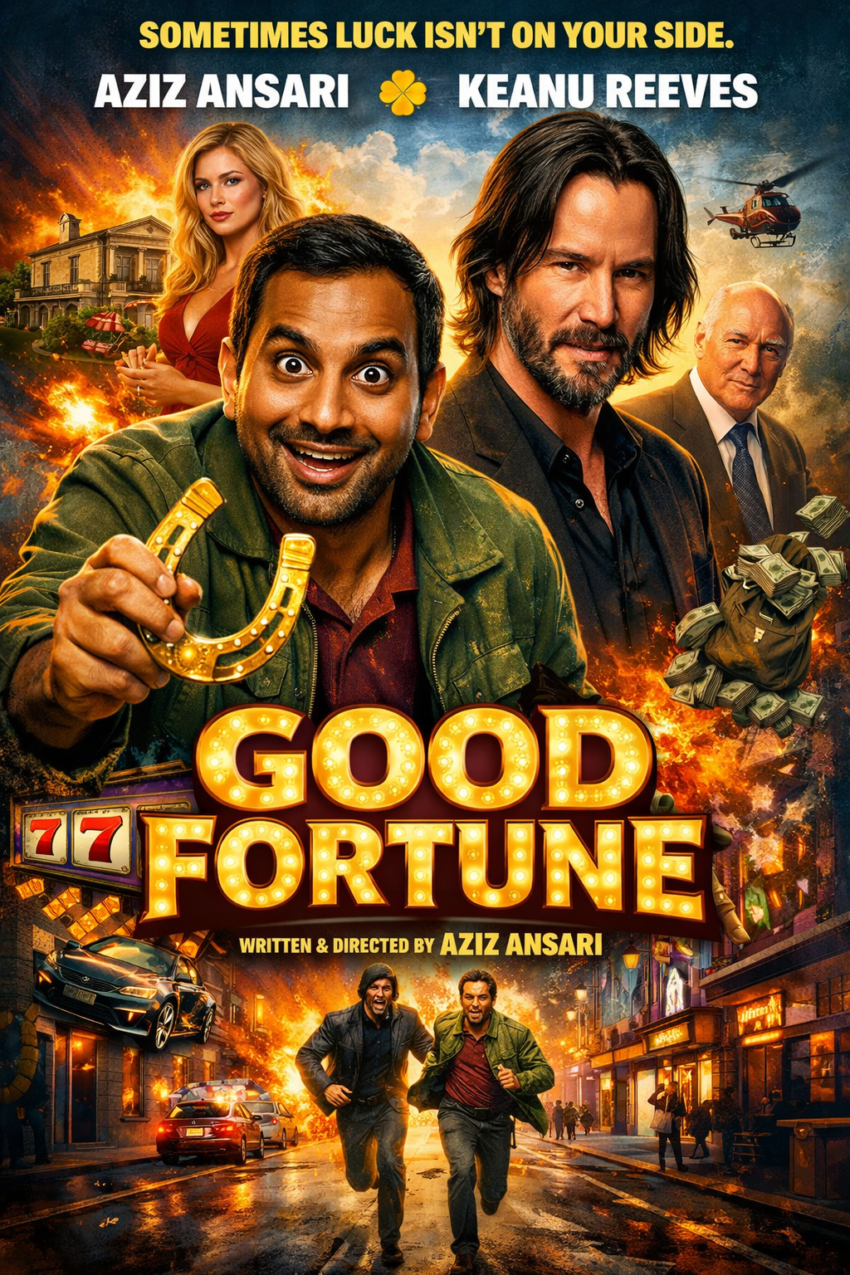
- What Ansari did to the idea of poverty and wealth is what AI did to his movie poster.