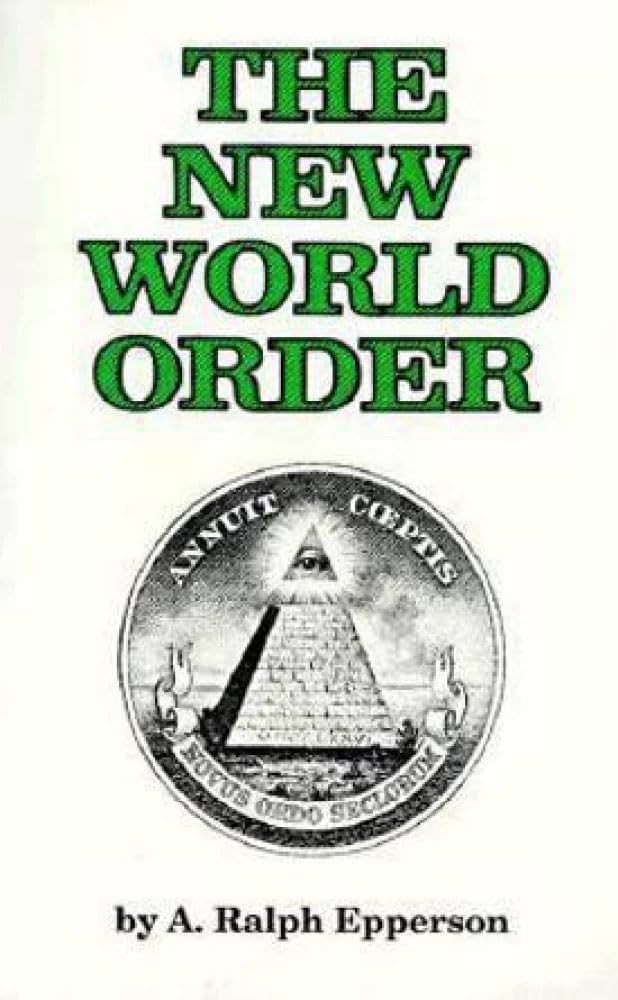
A. Ralph Epperson’s The New World Order Reconsidered.
Epperson was the Prophet who looked in the wrong direction. He was proved to be right but for wrong reasons.
In 1989, the Berlin Wall crumbled and Francis Fukuyama proclaimed “The End of History.” In such a time, a little-known researcher named A. Ralph Epperson published The New World Order, a book that would be dismissed by mainstream critics as paranoid conspiracy theory. Yet viewed from the vantage point of January 2026, Epperson’s work demands serious reconsideration. Not because his conclusions were correct, but because his intuitions were remarkably prescient, even as his analytical framework led him catastrophically astray. We revisit this book as President Trump completes a year in office in his second term and the ‘liberal’ international order fragments into competing civilizational blocs.
The Intuitive Leap
Epperson’s journey began with the Great Seal of the United States, printed on every dollar bill. He spent 27 years studying its symbols like the pyramid, the all-seeing eye, the Latin phrase “Novus Ordo Seclorum.” Where others saw patriotic imagery, Epperson sensed concealed intention. His intuition was right. His suspicion was not entirely baseless.
The Founders of USA were not occultists and they genuinely had an ambitious, transformative vision for America’s role in history. The phrase does mean “New Order of the Ages,” and the Founders did believe they were creating something unprecedented that would reshape the world.
Epperson’s fundamental insight, writing in 1989-1990, was that the end of the Cold War would not bring peace, but would unleash an aggressive project to remake the global order. At a moment when most Americans were celebrating victory, Epperson warned of coming “sea of blood” and predicted that the United States would play “a major role in bringing it to the world.” He foresaw institutional changes that would “erode national sovereignty piece by piece” and anticipated profound cultural transformations targeting “the family, the workplace, and religion.”
This was prophetic. But prophecy and analysis are different things.
The Geopolitical Project
Epperson correctly identified that powerful forces within the American establishment were preparing to use the “unipolar moment” to construct a new global architecture. Within months of his book’s publication, President George H.W. Bush would explicitly use the phrase “new world order” in his September 11, 1990 speech to Congress. The Uruguay Round of GATT negotiations concluded in 1994. It created the World Trade Organization in 1995. This was precisely the kind of supranational institution Epperson warned about.
The violence he predicted materialized with horrifying precision. Brown University’s Costs of War Project documents that post-9/11 wars in Iraq, Afghanistan, Syria, Yemen, and Pakistan killed 4.5 to 4.7 million people between 2001 and 2023. This is the “sea of blood” Epperson warned about was not a metaphor, but a literal tsunami of human death that accompanied America’s attempt to forcibly reshape the Greater Middle East.
The Cultural Revolution
Epperson’s predictions about social transformation have proven equally prescient. His warning that traditional Christianity would be marginalized, that “diversity” would become a quasi-religious principle came true. His correctly warned that established gender and family norms would be radically redefined.
The society materialized in ways he could scarcely have imagined. The rise of what contemporary observers call “woke culture” with its emphasis on perceived oppression of minorities. Systemic transformation of institutions with its quasi-religious fervor, and its aggressive promotion bears an uncanny resemblance to his warnings about a “New Age” ideology. Though he was not right about “manifested through organizations like Masonry” and implemented “through the Church, the Masonic Fraternity and the educational field.”
He was wrong about the mechanism (secret societies) but right about the phenomenon (institutional capture by a transformative secular ideology).
The Timeline
Perhaps most remarkably, Epperson identified the late 1980s through the 1990s as the critical period when this transformation would accelerate, with full implementation expected around 1999. While his millennial prediction failed literally, the period from 1989 to 2008 did witness the zenith of American-led globalization. The WTO was created, NATO was expanded, the Iraq War, and the aggressive promotion of ‘liberal’ values through both economic and military means. But this is where his predictions ceased to be correct.
The Category Error
Epperson’s fatal flaw was not in his observations but in his explanatory framework. Unable to comprehend a powerful secular project, he could only interpret it as religious conspiracy. He saw the rise of post-Christian universalism and concluded it must be ancient Luciferian worship. He observed the missionary zeal of liberal internationalism and decided it was the work of Freemasons and Illuminati rather than graduates of Harvard, Princeton, and the Council on Foreign Relations.
This was a category error of the highest order. The “New World Order” was not a secret project. It was the openly stated foreign policy doctrine of successive American administrations. The “conspirators” were not hidden priests but visible technocrats who published their plans in Foreign Affairs quarterly and debated them in congressional hearings.
Epperson spent 27 years studying the Great Seal’s symbols when he should have been reading the Federalist Papers, studying Wilsonian internationalism, and analyzing the intellectual history of liberal hegemony. The “ancient mysteries” he sought were actually Enlightenment ideals about universal reason, progress, and the perfectibility of human institutions through rational design.
The Religious Obsession
Epperson’s fixation on religion led him to predict a unified world faith under “Lord Maitreya” by 1999. This prediction failed spectacularly. Instead of religious convergence, the 21st century witnessed explosive growth of individual faiths. Reemergence of evangelical Christianity in the Global South, political Islam, Hindu nationalism, and the reassertion of Orthodox Christianity in Russia. The world became more religiously divided, not less.
The “New Age Movement” he feared was never more than a fringe phenomenon in Western consumer culture. It never became the governing ideology of a world state. The real ideological victor, for a time, was not esoteric spirituality but secular technocratic liberalism. It required no mystical initiation ceremonies, only an advanced degree and belief in “evidence-based policy.”
Missing the Real Actors
By focusing on Freemasons, Epperson missed the actual architects like the Bretton Woods institutions, the foreign policy establishment, multinational corporations. The European Union bureaucracy also came into effect. These were not secret societies but openly powerful organizations whose membership rosters were published, whose meetings were reported in newspapers, and whose policy papers were available in libraries.
The tragedy is that many of these organizations shared his goal of fundamental transformation. They simply pursued it through trade agreements, military interventions, and institutional capture rather than occult rituals.
The Irony of History: 2026
The final irony is unfolding as this article is written. The week of January 27, 2026, witnessed the formal completion of the India-EU trade agreement, linking two billion people and creating a $20 trillion economic bloc entirely outside American leadership. Days earlier, China and Canada finalized their own comprehensive partnership. The WTO, once the crown jewel of global governance that Epperson warned about, is now functionally defunct. It remained paralyzed since 2019 when the United States blocked appointments to its Appellate Body.
The “New World Order” Epperson feared has not been defeated by Christian resistance or exposure of occult conspiracies. It has collapsed under the weight of its own contradictions and the resistance of civilizational states pursuing their own interests. China’s Belt and Road Initiative as a counter-system, Russia’s military assertion of sovereignty, India’s strategic autonomy, and the rise of the European Union as an independent pole.
President Trump’s second inauguration on January 20, 2026, symbolized America’s retreat from the universalist project Epperson identified. The ‘liberal’ international order, the actual “New World Order”, fractured not into Orwellian tyranny but into multi-polar competition between distinct civilizational blocs. Each block is fiercely defending its own cultural and economic model.
Epperson was right that an ambitious project existed. He was right about its violence and cultural radicalism. He was right about its timeline. He was catastrophically wrong about its nature, its agents, and its ultimate fate.
Conclusion:
The Artist’s Vision and the Scholar’s Discipline
A. Ralph Epperson possessed what all great artists have: intuition. The capacity to sense patterns that cannot yet be reduced to reason. Looking at the Great Seal in the 1980s, he felt the presence of ambition and ideology. His error was in how he investigated that intuition.
He went backward by seeking answers in ancient Egyptian mysteries. He should have gone forward from 1776, tracing how Enlightenment universalism evolved into Wilsonian idealism. He should have looked into post-World War II liberal hegemony, and the aggressive globalization of the 1990s and 2000s through GATT and WTO. The thread he found was real. He simply wove it into the wrong tapestry.
His book remains valuable not as prophecy but as psychology. It is a raw, unfiltered record of how traditional America experienced the aggressive secularization and globalization of the late 20th century. It captures genuine anxieties about genuine transformations, even as it misdiagnoses their source.
In the end, Epperson was a canary in a coal mine who correctly sensed toxic gas but mistakenly identified it as dragon’s breath. The fumes were real. The violence, the institutional change, the cultural revolution all happened. But they came from the engines of modernity and liberal internationalism, not from altars to Osiris.
As the world of January 2026 fragments into competing civilizational orders, Epperson’s greatest vindication is also his greatest refutation. The project he warned about was real, powerful, and transformative. It was also mortal, vulnerable, and ultimately defeated but not by exposure of ancient conspiracies. It was defeated by the stubborn persistence of nations and cultures unwilling to be dissolved into a universal order. They refused to accept its rational designed or benevolent intention. Time has proved them right.
The boot he warned would stamp on human faces forever has been thrown off by peoples asserting their own particular identities. It did not happen by uncovering hidden symbols on dollar bills.
References:
- New World Order by AA. Ralph Epperson: https://dn790003.ca.archive.org/0/items/TheNewWorldOrder_342/TheNewWorldOrder.pdf
- India-EU trade deal: https://www.pib.gov.in/PressReleasePage.aspx?PRID=2219113®=3&lang=1