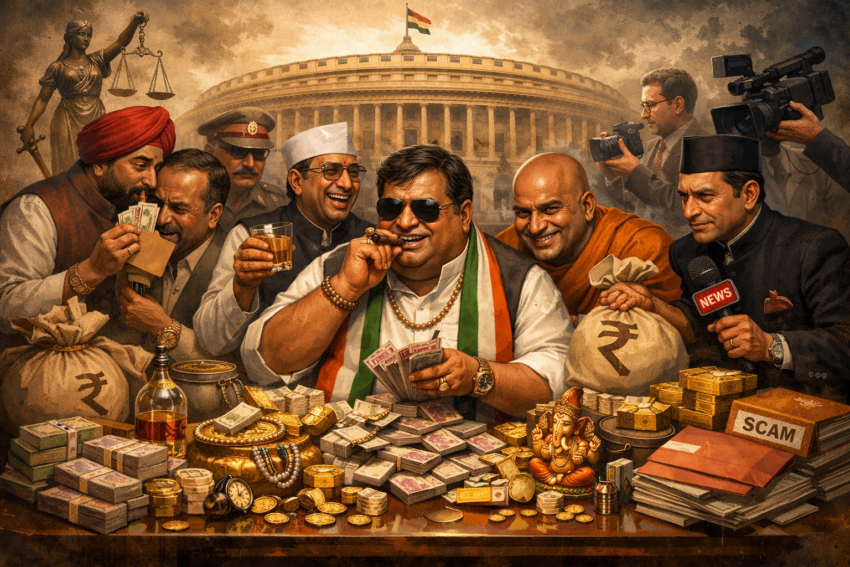
The Conflict of Interest
Chapter 7
When the leadership class i.e. politician is the primary beneficiary of the system it does not want any change. This makes reforms structurally impossible. The challenge to India’s anti-corruption architecture is not its institutional failure. It is the character of the people operating it and seeking to lead it.
In Chapter 6 of this series I had explained the various laws to deal with corruption. It was also shown that historically corruption is not something averse to average citizen. For generations they have survived corrupt invaders ruling over them, by bribing the intermediaries. It was also explained that premier institution to fight corruption, CBI is a caged parrot. Let me explain it through examples:
Examples
Jayalalithaa was convicted of accumulating assets of Rs 66.65 crore disproportionate to her income during her first tenure as Chief Minister from 1991 to 1996, when she famously drew a salary of Re 1 per month. Her declared assets included 2,000 acres of land, 30 kg of gold, and 12,000 saris. The trial lasted eighteen years, was transferred from Tamil Nadu to Karnataka to ensure a fair hearing. Trial saw prosecutors replaced mid-trial, and multiple prosecution witnesses change their depositions after her party returned to power. She died before final sentencing. The case is a monument to how long the system can be stretched before it delivers even one verdict.
Lalu Yadav
Lalu Prasad Yadav is the other name on the convicted list. The Fodder Scam involved embezzlement of approximately Rs 940 crore from the Bihar government treasury. Documents were fabricated through fictitious livestock for which fodder and medicines were claimed. He was convicted in 2017. He has since remained out on bail and medical parole, doing back-door politics while pretending to be politically inactive.
After thirteen years of investigation, the CBI gave clean chits to Mulayam Singh Yadav and his son Akhilesh Yadav in their disproportionate assets case, finding no prima facie evidence of misconduct. Thirteen years to conclude lack of evidence!
The investigation itself is the punishment in India, strategically extended and then quietly buried.
The Abhishek Banerjee episode
In March 2019, Rujira Narula, wife of Trinamool Congress MP Abhishek Banerjee. Abhishek is the nephew of Chief Minister Mamata Banerjee, arrived at Kolkata airport on a Thai Airways flight from Bangkok. Customs officials, suspicious of her baggage after an X-ray, wanted to check her luggage. She resisted the checking. Senior Kolkata Police officers then arrived at the airport and attempted to whisk her away, leading to a direct confrontation between state police and central customs officials.
The Centre told the Supreme Court that customs officials were threatened with an FIR if they did not let the women leave. An FIR was then registered against customs officials based on Rujira’s own complaint. The law enforcement machinery of a state government was deployed at an airport to obstruct central customs officers performing a statutory duty. The Supreme Court issued notice to the West Bengal government, calling the incident very serious, saying it wanted to know what was happening in West Bengal.
The case remains sub-judice to this day. 7 years of masterly inaction.
The affidavit of Wealth
In India, every candidate contesting an election must file an affidavit with the Election Commission declaring their assets. The affidavits are public documents. They regularly show extraordinary wealth accumulated by career politicians who have never held a private sector job, never run a business, and whose declared government salaries over their entire careers would not come close to explaining their declared holdings. The affidavit system was designed as a transparency tool. It has become instead a legalised declaration of what the system tolerates.
The Pattern
Indian politicians charged with corruption are three times as likely to win parliamentary elections as those who are not. That statistic is the verdict on what the public has come to accept. Corruption is not a disqualification in Indian electoral politics. In many constituencies it is a credential. It is a proof that the leader is powerful enough to extract resources from the state for his community.
The political consensus seems to endorse the present system as it enable them to accumulate wealth without earning. Every reform law they pass, is designed to punish a rival when politically necessary, never enough to threaten the class as a whole.
In the next article, Chapter 8, we shall discuss the role of auditors.
References:
- Is India in Governance Crises?: Chapter 1.
- Is India in Governance Crises?: Chapter 2.
- Is India in Governance Crises?: Chapter 3.
- Is India in Governance Crises?: Chapter 4.
- Is India in Governance Crises?: Chapter 5.
- Is India in Governance Crises?: Chapter 6.
- Law of Corruption in India by Sandeep Bhalla (2020):