The Global Conundrum of Caste or Economic Segregation: Chapter 8
Japan is an ancient and continuous civilization. From a distance, we often presume it to be a democratic society like a Western country. But that is far removed from the facts. Japan’s history goes back to thousands of years. We do not know exactly when humans first settled the archipelago. The early settlement is not fully pinned down. But there is sufficient evidence about it for the last about one thousand years. This is gathered from the court diaries, legal codes, temple records, warrior documents, and later official histories.
Historically, it evolved from an agrarian society to a warrior state. Then it moved to an imperial state. Finally, it returned to periods of warrior domination under Imperial overlordship.
The power structure of Japan is often referred to as the seat of power. Japan did not always have one fixed capital in the modern sense. Therefore, period names often reflect where power was centered. When a powerful Emperor ruled from Kyoto, it became the Kyoto period. When a powerful shogun ruled from Edo, it became the Edo period.
Imperial Democracy
Today Japan is an Imperial democracy with an elected Parliament and a Prime Minister answerable to it. The emperor merely reigns and does not rule. The West likes to call it a Democratic Monarchy on British lines. But that is their bias. The Constitution of Japan specifically refers to an Emperor. Therefore, it is an Imperial Democracy.
The British use the word Monarch. Hence, it is called a Constitutional Monarchy (without even any Constitution). When the constitution of Japan uses the word emperor, it will be an Imperial democracy.
Historically, Japan did not have a modern centralized national army for most of that time. Instead, military force was organized through regional warrior elites. These included samurai, retainers, and daimyō. They controlled land, collected revenue, and raised troops when needed. Administration was also often decentralized. Local warriors and domain lords handled taxation, land control, policing, and war preparation.
The Emperor remained the formal sovereign for much of the pre-1868 period. A shogun was Japan’s top military ruler. He wielded the real military and political power.
For people from India, there is no real comparison. A distant loose comparison can be made with the Maratha Empire. This is with its military commander holding the title of Peshwa. Both wielded power, often yielding to one another.1
Japan was usually a highly hierarchical society. It was not a debating society in the modern democratic sense. Village assemblies, local customary authority, and temple networks played real roles. Domain administration, merchant guilds, and warrior households also participated, depending on the period.
Japan’s premodern order was more hierarchical and warrior-centered. Meanwhile, India had a wider variety of political forms. These included local, regional, and republican forms across different periods. But neither civilization was static. Both developed institutions of governance beyond a single central ruler.
To understand how successfully hereditary hierarchies adapt to modern democratic transformations, we must look deeper.
The Edo Period
Edo (meaning “estuary”) was the former name of Tokyo. Before the 17th century, it was a relatively small fishing village. Its destiny changed in 1603. Tokugawa Ieyasu, the first shogun of the Tokugawa dynasty, chose it as his base of power.
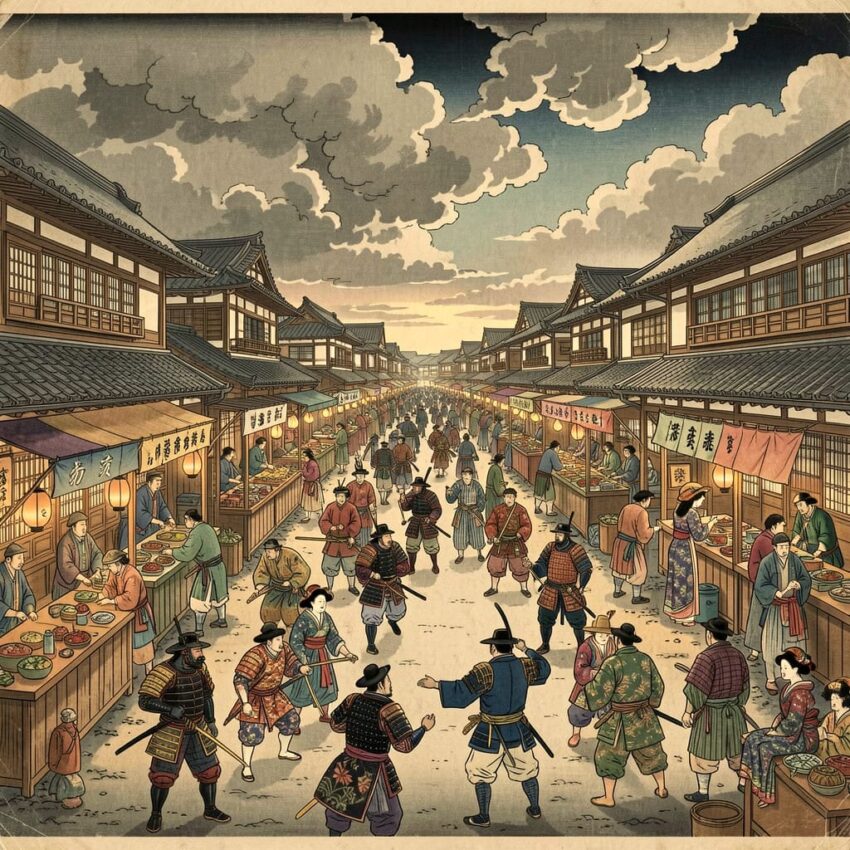
During the Edo period from 1603 to 1868, Japanese society was governed under the Shi-nō-kō-shō (士農工商) system.2 This was a highly rigid, legally enforced social pyramid. The Tokugawa shogunate established it to maintain absolute political control.3
                        THE TOKUGAWA FEUDAL PYRAMID
      [1. Samurai (Shi)]   ──> Warrior-administrators (Held the swords & power)
      [2. Peasants (Nō)]   ──> Rice-growers (Nourishers, legally bound to soil)
      [3. Artisans (Kō)]   ──> Skilled craftsmen (Utilitarian makers)
      [4. Merchants (Shō)] ──> Wealthy traders (Parasites, socially degraded)
               =======================================
      [OUTCASTS: Eta / Hinin (Burakumin)] ──> "Polluted" (Dalits of Japan)
It is called the four-way structure as the outcast had no power or sway over others. They were at the bottom of the pyramid below common citizens.
The Samurai (士 – Shi)
They sat at the absolute apex of the pyramid. The Samurai were not merely sword-wielding warriors. They were the government administrators, the judiciary, and the military police all rolled into one. They possessed exclusive, legal privileges that separated them from the rest of the population. For example, they were the only class permitted to carry swords in public. They could also use family surnames, ride horses, and receive direct rice stipends. They could also provide private security if needed. Remember the movie Seven Samurai by Akira Kurosawa.4 Do watch it to view a good picture of Samurai and their privilege to eat rice. It shows the Peasants’ obligation to provide it.
The Peasants (農 – Nō)
Peasants are next in the hierarchy. Under the influence of Neo-Confucian philosophy, farmers were theoretically elevated as “those who nourish all.” This was because their labor produced the rice that literally powered the economy. In reality, they lived in grueling poverty. They were legally bound to their designated fields. They had no freedom of movement, no career choices, and faced a complete prohibition on weapon ownership.
The Artisans (工 – Kō)
Artisans were the skilled craftsmen who manufactured swords, silk, lacquerware, and household tools. Artisans were valued for their technical skills. However, they were considered less essential than the food-producing peasantry. This position somewhat resembled the industrialists in socialist systems. Consequently, they were restricted to the designated castle towns under close government supervision.
The Merchants (商 – Shō)
Merchants occupied the bottom of the hierarchy. This may appear incredulous as they were frequently the wealthiest class in Japan. Neo-Confucian ethics viewed commerce with deep moral suspicion. They branded merchants as “parasites.” These parasites accumulated wealth from the labor of others without producing physical goods.
This hierarchy was designed to prevent economic wealth from challenging established political power. The Tokugawa Shogun kept wealthy merchants socially degraded. Meanwhile, the military Samurai remained politically supreme. This division prevented the rise of a merchant-led power usurpation. But the Dalits of Japan were the worst off.
Eta, Hinin, and Burakumin
The name Burakumin comes from buraku, meaning hamlet or village. But modern Burakumin are not a separate village population. These were the Eta (穢多, meaning “abundant filth”) and the Hinin (非人, meaning “non-human”). These groups were subjected to physical and social untouchability.5 Today, Burakumin is mainly a historically derived social label. It is rooted in older geography and settlement patterns. This represents the outcasts in Japanese society. The system closely mirrors the historical oppression of untouchables in India:
Polluting Vocations: The hereditary professions of butchering animals, tanning leather, and executing criminals were considered polluting. Handling graves and clearing sewage were also polluting vocations.6 These related to Buddhist and Shinto concepts of death and blood. The people engaged in them were treated as outcasts. The rest of society used them professionally but did not interact with them at a social level.
Absolute Spatial Segregation: The Burakumin were legally barred from living in mainstream neighborhoods. They were forced into isolated, designated hamlets. They could not enter the homes of the four main classes. Nor could they share their food or wells. They were not permitted to intermarry with other castes under any circumstances.
The Meiji Restoration: In 1871, the Meiji government passed the Emancipation Edict (Kaihorai).7 This officially abolished these outcast statuses and declared them equals under the law. The law did not change the social status on the ground, and it is the same today.
Emancipation of Outcast
The legal emancipation did not dissolve centuries of deep-seated social prejudice. Today, the descendants of these outcasts are also known as Burakumin (部落民). They represent roughly 1% to 2.5% of Japan’s modern population. This is approximately 1.5 to 3 million people. Even in modern and contemporary Japan, Burakumin descendants face systematic, informal discrimination:
Matrimonial Investigations: Families routinely hire private investigators to conduct background checks. These are koseki checks on prospective brides and grooms.8 They ensure they do not have Burakumin ancestry.9 The wedding is called off if a Burakumin connection is found.
Employment Gatekeeping: Multi-national Japanese corporations have historically compiled and circulated secret directories of Burakumin neighborhoods.10 They quietly filter out job applicants whose residential registries match these locations.
The Burakumin stand as living proof of a profound civilizational truth. A society can legally abolish untouchability and implement modern democratic education. However, the informal structures of hereditary exclusion will persist. This happens as long as the community maintains the underlying lineage database.
The Kazoku and Reforms
Following the Meiji Restoration of 1868, the shogunate collapsed. The new government officially abolished the four-tier system. They stripped the Samurai of their swords and stipends. The new government established a new, European-style peerage system called the Kazoku (華族). This merged former feudal lords (Daimyō) with traditional imperial court aristocrats.
This formal aristocracy was legally dismantled in 1947 under Japan’s post-war, American-drafted constitution. The new laws eradicated all hereditary titles and peerage privileges.
Rise of Zaibatsu Corporate Dynasties
In Chapter 4 we had seen how the British elite caste became corporate and business moguls. Similarly, the Japanese nobility or elite did not vanish. They successfully converted their historical feudal prestige into modern economic capital.
                  THE TRANSFORMATION OF JAPANESE ELITES
  [Feudal Samurai / Daimyō Privilege] ──> [Zaibatsu Corporate Conglomerates]
  - Concentrated land & royal patronage     - Mitsui Family (Samurai to Global Bank)
  - Exclusive administrative networks       - Shimazu Family (Feudal Lord to Tourism/Media)
  - Controlled regional resources           - Maeda Family (Daimyō to Real Estate)
The Mitsui Family
The Mitsui family was originally a prominent Samurai lineage. They successfully transitioned into commerce during the late Edo period. Following the restoration, they leveraged their immense capital. They built one of the “Big Four” Zaibatsu (corporate conglomerates) that powered Japan’s industrialization. Today, the Mitsui Group remains a multi-billion dollar global empire. Their family name opens elite doors worldwide.
The Shimazu Family
They were the former hereditary rulers of the powerful Satsuma domain. Following the abolition of their feudal rights, they systematically reinvested their vast estates. They put capital into heritage tourism, real estate, and modern media groups. This preserved their regional economic and cultural supremacy in Kagoshima.
The Maeda Family
The Maeda family was the former ruler of the Kanazawa domain. They transformed their historic castles and private gardens, including Kenrokuen Garden. They made these into lucrative public heritage sites, retaining immense cultural prestige and commercial revenues.
These are just a few examples. A deeper research will yield more such families of former elites who transformed into modern business corporations.
Conclusion
The Persistent Shadow of the Feudal Pyramid.
Japan’s social evolution stands as a brilliant case study in the resilience of hereditary hierarchy. Casual Western observers look at modern Japan and see a hyper-advanced, technological, and egalitarian society. Yet, the structural shadow of the Edo period lurks underneath the society. It lingers beneath the glittering neon lights of Tokyo and the high-speed transit networks:
The descendants of the Samurai and Daimyō occupy the highest echelons of power. They leverage inherited social networks in corporate, diplomatic, and political spheres. This is the natural result of centuries of accumulated generational advantages. These transformed seamlessly from military swords into modern corporate shares.
The descendants of the Burakumin struggle against quiet, informal barriers in marriage and employment. They remain confined to the margins of social visibility. If someone disputes this, ask for the name of one such person. Ask for a descendant of Burakumin in a political office or corporate boardroom.
Japan legally deleted the feudal pyramid, but it preserved the networks. As long as those exclusive networks remain intact, the ancient divisions continue. The Shi-nō-kō-shō system will quietly govern the modern democratic state.
The next chapter explores the transition of caste from Confucian Mandarins to Communist Cadres in China.
References:
All articles on The Global Conundrum of Caste or Economic Segregation
-
The Bajirao Peshwa was the most successful commander ever in human history. The Western epistemology would refuse to admit this fact. But the Bajirao Peshwa never lost a war in his lifetime. Therefore, he was the most powerful as well. ↩
1 thought on “Japan: Feudal Pyramids and the Burakumin Outcasts”