Chapter 3
This was the question I had posed a few months back (in Chapter 1):
If the bureaucracy, police, regulators, and enforcement apparatus are internally sabotaging the elected government, is this still a democracy? Or has it become a permanent state that tolerates elections but ensures elected governments cannot actually govern?
This was articulated as Paralysis in Governance of India. There, it was reviewed that Government of India is in a weak position to govern and deliver results. Its delivery is limited to projects which did not rely on the existing infrastructure and acted through the new digital stack. For grave political questions the government is in image crises. It Can’t stop crop burning because it is anti-farmer. It can’t regulate monopolies as it is anti-business. It cant protect Hindu festivals from rioters as that is communal. It can’t enforce environmental law to ensure clean air as that is fascist. The result? A government that won elections but lost the ability to govern.
In same pattern of failure to govern arose the recent LPG gas crises during the Iran war and strait of Hormuz crises which is discussed and analyzed in detail here. It demonstrates a ten days paralysis on this issue, in governance.
On deeper analysis it appears that there is systemic rot which government has, at present, no plan to deal with. The problem is bureaucracy has too much to do except their own jobs and without any accountability or oversight. To use the Americans phrase, every government just kicks the can down the road and hope to deal with on a later date. The inference therefore is:
Has Government of India surrendered before bureaucracy?
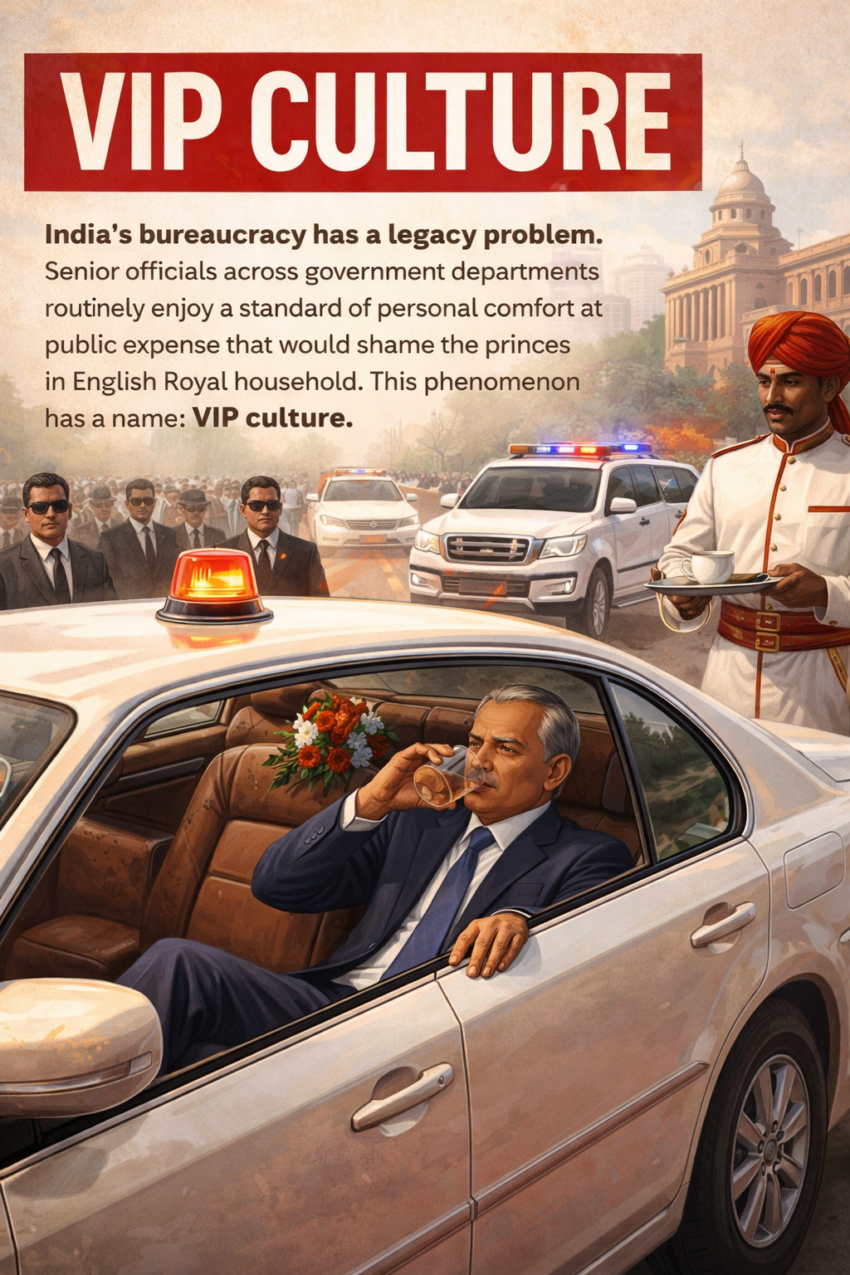
India’s VIP Culture
India’s bureaucracy has a legacy problem. Senior officials across government departments routinely enjoy a standard of personal comfort at public expense that would, shame the princes in English Royal household. This phenomenon has a name: VIP culture. It is not a collection of isolated incidents. It is a self-reinforcing system in which rank automatically converts public resources into private entitlements.
Corruption, as commonly understood, involves illegal payments or the abuse of specific laws. VIP culture is different. It operates largely within the law, or in the gaps the law leaves open. It is not prosecutable. It is normalised. The entire system functions within a legal grey zone that was never addressed because the people with the power to address it are the people who benefit from it. Judges, Bureaucrats and Politicians, all benefit from it, directly or indirectly.
This chapter examines this VIP culture through example of real cases that are drawn from public record and personal knowledge. Each case illustrates a different dimension of the same problem. Taken together, they reveal not individual misconduct but a structural failure that has survived every government and every reform promise since Independence.
The BSNL Protocol Leak
Bharat Sanchar Nigam Limited (BSNL) is a loss making India’s state-owned telecom company. In February 2026, an internal document from BSNL leaked and went viral on social media. The document was a protocol prepared for a two-day official visit to Prayagraj by Vivek Bansal, a Director-level officer at BSNL. It had been issued from the PGMT office in Prayagraj and signed by a Deputy General Manager.
The protocol listed elaborate arrangements for the visit. Around fifty officials were to be deployed to manage logistics. The document also specified that personal comfort items be arranged for the visiting officer, including soap, oil, shampoo, a comb, and underwear. These items were to be sourced and kept ready at public expense.
The document went viral because it read like a caricature. Deploying fifty government employees to manage the arrival of one officer, and using public funds to stock his personal toiletries, struck the public as a grotesque misuse of a government body already struggling financially. BSNL has required multiple taxpayer-funded bailouts over the years. Spending public money on a senior officer’s bath kit in that context was a provocation.
The Official Response
The Union Communications Minister, Jyotiraditya Scindia, called the arrangements improper, unacceptable and shocking. The Centre issued Vivek Bansal a show-cause notice asking him to explain the protocol within seven days. The planned visit was cancelled. BSNL’s Public Relations Officer confirmed the earlier protocol was null and void. The DGM who had signed the protocol was transferred.
The official response was swift and loud. But it was also selective. The BSNL protocol leaked by accident. Hundreds of similar arrangements across government departments and public-sector units never leak. Show-cause notices and ministerial outrage are not reform instruments; they are narrative instruments. They manage public perception without dismantling the underlying system. The officer who was punished was not exceptional in his demands. He was exceptional only in having his demands written down and circulated.
There was no public inquiry to find the existence of such protocols in every government department. There was no need. It is a secret that public knows but the government and its minister do not know.
Accountability activated not because the conduct was unusual, but because it became visible.
The Loofah that Was Not Ordered
The joke on social media was,: “at least they did not order a loofah for him“. It was a dark humour. Protocols entitled the officers to list any number of luxuries but someone exercise restraint. But if one looked carefully, a proverbial loofah could also be found.
The baseline of acceptable official hospitality now already include soap, oil, shampoo, a comb, and underwear at public expense. The absence of one more item becomes the evidence of austerity. The bureaucratic mindset show that an absurd list of demands is seen by them as ordinary, even moderate.
It means that internal controls, norms, and peer accountability within the bureaucracy have failed completely in this domain. No one at the DGM level who signed that protocol felt they were doing something unusual. They were following precedent. The precedent itself is the problem, and it is invisible from inside the system.
Dog Walking in Thyagraj Stadium
Thyagraj Stadium in Delhi is a government-run sports facility used by athletes and coaches. In 2022, it was being closed earlier than its scheduled hours in the evenings. Athletes and coaches alleged that they were being asked to vacate the ground by around 7 pm, well before the normal closing time.
Why? This was done to meet the whim of an IAS officer of 1994 batch. That man was Sanjeev Khirwar, from the AGMUT cadre who was serving as Delhi’s Principal Secretary for Revenue. The stadium was being cleared so that he could walk his dog on the running track.
This was not a one-time lapse. It was a regular arrangement. Athletes training for competitions were displaced and evening practice schedules were disrupted. Yet no one in the system found this arrangement absurd enough to resist, until it became public.
The priority of a Government officer was to use a public space to walk his dog. It was nothing short of misappropriation of public property for a few hours every day. Yet the response was a meek transfer.
Once this arrangement was highlighted in media, the Delhi government ordered all state-run sports stadiums to remain open for athletes until 10 pm. The Ministry of Home Affairs transferred Khirwar out of Delhi to Ladakh. His wife, Rinku Dugga, also an IAS officer, was transferred to Arunachal Pradesh.
Back to Future
As stated, nothing meaningful happened. Perhaps the officer went on long leave after joining in Ladakh or served there from State Guest House for few years. In early 2026, Sanjeev Khirwar was reappointed as Commissioner of the Municipal Corporation of Delhi. The outrage of 2022 had passed.
The cadre network and seniority protections of the IAS had quietly reasserted themselves. The transfer to Ladakh was the optics of accountability. The MCD appointment was the system returning to its default.
It is well settled in law that the transfer is not a punishment. It was proved by action. Transfer was temporary. The network was permanent.
The Khirwar arc is perhaps the most blatant illustration of how VIP culture sustains itself. It does not need to defeat accountability. It only needs to outlast it.
Clubs, Schools, and Quiet Entitlements
The Gymkhana model
Delhi’s elite clubs, particularly those on government land or with government-category memberships, operate on a formal membership system. On paper, the rules apply to everyone. In practice, government officers, judges, and senior officials access these clubs at highly subsidised rates, with shorter waitlists or legacy categories that were never designed to be scrutinised. Private citizens, regardless of income, face multi-year or multi-decade waitlists and full commercial rates.
This is VIP culture in its quietest and most durable form. It is buried in bylaws and legacy categories. It generates no protocol document that can be leaked. It is defended as ‘tradition.’ And it operates continuously, without interruption, across every government in power.
The Institute
As if that were not enough, the posh Chankyapuri has IAS officers club but it called by another name. It is called Civil Services Officers Institute (CSOI) situated at Vinay Marg. Vinay means humble but visit it and one can see that it is anything but humble. It has everything from a huge bar to a theatre to sports an everything that any club has. Perhaps they skipped the card room to keep its status as “Institute.” It is managed by Governing Council chaired by Cabinet Secretary. The man who helps the Prime Minister to run the country.
If you still do not agree on luxuries of “Institute”, visit the Army Club at Dhoula Kuan and see it from inside. When compared to the “Institute”, Army Club looks like College Canteen.
School Admissions
Delhi’s nursery and primary school admissions system uses a formal points structure: distance, siblings, and other criteria determine priority. The system exists on paper. But in elite institutions on government land, or in schools with strong political connections, networks and recommendations routinely operate alongside the formal system. Families connected to the bureaucracy and political class navigate the queue with advantages that never appear in any document.
The same families that benefit from protocol arrangements, club access, and stadium privileges also tend to find their children in prime schools. The entitlement is not limited to one domain. It travels across every public resource their rank can reach.
The BSNL protocol went viral because it was written down. The Thyagraj stadium story spread because athletes spoke up. But the club memberships and school admissions networks leave no paper trail. They are more powerful, more durable, and more pervasive than anything that has ever appeared in a show-cause notice. The visible cases are the exception. The invisible ones are the rule.
The Discretion
Every episode described above is fuelled by same administrative discretion exercised by rank. Formal rules exist in every domain. Stadium usage schedules, school admission criteria, club membership bylaws, and official visit protocols are all documented. But rank allows discretion to bend each rule without formally breaking it. A verbal instruction clears a stadium. A phone call adjusts a school queue. A DGM signs a protocol because he is expected to. The rules are decorative. Discretion is structural.
The colonial inheritance
India’s administrative framework was inherited from the British colonial state. That state was explicitly designed to govern a subject population from a position of elevated, unquestioned authority. The Indian Civil Service became the Indian Administrative Service, but the architecture carried over: discretionary power, security of tenure, cadre loyalty, and rank-based privilege. The tools of colonial authority were transferred to the new ruling class without being dismantled or redesigned.
Post-independence governments found the structure useful. It concentrated authority efficiently. It rewarded loyalty. It consolidated power among the loyal.
The cost was a system in which the state’s own officers were systematically insulated from the accountability norms applied to ordinary citizens.
VIP culture does not require lawbreaking. It requires only the absence of accountability norms strong enough to reach it.
References:
BSNL Protocol Leak
- https://indianpsu.com/bsnl-director-vivek-banjal-prayagraj-visit-cancelled-protocol-row/
- https://www.republicworld.com/india/improper-shocking-unacceptable-centre-issues-show-cause-notice-to-bsnl-director-over-viral-royal-protocol-circular
- https://www.indiatvnews.com/news/india/govt-calls-bsnl-director-visit-demands-absurd-shocking-and-unacceptable-issues-show-cause-notice-latest-updates-2026-02-25-1031644
- https://www.deccanherald.com/india/hair-oil-to-underwear-bsnl-calls-off-directors-trip-to-prayagraj-after-snaan-kits-order-goes-viral-3911216
Thyagraj Stadium and MCD Reinstatement
- https://www.businesstoday.in/india/story/ias-officer-transferred-for-emptying-stadium-to-walk-his-dog-returns-as-delhis-new-mcd-commissioner-512257-2026-01-22
- https://www.theweek.in/news/india/2026/01/22/who-is-sanjeev-khirwar-the-ias-officer-transferred-after-dog-walking-row-now-leading-delhi-s-mcd.html
- https://thefederal.com/category/states/north/delhi/ias-officer-sanjeev-khirwar-delhi-stadium-walk-dog-mcd-commissioner-226408
P.S.: Rinku Dugga, IAS, wife of Sanjeev Khirwar, was subsequently compulsorily retired under Fundamental Rule 56(j) following an assessment of her service record. Khirwar himself was reappointed as MCD Commissioner in January 2026. The divergence in outcomes was not publicly explained.