Appointment of Retired Judges at Sittings of High Courts.
The Supreme Court Collegium has recommended the appointment of five retired judges as ad hoc Judges of the Allahabad High Court for a period of two years. The decision was taken on 3rd February 2026. The five retired judges whom the Supreme Court Collegium has recommended to be appointed as ad hoc judges of the Allahabad High Court under Article 224-A are:
- Justice Mohd. Faiz Alam Khan
- Justice Mohd. Aslam
- Justice Syed Aftab Husain Rizvi
- Justice Renu Agarwal
- Justice Jyotsna Sharma
The decision sets a dangerous precedent and is wrong for multiple reasons. The first relate to the tenure itself.
Two Year Tenure
Four out of the five judges being recalled under Article 224-A did not serve even two full years as regular High Court judges. Only Mohd. Faiz Alam Khan served for 7 years. He joined the High Court on 22 Nov 2018 and was made permanent in Nov 2020. He retired on 25 Jan 2025. See for yourself:
| Judge | Date of Elevation to High Court | Date of Retirement |
|---|---|---|
| Mohd. Faiz Alam Khan | 22 November 2018 | 25 January 2025 |
| Mohd. Aslam | 25 March 2021 | 14 January 2023 |
| Syed Aftab Husain Rizvi | 25 March 2021 | 13 April 2024 |
| Renu Agarwal | 15 August 2022 | 21 June 2024 |
| Jyotsna Sharma | 15 August 2022 | June 2024 |
All other four retired judges had a tenure for less than 2 years. The appointment of judges is made on the recommendation of Collegium. Is the decision of 3rd February 2026 an indication that the earlier Collegium committed a mistake in not appointing these ‘exceptional’ judges early?
Thus, the judges who served less than 2 years on bench as regular judges will serve 2 years on the bench as ad hoc judges. This is extraordinary. But why?
Unfortunately we will never find out as the reasons of the decision of the Supreme Court Collegium are never shared with public. Non-transparency is the decision of the Supreme Court. Now the second problem.
Diversity Hiring
As is apparent from the names it is a diversity hiring aimed at fixing the under representation of identities of Muslims and Women on the bar.
The Allahabad High Court’s sanctioned strength is 160 judges (120 permanent + 40 additional). The court currently has about 109–110 judges in office. From a casual search I found out the following five women judges:
- Nand Prabha Shukla
- Garima Prashad
- Swarupama Chaturvedi
- Vani Ranjan Agrawal
- Sangeeta Chandra
Thus, there are women judges at the court, even if their numbers are low relative to the total. There must be at least one third women judges. Appointment of 2 more women judges does not change the picture. This is a problem which can not be solved by ad hoc appointment.
Similarly there are at least five Muslim judges namely:
- Abdul Shahid,
- Irshad Ali,
- J.J. Munir,
- Abdul Moin,
- Syed Qamar Hasan Rizvi,
- Zafeer Ahmed
Is that a small number? Should it be more? These are the hard facts:
Muslims are second majority in India with population of 15% of the total population of India. Literacy rates among Muslims lags behind the average for the entire population but it is improving. However, their representation in High Education has severe problem. In the year 2021-22 out of slightly over 43 million students in higher education just over 2 million Muslims students opted for higher education. That is less than 5%. This is way below India’s overall Gross Enrolment Ratio (GER) with average of 24.1%.
Therefore even on the principle of diversity hiring, the ad hoc appointment does not meet hard facts. With six judges out of 110 judges, Muslims are adequately represented. But just 6 women judges in a society where women constitute about half the population is gross under representation.
Women literacy rates have improved significantly from 66% in 2011 to about 80% recently but slightly behind 85% litracy among males. But when it comes to higher education they are adequately represented. Out of 43 million students in higher education over 20 million are women.
The High Court already has Muslim judges (men) and women judges (non-Muslim). The intersection (Muslim women) is currently unrepresented. What Allahbad High Court required was at least 3 Muslim women judges and they are available in Judicial Service and Bar of Uttar Pradesh. The future appointments can take care of that.
If, and that is a big ‘if’, diversity hiring is permissible under article 224-A the appointment should have been of only women judges. Male Muslims are already adequately represented. Now let us look at the Article 224-A, which is as under:
Notwithstanding anything in this Chapter, the Chief Justice of a High Court may at any time, with the previous consent of the President, request any person who has held the office of a Judge of that Court or of any other High Court to sit and act as a Judge of the High Court for that State, and every such person so requested shall, while so sitting and acting, be entitled to such allowances as the President may by order determine and shall have all the jurisdiction, powers and privileges of, but shall not otherwise be deemed to be, a Judge of that High Court.
It allows a retired High Court judge to be temporarily brought back only to sit, not to hold office again in the full sense. Such a judge is entitled to allowances, but does not become a permanent or additional judge. He or she merely “sits and acts” for a limited purpose and duration.
The text refers only to requesting a retired judge to “sit and act”. It does not speak to demographic composition or corrective representation. Representation concerns have to be addressed in regular appointments under Article 217.
The Collegium has therefore exercised the power for an objective which is alien to the provision of the constitution. But does the Supreme Court Collegium has the power at all?
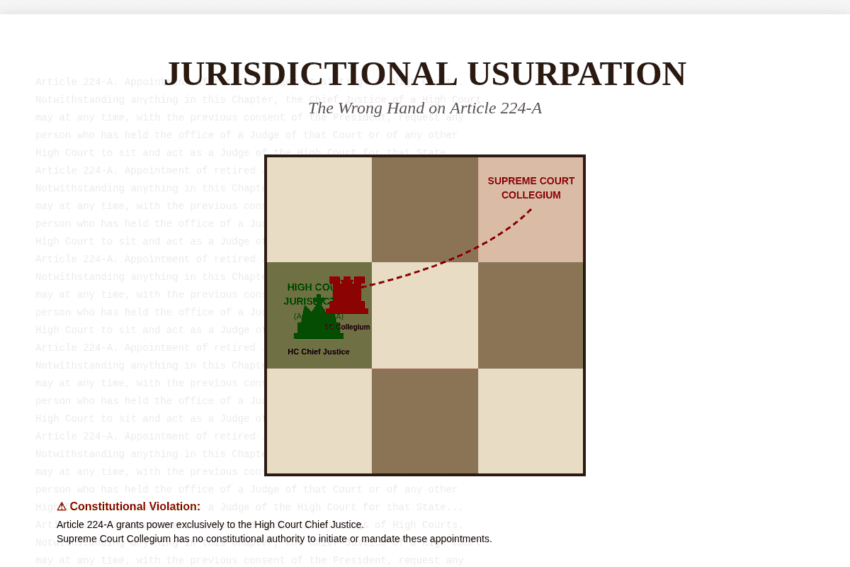
Jurisdictional Usurpation
The Collegium of judges of Supreme Court, is not a constitutional authority per se. It is a judge-made consultative mechanism derived from interpretation of Articles 124 and 217. Its legitimacy is confined to appointments where the Constitution itself contemplates Supreme Court consultation.
The Chief Justice of a High Court is not subordinate to the Chief Justice of India in administrative or constitutional matters. There is no vertical command structure. The relationship is one of constitutional parity within distinct jurisdictions, not hierarchy. Any practice in which the Supreme Court directs, pre-decides, or effectively compels a High Court Chief Justice to “request” particular retired judges collapses that parity.
The only constitutionally valid pathway would be:
- The High Court Chief Justice, after independently assessing need of court and utility of a judge, decides to invoke Article 224-A.
- He or she identifies specific retired judges, based on performance and necessity.
- The proposal goes to the President for consent.
- The Supreme Court has no initiating or substituting role.
Anything else is not “coordination”. It is constitutional overreach dressed up as collegiality. Supreme Court has no jurisdiction to pass the resolution, it has chosen to pass. When law provides a manner to perform a power it must be performed in that manner or not at all, is a settled constitutional principle. Note the following maxim:
Quando aliquid prohibetur ex directo, prohibetur et per obliquum
If a statute or the Constitution confers a power, andlays down the authority who may exercise it, and prescribes the manner and purpose of its exercise,then any deviation is not an irregularity, it is illegality.
Article 224-A is not vague. It does not say “judicial authorities may decide”. It does not say “the Supreme Court may coordinate”. It says the Chief Justice of the High Court may request. That single sentence fixes the actor, the method, and the nature of the act. The moment someone else designs the outcome and merely routes it through the High Court Chief Justice, the constitutional condition is already violated. At that point, even good intentions are irrelevant.
Track Record of Judges
The proposed five judges do not have any standout record of rapid or efficient disposal. They were not known as docket-clearing judges. Some were, with respect, mediocre. When a decision-maker claims urgency and then ignores the very metric that defines urgency, the decision collapses under Wednesbury scrutiny. Even worse, the Collegium never explains why these five.
There are many retired judges who could have plausibly satisfied a backlog-reduction rationale. The judges with far stronger disposal records, reputations for discipline, and administrative competence. The absence of any comparative reasoning raises the unavoidable inference that non-performance criteria dominated the selection.
Article 224-A was never meant to be a shadow diversity mechanism, nor a post-retirement placement tool. Using it that way is not only arbitrary; it is constitutionally dishonest, because it smuggles a value judgment through a provision that does not permit it. It is a colourable exercise of power.
Legislative Background
Article 224-A was not part of the original Constitution of 1950. It was inserted later by the Constitution (Fifteenth Amendment) Act, 1963. The government in power at that time was the Indian National Congress government led by Prime Minister Jawaharlal Nehru. Though Nehru died in May 1964, the amendment process began earlier continued and was passed by Parliament.
In the early 1960s, some High Courts faced temporary shortages because judges retired at a fixed age and the replacements took time. There was also a sudden spikes in workload occurred due to reorganisation of states and legal transitions. The idea was not systemic backlog and certainly not representational correction. It was closer to an emergency stop-gap:
“If, for a short period, a court is short-handed, can we request an experienced retired judge to help clear specific work?”
Parliamentary debates around the Fifteenth Amendment make it clear that this was conceived as an exceptional, sparingly used power, meant to preserve continuity and avoid paralysis. It was not meant to create a parallel recruitment system.
Thus, the scope of Article 224-A is very limited. It is a supplementary tool to deal with severe backlogs or temporary shortfalls in judicial strength. It does not bypass regular appointments.
Wednesbury Arbitrariness
The decision of Collegium suffers from classic Wednesbury unreasonableness. It ignores relevant considerations (performance, efficiency) considers irrelevant considerations of diversity (identity representation). Thus, it exercises discretion for an improper purpose. It usurps the power of Chief Justice of High Court.
The President of India should ignore this resolution as non est.
Reference:
- Statement of Collegium: https://cdn.s3waas.gov.in/s3ec0490f1f4972d133619a60c30f3559e/uploads/2026/02/2026020353.pdf
- Law Trend: https://lawtrend.in/historic-first-supreme-court-collegium-invokes-article-224-a-to-appoint-5-retired-judges-to-allahabad-high-court/
- Bar and Bench: https://www.barandbench.com/news/collegium-invokes-article-224a-recommends-5-ex-judges-as-ad-hoc-judges-of-allahabad-hc
- List of Judges in Allahabad High Court: https://www.allahabadhighcourt.in/service/judgeListSeni.jsp
- Muslim Graduates in India: https://kashmirlife.net/in-43-26-million-higher-education-enrolments-in-india-only-4-87-percent-are-muslims-aishe-376399/
- Muslims at the bottom of education ladder: https://www.indiaspend.com/muslims-at-bottom-of-higher-education-ladder-alongside-backward-tribes-28385
- Supreme Court Decision: State of Uttar Pradesh v. Singhara Singh (1954)
- Associated Provincial Picture Houses Ltd. v. Wednesbury Corporation (1948) 1 KB 223 (Court of Appeal)
- Tata Cellular v. Union of India, (1994) 6 SCC 651.
- State of Uttar Pradesh v. Renusagar Power Co., (1988) 4 SCC 59