Rebuilding West Bengal from Ashes. Will the Phoenix Rise?
(Chapter 6)
West Bengal election results have been announced on 4th May 2026. BJP won 206 seats and TMC won 81 seats. The day ended with BJP supporters celebrating with distribution of sweets. They applied colors on each other, as if it was Holi. The threats given by Abhishek Benerjee fizzled out. TMC workers are silent. So far there is peace if not calm.
Journalist Dheerendra Pundeer is in Kolkata for two weeks but he was not getting clear responses from people. People sometimes talked off camera but nothing on camera. Today people are talking to him on camera. Their talks about corruption and hooligans of TMC signify end of an era. The era of terror. The era of Mamata and its TMC.
The Morning After
Election verdicts are only the beginnings. The question of winning of BJP is secondary. The harder question is what comes after the counting, after the CAPF and armored vehicles return to Kashmir and Manipur, after the Observer Monitoring Cell packs up its screens, after the martial law that was not called martial law quietly withdraws. Bengal has been here before.
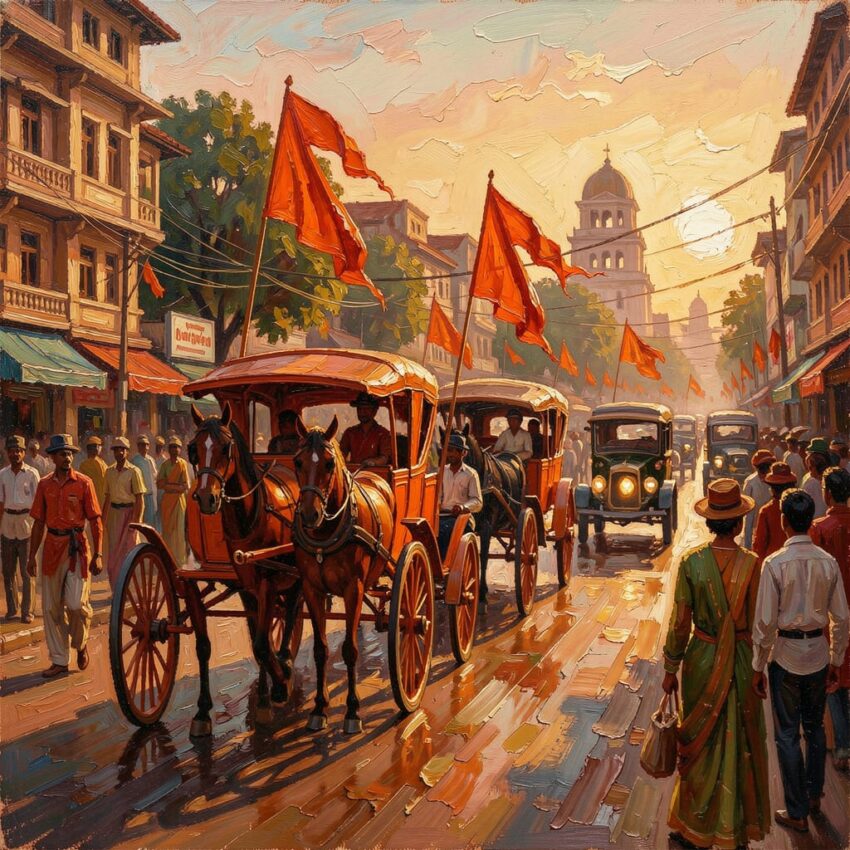
Chowringhee was built to mirror Piccadilly. It was built at that scale because someone believed Calcutta would become what London was. That belief was not wrong about the city’s potential. It was wrong about the century. The British left. The Left arrived. Then Mamata. The potential has been waiting inside the bones of that Victorian boulevard for longer than independent India has existed.
The Abdali Question
There is a Punjabi saying: ‘Khada peeta apna baki sab Abdali da’. What you have eaten and drunk is yours. The rest belongs to Abdali.
Ahmad Shah Abdali raided Punjab eight times in the eighteenth century. The peasant who hid his grain and spent his savings before Abdali arrived was not being irrational. He was being accurate. Accumulation was an invitation to plunder. The rational response to a permanent predator is to not accumulate visibly.
West Bengal has had its own Abdali for fifty years. First the CPM syndicate taxed every productive enterprise at the booth level. Then Mamata’s operators did the same with more personal violence and less ideological justification.
The jewelry workers left for Zaveri Bazaar in other cities. The taxi drivers left for Mumbai and Delhi. The lawyers used dial up modems in 2008 because broadband was beyond their compressed purchasing power. One rupee street food in a city built to mirror Piccadilly in London speaks about its fall.
West Bengal became an economy that learned not to grow because growth attracted Abdali. Growth attracted extraction. It is the more difficult work of convincing a population conditioned across generations that this time Abdali is actually leaving. That the accumulation they build will still be theirs next year. That the shop they open will not require a syndicate payment to stay open. That the factory they establish will not be burned when the political wind shifts.
The question is whether BJP has the institutional character to break the pattern that has repeated itself for fifty years or whether the morning after simply installs a new set of operators into the same running machine. History in Bengal does not forgive optimism cheaply.
The Cadre Question
Political violence has been the operating system of local power in West Bengal for decades, across parties. The Left ran the same machinery before TMC. BJP would face enormous temptation to run it after winning, especially given how much their workers suffered in 2021 when lakhs of people had emigrated to neighbouring Assam to escape violence.
The critical question for West Bengal is whether BJP built the same kind of cadre here over the past twelve years or whether it will shortcut the process by absorbing TMC and CPM defectors who brought their territory, their technique and their appetite but left their ideology, such as it was, at the door.
RSS Cadre
For last many decades and especially for last twelve years RSS is building cadre in a Bengali speaking state with its own history of political violence and institutional decay. Twelve years of shakha culture creating booth level workers whose loyalty was organisational and ideological rather than transactional.
That cadre will not transfer to the next party when the political wind shifted. It stayed because it had somewhere else to belong. The RSS is not a political party. It does not lose elections. It continues regardless of who wins. That continuity is what makes its cadre resistant to the rundi logic. A shakha worker who has spent twelve years in organisational culture has a fixed reference point outside the political transaction. He cannot simply change jerseys because his jersey is not really political in the first place.
Hence, the question is, which cadre will prevail now?
The answer is probably both. In some districts the RSS cadre is deep and genuine. In others the pressure to win seats has produced transactional absorption. BJP’s first term will be defined by which of these two tendencies dominates its ground level governance.
If the genuine cadre wins that internal contest West Bengal has a chance. If the absorbed machinery wins, the Phoenix will turn out to be the same bird with different feathers.
The Yogi Question
Amit Shah promised in election speeches that BJP would follow the UP precedent in West Bengal. Yogi Adityanath’s dismantling of the criminal network in Uttar Pradesh through what became known as the bulldozer model is BJP’s most visible achievement and electoral promise.
Firstly, Yogi is stitched from a unique cloth. It will be difficult to find a leader and administrator like him. In Government it is not enough to have will to do something. The good administrator is the one who can handle the bureaucracy which tacitly slows down. Raghubar Das, the 6th Chief Minister of Jharkhand is one such example. He dug up whole state only to end up losing the elections without any visible achievement. He headed one of the rare governments of BJP which fell due to nonperformance called by media as anti-incumbency. Similar is fate of BJP in Karnataka and Rajsthan where turnstile throws it in and out every 5 years.
Secondly, UP and West Bengal are not the same problem. In UP the criminal network was organised around identifiable individuals. Mukhtar Ansari. Atiq Ahmed. Named men with personal empires who sat at the top of visible pyramids. Yogi could target them without targeting his own political base because they were outside his coalition.
West Bengal’s criminal network is different in its very architecture. It is not a pyramid. It is a mesh. Thousands of local operators at the booth level, in every constituency, in every district, many of whom just helped BJP win this election. To dismantle the network BJP would have to dismantle some of those people it owes its victory to. That tension did not exist for Yogi in the same way.
This does not mean it cannot be done. It means it requires a different model. Not the bulldozer which targets named individuals at the top. But a slower, more granular institutional reform that rebuilds the state police, restores the district administration and creates enough rule of law at the ground level that the mesh loses its economic logic.
Here is good news. Suvendu Adhikari, the likely occupant of the office of Chief Minister, seems to meticulous calculative person. He not only defeated Mamata Benrjee from her constituency he predicted on camera as to in which wards she would first lead and when she will start losing. vote count proceeded exactly as predicted. It shows Adhikari is capable of meticulous observation and calculation. If he applies the same meticulous calculated effort on the problem in same granular manner.
The forbidden apple is to use the existing machine even though it is faster and more efficient than building a new one.
The Economic Phoenix
West Bengal has 7 crore people, a port, a river system, proximity to Bangladesh, Myanmar and the entire Northeast, a tradition of skilled artisanship and intellectual culture that survived fifty years of misgovernance without disappearing entirely. It simply relocated.
A conservative estimate is that a genuinely governed West Bengal could add 1 percent to India’s national GDP within a decade. That is not an ambitious projection. That is what happens when you remove the criminal tax on enterprise and allow a population of 7 crore to participate normally in a growing national economy.
Bengal has exported its traditional knowledge all over India. For example, every second sweets shop in New Delhi is named ‘Bengal Sweet Corner’. That is because Bengal’s Chenna or Paneer based sweets are part of Bengali cuisine which it exported to rest of country.
West Bengal’s tourist unfriendliness is part of a psychology that distrusts stranger. It is part of a makeup which places language above communication. A place which is no friendly to tourist can not get business. Nobody likes smart-ass. Forgive my French.
That psychological rebuilding takes longer than any election cycle. It requires visible, consistent, repeated demonstrations that the rules have changed. Every criminal prosecuted. Every extortion network dismantled publicly. Every businessman who returns to Bengal is treated with welcome and that becomes evidence that return is possible.
Morale of Government
The previous Government in West Bengal had lost its moral authority by its conduct. It cared for vote banks of criminals at the cost of innocent victims. There are over 15000 women crying for justice since 2021. The High Court passed order but Government went to Supreme Court to challenge the orders.
When thousands of petitions are filed in the High Court seeking justice for rape victims and the government deny, it is not an administrative failure. It is a policy. Denial at that scale requires active institutional effort. Mamata slept comfortably, oblivious to the cries of the victims because the system was working exactly as she had designed it. She was not running a government. She was running a criminal racket.
Justice for 15,000 victims is not a humanitarian obligation separate from the rebuilding project. It is the rebuilding project. It rebuilds the confidence of the public in the system of Governance and Justice. It restores the Iqbal of the Government.
Iqbal in the Urdu philosophical tradition means honour, dignity and self-respect of a people collectively. A government that denies the rapes of its own citizens has not merely lost administrative credibility. It has destroyed the collective dignity of the governed. Restoring Iqbal means restoring the relationship between the state and its people. No rebuilding can start without steps to ensure justice to the victims.
Morale of Bureaucracy
We have seen the reverse polarization in elections result announced on 4th May 2026 in West Bengal. Bureaucracy is also a part of rest of society. Polarisation of Bureaucracy means a demoralised force. When some Government Employees identify with political groups and work to further their interest, others are demoralized. Revival of a State in economic demise is not possible with such demoralized force.
A police Constable Ramkrishna Kayal in West Bengal Police, on 27 April 2026 posted a video on social media. He accused the Trinamool Congress (TMC) government (under Mamata Banerjee) of enabling the “Islamisation” of the West Bengal Police department and broader society over the last 15 years. He claimed there has been systematic favoritism toward Muslims in the police force, administrative conversions of Hindus to Islam, and growing “Jihadi” influence. He warned that a TMC victory would mean the victory of “Jihadi forces” and further harm to Bengali Hindus (including destruction of temples/maths). He directly urged voters, especially Hindus, to defeat TMC in the second phase of the West Bengal Assembly elections on April 29, 2026, to save Bengali Hindus.
Kolkata Police acted swiftly and suspended him while issuing a general directive to all personnel to avoid posting, sharing, or endorsing any content that violates service rules or the MCC, while reiterating the need for complete impartiality.
A man with 23 years of service, in full uniform, put his face on camera and burned his remaining 17 years. That is not the act of someone making a calculated political intervention. That is the act of someone who felt he had nothing left to lose, or felt the situation was urgent enough that his career was a secondary consideration.
One Kayal is a symptom. A force full of Kayals on both sides is a diagnosis. The new administration inherits both. Thus, the fracture in bureaucracy, is visible. It will be uphill task. New Administration will need to flush out many bad apples and import people from other states or centre on deputation to fill the gap.
BJP will have to prove another saying. Impossible we do every day. It is improbable which takes longer.
Phoenixes do not rise painlessly. The fire that precedes the resurrection is real and it burns what was there before.
What this election also burnt down was the model of Secular Politics in India. More about that in Chapter 7.
References:
- Threat by Abhishek Benerjee: https://www.indiatoday.in/amp/elections/assembly/story/may-4-abhishek-banerjee-bjp-convoy-attack-tmc-mp-mitali-bag-arambagh-2902273-2026-04-27
- Dheerendra Pundeer’s Video Report: https://www.youtube.com/live/Ezrz7_BVtt8?si=5yVsVkmGzUWiYGs6
- Kolkata High Court order on rape victims: https://indiankanoon.org/doc/174361218/