Chapter 5
The Media Without Journalism
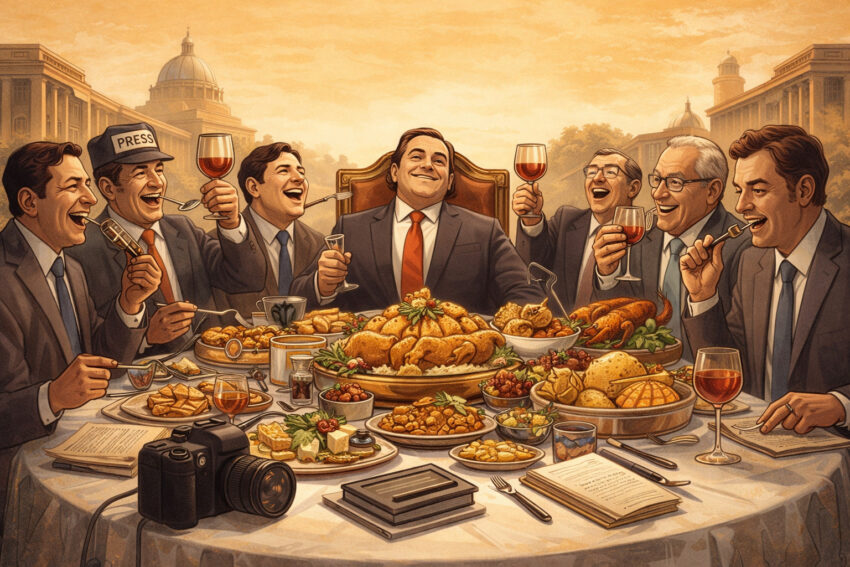
India’s free press was constitutionally guaranteed. What was never guaranteed was that the press would want to use that freedom. It had freedom to criticise the Government. To keep the bureaucracy in check. But it decided to partake in the same luxuries it was meant to expose.
A significant section of Delhi’s mainstream media did not lose its independence through censorship or coercion. It surrendered it voluntarily, in exchange for something more immediately valuable: proximity, comfort, and access. Thus, India’s VIP culture is not limited to bureaucracy alone.
The patronage architecture was not hidden. It operated in plain sight through accumulated small arrangements.
Hindustan Times
Durga Das was the Editor-in-Chief of Hindustan Times at the time of Jawaharlal Nehru the Prime Minister. In his book “India from Curzon to Nehru and After (1969)”, he has explained how he was asked by Nehru to conduct a tour of western nations as a back channel diplomat to assess their position towards India. The details of the tour can be found at page 340 of the book.
Durga Das, however, did not hesitate in criticizing the Nehru though he articulated his criticism to appear more like an exposition of his qualities. But that was his writing style. About the bias of his British editor Moor at The Statesman he wrote:
“I bade farewell to The Statesman, which had provided me with six years of exhilarating journalistic activity. But I had not been wholly happy after Moore had relinquished the editorship of that paper. He belonged to that genre of great editors the like of whom are hard to find today. There were occasions when he acted inexplicably and perversely, but by and large he displayed a remarkable sympathy for Indian aspirations.
He joined Hindustan Times thereafter and this is what he had to say about it:
The financial control of the Hindustan Times had passed into the hands of G. D. Birla, one of the most enterprising Indian industrialists; Devadas Gandhi, the youngest son of the Mahatma and son-in-law of C. Rajagopalachari, was its Managing Editor.
The point I am trying to make that there never was a day in India when journalist wrote for people or for themselves. They wrote what was expected of them. But they also did not claim to be holier than thou. That is something which happened after medium of journalist changed from writing to visual. TV changed that. Now they show a selected clip and ask you to make a judgment on it.
They will like you to believe that Government of the day is in glove with industrialist. Here is what Durga Das wrote:
the transfer of H. V. R. Iengar to Delhi from Bombay as Secretary to the newly created Department of Planning. The Department soon set up cells to draft plans for river valley projects, steel mills, cement factories, and machine tool plants, scientific laboratories and the other sinews of industry. The attempt was to put the Government ahead of the economic planning of the Congress and of the Tata-Birla Plan, published with fanfare early in I944.
The Tata-Birla plan was also called Bombay Plan. This was, as name suggest, was proposal of Industrialists and Government of Independent India started out with its implementation. So much for “Suit-Boot ki Sarkar.” or the jibe of “Ambani and Adani.”
He also tells about freedom to write in Hindustan Times in these wrods:
I offered to write a weekly column in the Hindustan Times on the understanding that it would be published under my pen-name Insaf and that I would have the olumnist’s freedom to write what I felt without inhibitions imposed by our editorial policy.
Columnist could be free to write but editor had to follow the policy. It is something similar we saw in the case of Washington Post.
G.D. Birla owned the Hindustan Times and was employer of Durga Das. As Nehru’s Special Assistant from 1946–1959, Mathai provides insider accounts of political funding, including G.D. Birla’s contributions to Congress and Nehru. He writes that from 1952 onwards, G.D. Birla sent Nehru annual birthday gifts calculated as ₹1,000 per year of Nehru’s age plus ₹1/-. For example ₹60,001 in 1959. This shows Birla’s ongoing financial support amid election-era fundraising to a sitting Prime Minister.
India Today
India Today was launched on December 1, 1975, during the Emergency, at a time when other publications were being silenced or shutting down. Its founder Aroon Purie attended The Doon School where his contemporary was Rajiv Gandhi. Its cover pages from 2010 to 2019, listed in the references below, speak for themselves.
Whenever I want to see Rahul Gandhi or news about Congress party I turn to India Today. It is assured source of authentic information for that party. There is no need to say more.
Republic TV
The same pattern appeared on the opposite side of the political spectrum. Republic TV was funded in part by Rajeev Chandrasekhar, a then-independent Rajya Sabha member with close links to the BJP and vice-chairman of the NDA in Kerala, through his company Asianet News. Through his firm Jupiter Capital, Chandrasekhar invested Rs 30 crore in Goswami’s channel. He resigned from the board after officially joining the BJP in April 2018. Goswami then purchased back his shares in May 2019. Chandrasekhar has now filed his nomination from Nemom constituency for the Kerala Assembly elections of 2026.
NDTV
Sanjay Baru tells the story of cozy relationship between the NDTV and Prime Minister Manmohan Singh. This is what happened on 9 May 2005. Read for yourself:
On 9 May, when he was in Moscow, NDTV ran a story that External Affairs Minister Natwar Singh had secured a low ‘score’ on the PM’s ‘report card’ and was likely to be dropped from the Cabinet. Natwar was most unhappy and took the day off on ‘health grounds’. This news reached the PM in Moscow when he was in the midst of a briefing at his hotel. He asked me to find out what exactly NDTV had reported.
When I briefed him he burst out angrily, ‘Tell Prannoy to stop reporting these lies.’
I called Prannoy Roy, the head of NDTV, and had just begun speaking to him when the PM asked for my mobile phone and spoke to Prannoy himself, scolding him like he was chiding a student who had erred, saying, ‘This is not correct. You cannot report like this.’ Indeed, the relationship between him and Prannoy was not that of a prime minister and a senior media editor but more like that of a former boss and a one-time junior. This was because Prannoy had worked as an economic adviser in the ministry of finance under Dr Singh. After a few minutes, Prannoy called me back.
‘Are you still with him?’ he asked.
I stepped out of the room and told him that I was now alone.
‘Boy, I have not been scolded like that since school! He sounded like a headmaster, not a prime minister,’ complained Prannoy.
Roy was not outraged. He was almost nostalgic. The relationship between him and the PM was that of a former boss and a junior, not a constitutional institution and the press that was meant to hold it accountable.
The Rashtrapati Bhavan Anniversary
In 2013, when Pranab Mukherjee was President, NDTV celebrated its 25th anniversary at Rashtrapati Bhavan, honouring 25 “living legends” including Shahrukh Khan, Ratan Tata and Mukesh Ambani. It was the first instance in independent India when the President’s residence was opened for a private function of this scale.
To be fair, the Times of India’s 175th anniversary and the inauguration of The Hindu Centre for Policy Research were also held at the President’s residence in the same period.
So it was not NDTV alone. But that qualifier only deepens the problem. Multiple private media organisations used the constitutional head of state’s official residence for corporate celebrations, apparently without any public tendering, transparent criteria, or accountability. Newslaundry documented this. When they tried to apply for similar access, they were sent in circles across the Central Registry, the Ceremonies Section, and the Secretary’s office, never receiving a formal response. The process for getting Rashtrapati Bhavan for a private event was evidently not a process at all. It was a relationship. And the relationship belonged to those already inside the circle.
Free Flight
Thirty journalists flew free with the Prime Minister on foreign trips, some over twenty times under the same government. Senior editors received embassy limousines abroad while the rest of the press corps took the bus. Private news channels held anniversary celebrations inside Rashtrapati Bhavan, not through any transparent application process, but through a relationship that no rule book defined and no authority ever questioned.
When the perks stopped after 2014, the most vocal critics of the new government were disproportionately drawn from those who had flown free the most. The criticism may have had legitimate substance. But its sudden intensity was inseparable from a personal economic rupture that had nothing to do with journalism.
This is the media dimension of VIP culture. It required no censorship, no threats, and no explicit bargain. The journalist who flies on the PM’s aircraft, eats at state expense, and launches his channel’s anniversary at the President’s house is not coerced into compliance. He is simply no longer structurally capable of it. His access, his career, and his institution’s prestige are all downstream of the relationship he is supposed to scrutinise.
Media was to be watchdog of society but it chose to chew on the bones instead of barking.
Notes and References:
- Durga Das: He worked as Editor of the Associated Press of India (the forerunner of the Press Trust of India) in New Delhi and Simla, subsequently as the first Indian Special Representative of the Statesman with the Government of India, then as Chief Editor of the Hindustan Times and, finally, as the founder and Editor-in-Chief of India News and Feature Alliance.
- Reminiscences of the Nehru Age by M.O. Mathai (published 1978, Vikas Publishing House).
India Today and Rahul Gandhi:
- Cover page 23 Aug 2010: https://www.pressreader.com/magazines/m/india-today/20100823
- Cover page 25 Oct 2010: https://www.pressreader.com/magazines/m/india-today/20101025
- Who should be next PM 6 feb 2012: https://www.pressreader.com/magazines/m/india-today/20120206
- In search of a leader: https://www.pressreader.com/magazines/m/india-today/20130204
- Rahul Raj: https://www.pressreader.com/magazines/m/india-today/20131014
- The makeover prince: https://www.pressreader.com/magazines/m/india-today/20140127
- Mr Liability: https://www.pressreader.com/magazines/m/india-today/20140602
- Brothers in arms: https://www.pressreader.com/magazines/m/india-today/20170227
- Will he fit the cap: https://www.pressreader.com/magazines/m/india-today/20171218
- Rainbow coalition: https://www.pressreader.com/magazines/m/india-today/20180402
-
- Game on for 2019: https://www.pressreader.com/magazines/m/india-today/20181224
- The Evolution of Rahul Gandhi: https://www.pressreader.com/magazines/m/india-today/20190107
- I will not allow Modi to escape: https://www.pressreader.com/magazines/m/india-today/20190513
India Today and Sonia Gandhi:
- Cover page 6 Dec 2010: https://www.pressreader.com/magazines/m/india-today/20101206
- Cover page 17 Jan 2011: https://www.pressreader.com/magazines/m/india-today/20110117
- How ill is Mrs Gandhi: https://www.pressreader.com/magazines/m/india-today/20111010
- Peoples Choice and Sonia’s Dilemma: https://www.pressreader.com/magazines/m/india-today/20120521
- Power play in Delhi: https://www.pressreader.com/magazines/m/india-today/20120806
- The truth about Sonia: https://www.pressreader.com/magazines/m/india-today/20140811
- Target Sonia: https://www.pressreader.com/magazines/m/india-today/20160516
- The big churn: https://www.pressreader.com/magazines/m/india-today/20180326
NDTV Anniversary at Rashtrapati Bhavan
- https://www.exchange4media.com/industry-briefing-news/ndtv-celebrates-25-yrs-by-honouring-25-greatest-global-living-indian-legends-53857.html
- https://www.mxmindia.com/media/ndtv-turns-25-at-rashtrapati-bhavan-recognises-25-legends/ Newslaundry attempting to book Rashtrapati Bhavan
- https://www.newslaundry.com/2014/01/03/party-at-the-presidents-house
Manmohan Singh phone call to Prannoy Roy
- https://scroll.in/article/661689/ten-revelations-about-the-media-in-sanjaya-barus-book
- https://www.mynation.com/news/manmohan-singh-ndtv-prannoy-roy-samarendra-singh-the-accidental-prime-minister-pf761k The Accidental Prime Minister — book references
- https://www.amazon.com/Accidental-Prime-Minister-Unmaking-Manmohan/dp/0143424068
- Narendra Modi Censored” (2019) by Ashok Srivastava: – https://www.mynation.com/views/book-review-narendra-modi-censored-behind-camera-account-dd-news-anchor-ashok-shrivastav-pocej8–
- Modi vs Khan Market Gang” (2024) by Ashok Srivastava https://organiser.org/2024/05/27/239695/bharat/modi-vs-khan-market-gang/
- Patrakarita Ka Kala Adyay by Manish Thakur: https://garudalife.in/patrakaritha-ka-kala-adhyay
- Shadow of the Mahatma: A Personal Memoir by G.D. Birla (published 1953 by Orient Longmans, Calcutta)