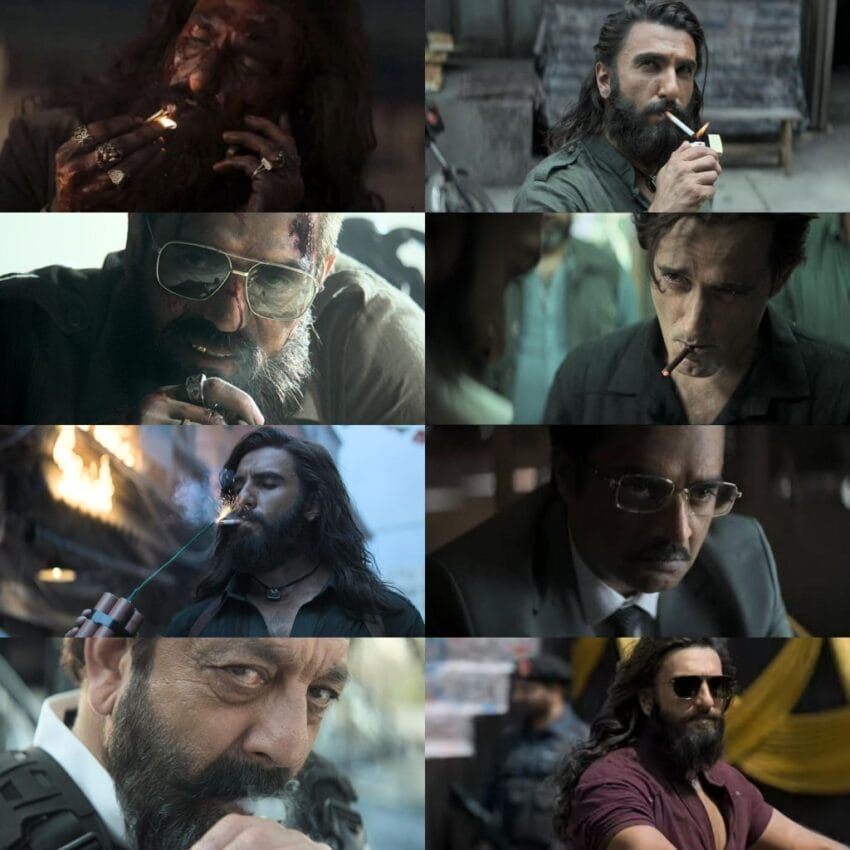
Producer of Dhurandhar Laughing on His Way to Bank.
First part of movie Dhurandhar was released in 2025 and it invited the criticism similar to what its part 2 ‘Revenge’ has attracted. This was a coordinated attack on the movie. Yet the movie made an all time record with collection of ₹840.20 Crore.
Dhurndhar: Revenge has already made 250 crors in two days. Raza Rumi convinced me to watch it. While I am waiting to book tickets to watch Dhurandhar: Revenge, Let me write about coordinated attack on Dhurandhar One.
The Coordinated Script
When Shobha De reviewed Dhurandhar she said something revealing, not about the film, but about how films get reviewed. Her exact words: “absolutely without any kind of narrative, script, nothing. Just spontaneous responses.”
Shobha De is not known for restraint. She has spent decades as a professional contrarian, critic of governments, and reliable voice of what passes for Mumbai’s liberal establishment.
She was assuring her audience she had no script. The assurance itself was the confession. You only deny having a script when scripts are known to exist. She spilled the beans on the review process while reviewing the film.
Anupama Chopra called it a frenzied espionage thriller driven by testosterone and shrill nationalism. Arfa Khanum Sherwani labeled it a toxic cocktail combining misogyny and Muslim hatred. The Wire and Caravan published pieces calling it dangerous propaganda. The vocabulary was identical across platforms. Testosterone. Toxic. Propaganda. Islamophobia. The conclusion was filed before the tickets were booked.
Then something interesting happened. Saregama Music, which sponsors Anupama Chopra’s platform, had also sponsored the film’s music. Commercial reality intervened. Chopra made her review private. The narrative immediately reframed this as coordinated harassment forcing critics to delete their work. A Film Critics Guild, with Chopra as chairperson, issued statements about threats to editorial independence. The people who attacked the film became its victims. The film’s audience became a mob. Its commercial success became evidence of authoritarian climate.
This is Goldilocks Fitna Management in real time. I will explain it below.
The Pakistani Review
While Indian secular critics were busy manufacturing outrage, a Pakistani journalist named Sabahat Zakariya did something radical. She watched the film and reviewed it.
She noted that the wedding dance sequence was not authentically Pakistani in style and showed actual footage of a Pakistani wedding dance to demonstrate the difference. Women do not dance in Pakistani wedding. She identified specific Urdu dialogue errors where actors mispronounced J and Z sounds. She observed that the women in the film were not dressed conservatively enough for actual Pakistani society.
This is film criticism. This is what engagement with a text looks like. A Pakistani, whose country is portrayed as harbouring terror infrastructure, gave Dhurandhar a more technically honest review than any of the Indian secular critics who called it Islamophobic propaganda.
Zakariya also noticed something the Indian critics strategically missed. Two scenes show women slapping their male partners, behaviour she correctly identified as unthinkable in actual Pakistani society. The film gave Pakistani women more agency and freedom than they possess in reality. The critics who called this misogynistic were attacking a film for being too generous to Pakistani women. The incoherence is not accidental. Consistency is not the requirement. Strategic outcome is.
Pakistani Society
What Zakariya revealed is not a new discovery. Perhaps she voted with her feet and left Pakistan and moved to USA. She did not take any stand on defending the conservative society in the video.
Yakub Memon, convicted in the 1993 Bombay blasts, fled to Pakistan but voluntarily returned to face trial and execution. His reason was that he did not want his daughter growing up in that society. His daughter lives in Mumbai today, educated and integrated. The society the secular critics romanticise is one that even its beneficiaries fled.
The Inconsistency Is the Point
Dhurandhar does to Pakistan what The Godfather III did to the Vatican. It exposes documented institutional corruption tied to religious ideology and shows how criminal networks finance political violence. The Godfather III was celebrated as bold filmmaking. Dhurandhar is attacked as Islamophobic propaganda.
Sacred Games featured a Muslim actor playing a Hindu gangster operating through corrupt institutions with graphic violence including a headshot execution of a female character. Critics praised it as gritty realism. Rambo had nationalist testosterone-driven themes and was hailed as bold cinema. James Bond has spent six decades portraying various nationalities as villains without generating a single Film Critics Guild statement.
The Khanani brothers, whose network the film depicts, are real. They are U.S. Treasury-designated entities. The ISI-criminal nexus the film shows is documented in international law enforcement records. The fake currency racket is established fact corroborated by demonetisation’s strategic rationale. Attacking the film as Islamophobic fiction requires simultaneously denying U.S. Treasury designations, ignoring established terror financing records, and preventing public understanding of how 26/11 was actually financed.
This is why the inconsistency is not a flaw in the critics’ position. It is the position. Content that emphasises Indian institutional failure gets celebrated as bold storytelling. Content that shows external threats with documented accuracy gets designated as propaganda. The standard is not artistic. It is operational.
Goldilocks Fitna Management
Goldilocks Fitna Management (GFM) is the activist class manufacturing the appearance of disorder at exactly the right temperature. Hot enough to mobilise a vote bank. Cool enough that actual violence does not erupt and discredit the whole operation. The fitna must never actually arrive because a real civil war destroys everyone including the managers. But the permanent threat of it, the endless almost, keeps the victimhood industry funded, the vote bank consolidated, and the grant applications compelling.
Rumi’s piece is a perfect instrument of GFM. It tells Muslims that a film is attacking them before they have seen it. Some will be angry. Most will ignore it or go watch the film anyway, which 97 crore opening day suggests they did. The fitna does not materialise. But the narrative of threat is refreshed, the victimhood is restocked, and the next grant cycle is justified.
The critics identified the real threat correctly even if they misdiagnosed its nature. Dhurandhar does not show Hindus versus Muslims. It shows Indian Muslims and Hindus together against Pakistani criminals and ISI infrastructure. A Muslim character in the film is a hero. The villains are not Muslims. They are a specific documented criminal-terror network operating out of Pakistan with state backing.
This destroyed the fitna management project’s core requirement. GFM depends on maintaining the perception that India’s Muslims face existential threat from Hindu nationalism. A film that shows Hindu-Muslim unity against an external enemy, and does so using documented facts rather than fiction, makes the manufactured internal conflict harder to sustain.
Kamlesh Singh on AajTak Radio captured the reality better than any critic. He and his Muslim colleague Asif Khan both enjoyed the film and laughed about not feeling guilty for enjoying it. They used the word guilty at least six times while laughing. Kamlesh mocked the secular critics and turned to Asif: look, he was enjoying a film that is supposedly against Muslims. Both laughed. Kamlesh then noted that weekday afternoon shows were houseful and asked sarcastically what people were doing, did they not have jobs. So much for the Islamophobia emergency.
The audience had already answered the critics before the critics finished writing.
The Boomerang
It was a miscalculation to assume that ordinary people lack the intelligence to recognise a manufactured narrative even when they cannot articulate its mechanics. They were wrong. People do not need to understand Goldilocks Fitna Management to notice that the same critics who praised Sacred Games are horrified by Dhurandhar. They do not need to know who funds Himal Southasian to notice that a pre-release review published two days before opening is not a review.
Every instrument deployed against Dhurandhar produced the inverse of its intended effect. Rumi’s pre-release attack became advance marketing. The toxic cocktail label became a recommendation. The Film Critics Guild victim narrative drew attention to the coordination it was meant to conceal. The 97 crore opening of the sequel is the empirical verdict on the entire operation.
The Streisand Effect describes what happens when attempting to suppress information generates more attention than the information would have received naturally. The POGO paradox describes what happens when the instruments deployed to achieve an objective produce the opposite result. Dhurandhar managed both simultaneously. The attempt to designate it as dangerous propaganda made it the most discussed and most watched film of the year. The attempt to create fitna created unity.
The Verdict
A Pakistani journalist gave Dhurandhar a more honest review than the Indians paid to review it. An Indian Muslim journalist laughed on radio about enjoying a film supposedly made to hate him. A convicted terrorist’s life choice testified more clearly about Pakistan’s reality than a Distinguished Lecturer at an American university writing from 11,000 kilometres away.
The critics were not wrong that the film was consequential. They were wrong about the consequence. They thought designation would delegitimise it. Instead it verified it. When the people whose job is to tell you what to think about a film are visibly coordinating their conclusions before watching it, the audience stops asking what to think and starts watching the film.
Now the Dhurandhar sequel opened with 250 crore in two days. Sold out through the weekend. Four-hour shows running every hour in Delhi multiplexes. Only the cheap seats for tomorrow are empty.
The criticism became the advertisement, again.
References:
- Box Office Collections: https://www.sacnilk.com/news/Dhurandhar_2025_Box_Office_Collection_Day_Wise_Worldwide
- Box Office Comparison: https://www.goodreturns.in/news/dhurandhar-2-vs-dhurandhar-1-box-office-collection-ranveer-singh-flim-beats-1st-part-by-265-sets-1497151.html
- Dhurandhar film (2025), director Aditya Dhar: YouTube discussion: Sherwani’s critique:
- Dhurandhar Movie Review by Sabahat Zakariya, the Pakistani Journalist:
- Dhurandhar Movie Review by Shobha De: https://www.ndtv.com/entertainment/shobhaa-de-reviews-dhurandhar-ranveer-singh-chewed-up-the-entire-film-9811920
- Sacred Games, Netflix series (2018)
- U.S. Treasury Department designation of Khanani organization: https://home.treasury.gov/news/press-releases/jl0574 https://home.treasury.gov/news/press-releases/jl0265
- De La Rue scandal documentation, 2006-2012: https://indianexpress.com/article/explained/the-story-of-de-la-rue-currency-printing-firm-at-centre-of-cbis-mayaram-case-8380691/
- Demonetization policy, November 8, 2016
- FIR against Arvind Mayaram: https://www.hindustantimes.com/india-news/cbi-books-ex-finance-secy-arvind-mayaram-for-graft-in-bank-note-security-thread-101673532118153.html
- Anupama Chopra Review made private: https://www.ndtv.com/entertainment/anupama-chopra-dhurandhar-review-row-a-video-made-private-a-backlash-some-solidarity-9784747
- Anupama Chopra is the chief editor of The Hollywood Reporter India, owned by RP-Sanjiv Goenka Group who also own Saregama Music: https://www.oneindia.com/entertainment/why-is-anupama-chopra-trending-her-review-on-dhurandhar-7940285.html
- AajTak Radio:
- Film criticism comparison: Rambo, Bond, Bourne series
- X post by Sherwani: https://x.com/khanumarfa/status/2000254759882944904?
P.S.: Shall write about Dhurandhar 2, as soon as I get to watch it.