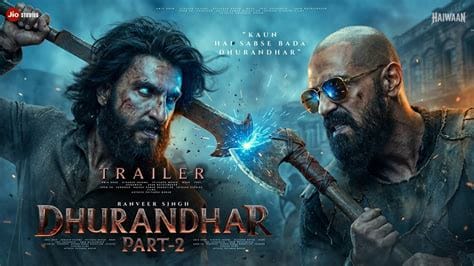
Dhurndhar Movie Critique without watching it.
On 17 March 2026, two days before ‘Dhurandhar: The Revenge’ released in theatres, Raza Rumi published a piece in Himal Southasian calling Hindi cinema’s treatment of Pakistan “appalling” and accusing Dhurandhar of being cinematic propaganda in service of Hindu nationalism. He had not seen the film. The publication did not mention this.
This is worth pausing on. A writer reviewing a film he has not seen, published by a magazine funded in part by Open Society Foundations, the vehicle of George Soros, who gave a speech at Davos in 2020 describing India’s democratic trajectory as the “biggest and most frightening setback” he had witnessed. A man with declared political interests in India’s direction, funding a magazine, whose writer accuses an Indian film of serving political interests. The symmetry is so complete it almost feels generous to point it out.
But the more interesting problem is not the funding. It is the Pakistan.
Pakistan
Rumi’s central complaint about Dhurandhar is that it constructs an imaginary Pakistan, specifically a Lyari where women move freely, ride motorcycles, slap men who deserve it, and exercise genuine agency. He calls this a distortion. An enabling fiction in service of propaganda. His implicit argument is that the real Pakistan is being misrepresented to serve India’s nationalist mythology.
I have spent the better part of two years observing and writing about Pakistan across eleven documented research pieces. What that research revealed is that Rumi’s Pakistan, the one being misrepresented by Bollywood, does not exist either. Dhar created a fictionalised version. Rumi’s version is a fantasy.
Documented Reality
Ajmal Kasab, the 2008 Mumbai attacker, was so thoroughly educated in a false reality by Pakistan’s official school curriculum that when he heard the azaan from his Mumbai lockup, he assumed it was his imagination. Muslims praying freely in India was not supposed to be possible.
This was not Kasab’s personal delusion. It was the product of textbooks reaching over 41 million Pakistani children, textbooks which taught that cooperation with Hindus was impossible and that Hindus planned to enslave Muslims. This is the Pakistan that sent men to Mumbai.
Cognitive Reality
The cognitive architecture Rumi defends has other features worth noting. Pakistan’s Defence Minister, after Operation Sindoor, claimed his country had shot down six Indian aircraft. His evidence, offered to credible international journalists, was that “it is on social media.” A cabinet minister with defence portfolio offers social media as military intelligence. This is not a fringe position in Pakistan’s discourse. It is the centre of it.
The World Health Organization’s 2025 data puts 34% of Pakistan’s population, approximately 67 million people, as suffering from mental illness, with only 5,000 trained psychiatrists for a country of 240 million. Approximately 60% of all Pakistani marriages are consanguineous, the majority between first cousins, a pattern that has compounded across generations with documented effects on population-level cognitive capacity. These are not polemical claims. They are sourced from WHO reports, peer-reviewed studies, and Pakistan’s own medical literature.
Meanwhile, since 2019, Pakistan has announced a new world-changing mineral or oil discovery approximately every three months. Asia’s largest oil and gas reserve. The fourth-largest oil reserves on earth. Rs 800 billion in gold near Sindh. In the same period, the Pakistani rupee collapsed from 150 to 300 per US dollar. Petrol reached 272 rupees per litre. The country now smuggles approximately one billion dollars of Iranian oil annually just to function. The announcements continue regardless.
This is the epistemological environment Rumi wishes to protect from Bollywood’s distortions.
Dhar’s Pakistan
Director Aditya Dhar’s Lyari, where women ride motorcycles and assert themselves, is not propaganda. Measured against the documented reality of Pakistan, it is a kindness. Dhar himself, in the logic of his own film, acknowledges it is an imaginary Pakistan, not the Pakistan that exists but the Pakistan the story requires. He is not claiming documentary truth. He is making a film.
Rumi, by contrast, is claiming documentary authority. He is positioning himself as a corrective to distortion while operating from a more complete fantasy than anything Dhar put on screen. Dhar’s Pakistan is imaginary and he knows it. Rumi’s Pakistan is imaginary and he does not know it.
I reviewed the first Dhurandhar six months ago. I watched it. My criticism, where I had it, came from having seen the thing I was criticising. Rumi’s criticism came from knowing what conclusion he wanted to reach before the film existed in a form he could watch.
There is a word for writing that begins with its conclusion and works backward through selective evidence to justify it. It is not film criticism. It is not cultural analysis. It is called activism. Himal Southasian calls it journalism. The funding sources make the motivation legible. The pre-release timing makes the intent transparent.
Dhar asked a hard question in his film:
Can you infiltrate something without becoming it?
Rumi answers the question from the outside and tells us that it can happen from a distance. Rumi has the same cognitive dissonance which pervades Pakistan.
References:
- Raza Rumi Article: https://www.himalmag.com/culture/dhurandhar-india-cinema-bollywood-hindu-nationalism
- About HimalMag: https://www.cjr.org/analysis/himal-southasian-mojumdar-dixit.php
- Dhurandhar Review: https://sandeepbhalla.in/why-dhurandhar-must-be-experienced-by-everyone/
- Cognitive Decline in Pakistan: https://sandeepbhalla.in/cognitive-decline-in-pakistan-is-shocking/
- Pakistan: https://sandeepbhalla.in/tag/pakistan/