Introduction: Moving past the Old Yardsticks to Review Movies
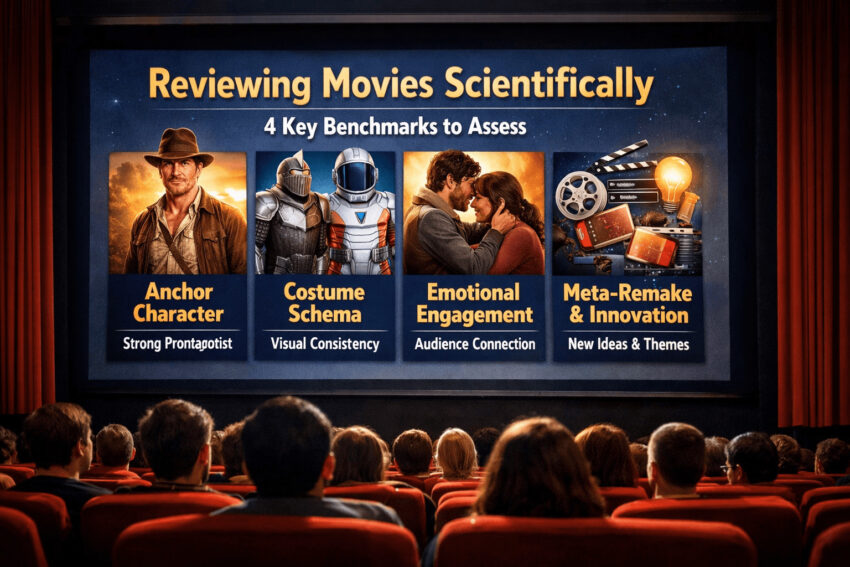
For decades, films have been judged primarily on star power, narrative originality, technical finesse, and box office returns. While these metrics remain relevant, they but it is possible to assess a movie on more scientific principles. There are four key benchmarks to assess:
- Anchor Character – the emotional and narrative fulcrum.
- Costume Schema – consistent visual design supporting character and theme.
- Emotional Engagement – provoking love or hate, never indifference.
- Meta-Remake & Innovation – self-aware reimagining and structural novelty.
A recurring catalyst is the Glamorized Villain. A magnetic antagonist who can define a work’s legacy. This is a rather new discovery made a few decades ago.
The Anchor Character Principle
A strong anchor is the narrative’s gravitational center, binding plotlines and motivating other characters. Without it, even spectacular scripts risk emotional hollowness. Anchors can be living and active (e.g., House M.D.), dead but present (Chamatkar, Jaane Bhi Do Yaaro), or transitional (Dost). Sometimes they fail, like the abstract memory of a father in Agneepath.
Key takeaway is that a strong anchor can carry a weak story, but a great story cannot replace a missing anchor.
Costume Schema
Wardrobe and visual design are more than aesthetics. They signal character arcs and narrative tone. When deliberate and consistent, they strengthen immersion (e.g., Sholay, Agneepath, Ghajini). Inconsistent or arbitrary costuming weakens identity and world-building (e.g., Shalimar, Shaan).
Emotional Engagement
Characters must evoke strong emotional responses. Neutrality drains momentum. Think affection for Jai & Veeru and hatred for Gabbar in Sholay, versus the indifferent leads of Shaan. In TV, The Good Wife builds deep sympathy for Alicia Florrick, whereas The Good Fight sometimes lets its political message overtake story.
Meta-Remake & Innovation
Some works thrive by reinterpreting their own cinematic DNA. Agneepath (1990) reimagines Amitabh Bachchan’s persona in a dense, operatic form. It is visually stunning yet initially distant without a clear anchor. Ghajini simplifies Memento but adds stronger anchoring and visual hooks, making it more emotionally accessible. Even though conceptually and philosophically Memento has far superior depth.
The Glamorized Villain Factor
When executed well, a villain’s charisma can overshadow even the protagonist like Gabbar Singh in Sholay, or Shakaal in Shaan. When unsupported by anchoring or cohesion, a compelling villain alone cannot salvage a film (See Shalimar).
Visual Storytelling Methods
There are three visual art forms. These names are my framing but it has nothing to do with names, any more. In all jurisdictions all types of movies are made. The classification is:
- Nautanki – high melodrama and heightened emotions. This is inspired from traditional Ram Lila in India. Strong dialogues and and songs and comedy woven in between.
- Russian Circus – lavish spectacle with thin character work (common in Hollywood action). Huge sets. Highly visible action packed movies like Mission Impossible fit this genre.
- British Stage Drama – dialogue-driven, performance-centered subtlety. The Yes Minister series even today beats all other dramas.
Over-reliance on one model like the spectacle model alone, without real innovation explains many recent big-budget flops. There has to ba a story and it has to be told visually. Dialogues matter but those alone do not make a movie.
Case Studies to Review Movies
Some of the case study of Hindi Movies prove the point. These are brief review movies.
Sholay (1975) — Perfect Alignment
- Anchor: Radha’s silent dignity ties all arcs. Note that anchor barely spoke a word. But all characters are working for revenge for her.
- Costume Schema: Consistent, authentic wardrobes.
- Emotional Engagement: Every character evokes strong reactions.
- Glamorized Villain: Gabbar Singh’s presence became a cultural landmark.
Shalimar (1978) — Glamour Without Core
There is no unifying anchor. Incoherent costume choices does not match with movie. The villain is compelling but unsupported by narrative unity. No wonder it was a ‘surprising’ flop.
Shaan (1980) — Spectacle over Story
Weak anchoring and indifferent leads. Costumes lacked purpose. Costumes were used for spectacle and failed. Shakaal’s aesthetic coherence gives the film partial legacy value. But movie failed even though memorable even today.
Agneepath (1990) — Brilliant but Detached
A meta-reimagining of Amitabh’s oeuvre. A person watching this movie has watched all the movies of Amithabh Bachan’s ‘angry young man’ movies. The father’s memory is too abstract to serve as a full anchor. Costumes and set design are visually rich. Yet the movie failed as there was incoherence in anchor character. Viewers wonder as to whose story is it. Some time Bachchan tells the story and then Mithun takes over and yet somebody else.
Ghajini vs. Memento
Ghajini offers strong anchoring, visual engagement, and emotional clarity; Memento is structurally brilliant yet emotionally colder and visually ordinary to give real experience of silver screen.
House M.D. vs. The Night Manager — Television’s Lesson
House M.D. arrives with a perfect anchor (House himself), a subtle but consistent visual language, and high emotional engagement through conflict and wit. The Night Manager has an excellent premise and performances but lacks a clear anchor; its generic costuming does little to reinforce character identity, so it’s remembered more for plot setup than sustained emotional pull.
The Hierarchy Principle
- Anchor Character — non-negotiable.
- Emotional Engagement — makes the anchor matter.
- Story Quality — important, but secondary to connection.
- Technical & Star Power — cannot substitute for the above.
Practical Application
These are old examples. Actually this article was written sometime ago and it got filed in drafts. Try applying this on some of the recent success story. RRR, Dhurandhar or which ever successful movie one may think of. Apply it on ‘Good Fortune’ released in 2025. The principles are scientific and still hold good.
TV Series can refine these benchmarks across seasons: The Good Wife built a strong anchor over time; House M.D. arrived fully formed. Others can improve by strengthening these levers.
Conclusion: The Architecture of Endurance
The works that last are not simply those with the biggest budgets or brightest stars. They endure when emotional anchoring outweighs technical polish, visual identity strengthens narrative unity, characters inspire love or hate, and innovation stays rooted in accessibility. These benchmarks reveal why equal resources can yield opposite fates—and why some “failures” evolve into cult classics.
References:
Sholay (1975) — Hindi film. Epic action-adventure directed by Ramesh Sippy; iconic characters and a culture-defining villain. IMDb: https://www.imdb.com/title/tt0073707/
Shalimar (1978) — Hindi/English film. Ambitious heist thriller whose glamor couldn’t compensate for weak anchoring and inconsistent costuming. IMDb: https://www.imdb.com/title/tt0078241/
Shaan (1980) — Hindi film. Big-scale action with memorable villain Shakaal but indifferent leads and visual inconsistency. IMDb: https://www.imdb.com/title/tt0081491/
Agneepath (1990) — Hindi film. Operatic reimagining of Amitabh Bachchan’s persona; visually rich but initially distant without a clear anchor. IMDb: https://www.imdb.com/title/tt0098999/
Ghajini (2008) — Hindi film. Emotionally driven, visually bold; uses styling as a motif of memory and identity. IMDb: https://www.imdb.com/title/tt1166100/
Memento (2000) — English-language film. Psychologically complex, structurally inventive, but emotionally cooler and visually minimal for repeat viewing. IMDb: https://www.imdb.com/title/tt0209144/
House M.D. (2004–2012) — English-language TV series. Medical drama anchored by a singular antihero; consistent visual language supports character identity. IMDb: https://www.imdb.com/title/tt0412142/
The Night Manager (2016) — English-language TV miniseries. Stylish spy thriller with strong performances; lacks a clear anchor and distinctive costuming for lasting emotional pull. IMDb: https://www.imdb.com/title/tt1399664/
The Good Wife (2009–2016) — English-language TV series. Legal/political drama that grows a powerful anchor in Alicia Florrick across seasons. IMDb: https://www.imdb.com/title/tt1442462/
The Good Fight (2017–2022) — English-language TV series. Bold and topical; occasionally lets message overtake anchoring coherence. IMDb: https://www.imdb.com/title/tt5853176/
Chamatkar (1992) — Hindi film. Fantasy-comedy with a “dead but present” anchor (ghost) driving the protagonist’s arc. IMDb: https://www.imdb.com/title/tt0103926/
Jaane Bhi Do Yaaro (1983) — Hindi film. Satirical cult classic; features a corpse as a narrative device (“dead but present” anchor wrinkle). IMDb: https://www.imdb.com/title/tt0085743/
Dost (1974) — Hindi film. Example of a transitional anchor; moral authority shifts across the narrative. IMDb: https://www.imdb.com/title/tt0071452/
1 thought on “How to Review Movies? Is There a Scientific Method?”