India, Preparing for the War of Future
A decade back, drone was a word known only to bee keepers. Then came the war between Azerbaijan and Armenia. The Drones outshone all military equipment. Drones destroyed Armenian armor, including 185 tanks. Many strikes were captured on video and shared publicly. After this war the title ‘Drone’ replaced the terms like ‘remotely piloted or autonomous aircraft’. It was no more a part of Sci-fi folklore. Future had arrived.
The war between Azerbaijan and Armenia erupted on September 27, 2020, over the disputed Nagorno-Karabakh region, lasting six weeks until a Russia-brokered ceasefire on November 9. Azerbaijan regained control of much of the territory previously held by Armenian-backed forces. Drones shifted the balance despite Armenia’s superior conventional armor.
Azerbaijan used Turkish Bayraktar TB2 drones for reconnaissance and strikes, alongside Israeli Harop kamikaze (loitering) munitions. TB2s carried bombs up to 55 kg and targeted tanks like T-72s, BMPs, and even T-90 regiments. Harop drones specialized in suicide attacks on tanks, radar, and air defences. Bayraktar TB2 cost around $2-5 million each and Harop cost about $0.5-1 million each which destroyed Armenian tanks valued at roughly $1-4.5 million apiece. This was very effective return on investment.
Armenia destroyed a few of the drones but not much as its air defence was taken out by the drones itself.
In 2025, Operation Sindoor India defended the drones from Pakistan with nearly 100% precision but that is a matter or another debate as to what and how an air defence could be so effective. Now India is building a pan India air defence called “Sudarshan Chakra”. Apart from air defence India is also working on another Drone project called “Sheshnaag”.
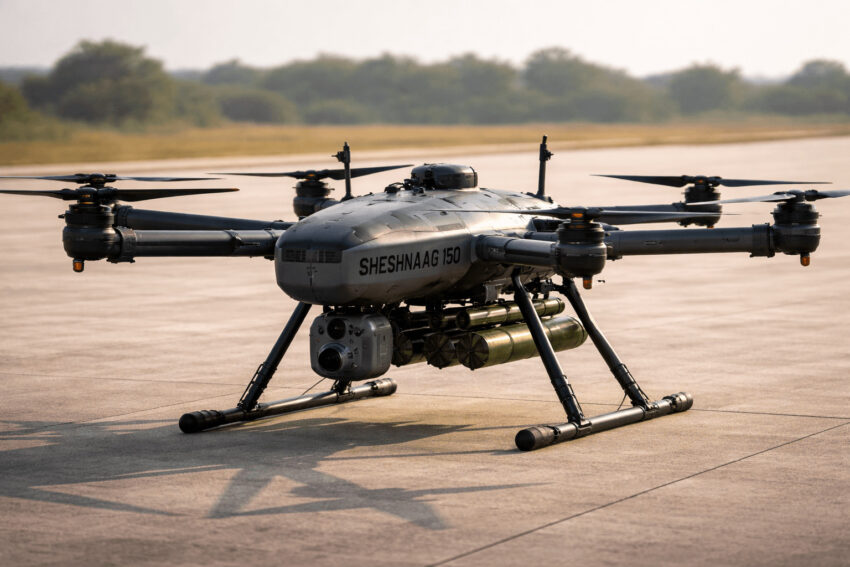
Sheshnaag-150
The Sheshnaag-150 drone has an operational flight range of over 1,000 kilometers. The drone’s developer, Newspace Research Technologies, has successfully commanded a swarm of drones flying in Ladakh all the way from their base in Bengaluru which 2500 km. away. The control systems demonstrate highly advanced, long-range communication capabilities.
Designed for long-range, deep-strike missions, the drone is highly fuel-efficient and can remain airborne for more than five hours. This extended flight endurance allows the drone to travel vast distances and also to loiter over target areas to conduct real-time surveillance, wait for time-sensitive cues, refine its aim using onboard sensors, and execute precision strikes.
Targets:
The Sheshnaag-150 drone is highly versatile, carrying a 25 to 40 kg warhead that provides enough destructive power to neutralize a wide array of high-value targets. It is designed to engage the following types of assets:
- Military Infrastructure: It can destroy fixed strategic targets like command posts, air defense nodes (such as radar systems), fuel and ammunition depots, and airfield infrastructure. A precision strike on such assets cause cascading disruption to enemy operations.
- Vehicles and Armor: The drone can damage or destroy military vehicles, tanks, logistics networks, and can even be used for area denial against advancing armored columns.
- Enemy Positions and Personnel: It can strike military personnel, troop build-ups, and fortified combat positions such as bunkers.
- Counter-Terrorism Targets: In hostile or remote areas, the drone swarm can track and eliminate high-value targets in hideouts, as well as strike terror camps and infiltration routes.
- Maritime Targets: The system can also be utilized for maritime coercion, targeting coastal approaches, strategic chokepoints, and complicating enemy naval air defenses.
Self Healing Swarm
The Sheshnaag drones operate in a swarm of multiple drones which is self healing. A “self-healing swarm” refers to a network of multiple drones that operate collaboratively as a single, highly intelligent “hive” rather than just flying along the same pre-planned route. If one or more drones are shot down or disabled by enemy defenses, the surviving drones automatically re-task and redistribute their mission roles in real-time.
It is powered by a proprietary software called “mother code,” these drones utilize advanced mesh networking and “self-refreshing algorithms” to continuously communicate and adapt mid-mission.
A self-healing swarm means an enemy must shoot down every drone simultaneously or the mission continues. There is no clean kill.
Suppose an air defense system shoots down six of ten drones. With a conventional strike package, that is a 60% loss. The mission likely fails. With Sheshnaag, the four surviving drones recalculate, redistribute targets, and press on. The enemy just spent missiles, radar time, and operator attention to achieve nothing decisive.
Communication
Sheshnaag-150 operate without GPS (or in GNSS-denied environments). It relies on a Visual Navigation System (VNS). Instead of depending on vulnerable satellite signals, this system uses image-based positioning to navigate by recognizing the visual terrain below it, allowing it to bypass enemy electronic jamming entirely
The drone maintains contact with command and control as well as with other drones in its swarm, through a versatile and highly resilient communication stack. It uses ‘Multiple Communication Channels’. The drone’s swarming software has been successfully tested using a combination of radio communications, 4G/5G networks, and SATCOM (Satellite Communications).
It is nearly impossible to disrupt all these modes of communications simultaneously especially to disrupt a drone which is not visible and is not known to be up in sky. You cannot disrupt communications of a threat you have not detected. Thus, this drone is nearly impossible to jam.
Launch and Take Off
Sheshnaag needs no drone port for launch. To prevent enemies from destroying the drones before they even take off, the Sheshnaag is designed to be launched from standard mobile trucks on normal highways. This makes the it practically impossible for the enemy to track or target pre-emptively the launch sites as no fixed or dedicated site is offered.
Cost
The exact cost of Sheshnaag-150 is not in public domeain but it does not cost in millions of dollars. This makes it special because it bridges the gap between cheap, disposable drones and expensive, high-end cruise missiles. It is designed for “asymmetric warfare,” meaning it allows a military to inflict massive damage on a highly advanced enemy at a fraction of the cost.
Conclusion
The Sheshnaag-150 represents a quiet but significant shift in how India thinks about force projection. Drones once belonged to science fiction. Then they reshaped a war in the Caucasus. Now India is building a weapon that combines range, swarm intelligence, and low cost in one system.
The real lesson from Azerbaijan was not just that drones work. It was that cheap precision beats expensive armor. Sheshnaag-150 takes that lesson further. A swarm that self-heals, navigates without GPS, and launches from a highway truck offers no easy target to a pre-emptive strike. On top of all this it is invisible and silent in communication which makes it impossible to detect or to block.
The era of tank is over. The age of asymmetric air power has begun. India is not just watching it. India is building it.
References:
- Drones in Armenia war: https://smallwarsjournal.com/2020/10/23/drones-nagorno-karabakh/
- War Data: https://www.militarystrategymagazine.com/article/drones-in-the-nagorno-karabakh-war-analyzing-the-data/
- FlapOne Aviation: https://www.flapone.com/news/what-are-sheshnaag-150-swarm-drones-india-s-1-000-km-deep-strike-loitering-munition`
- Raksha Anirveda “NewSpace Research and Technologies’ https://raksha-anirveda.com/newspace-research-and-technologies-sheshnaag-150-swarm-drone-for-deep-strike-missions-showcased-at-world-defense-show-2026/`
- The Hans India (“India’s Sheshnaag-150 missile makes headway!”):
http://hans.plus/n-1053574