(Chapter 8)
The Private Bureaucracy that Failed
Chartered Accountants occupy a unique position in India’s economic governance. They are not government officers. They are not politicians. They are licensed private professionals whose statutory duty is to verify, certify, and authenticate financial truth. Every company audit, every tax filing, every balance sheet placed before a bank or a regulator carries a CA’s signature as a guarantee of integrity.
They are, in theory, the last line of defence against financial fraud. But demonetization in November 2016 removed that pretense in one stroke.
Demonetization in 2016
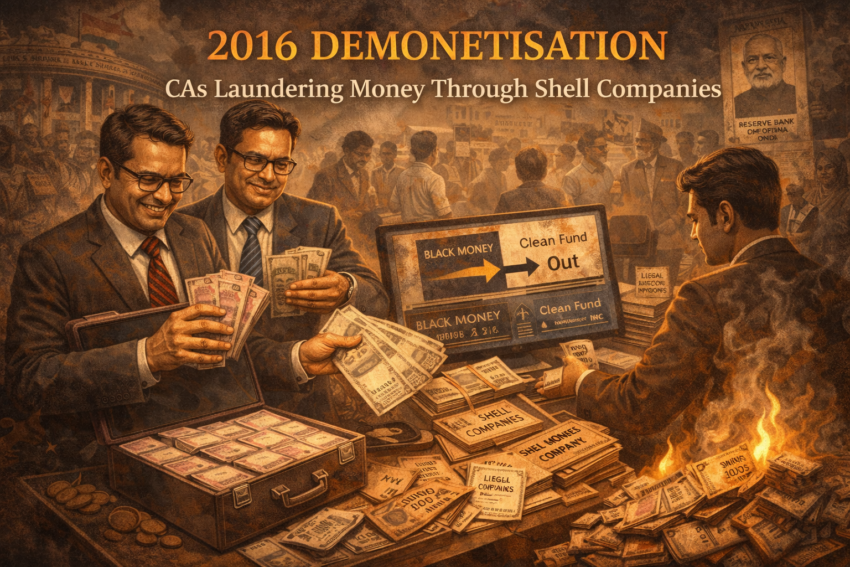
Rs 3,700 crore, approximately, was laundered by 559 beneficiaries with the help of 54 professionals identified by the Serious Fraud Investigation Office (SFIO). A Lok Sabha written reply clarified that these 54 professionals comprised 34 chartered accountants, 3 company secretaries, 4 advocates, and 13 others. Without giving direct reply to a query on whether shell companies swindled Rs 3,900 crore during the demonetisation period, Minister of State for Corporate Affairs Arjun Ram Meghwal said: “In one of the investigations by SFIO, it was found that a group of 11 companies had laundered money to the extent of Rs 3,790 crore during the period 2004-05 to August, 2010.”
Thus, at least 34 chartered accountants came under investigation for allegedly structuring large‑scale laundering operations, including those later exploited during the demonetisation period.
It was also found that Rs 1,238 crore in cash had been deposited into shell or dormant companies immediately after demonetisation. The infrastructure of shell companies, dormant accounts, and falsified books had been built and maintained over years, by professionals who knew exactly what they were constructing. The speed and sophistication of the laundering also revealed surprising facts. The laundering operations were not opportunistic responses to a sudden policy but these existed for a long time though hidden in layers.
In one case, Rs 13.6 crore in cash was found in a lawyer’s office during post-demonetisation raids, with allegations that he had conspired with bank officials and CAs to convert black money through fictitious accounts and demand drafts issued in the names of nonexistent persons.
Institute of Chartered Accountants of India
The ICAI’s response confirmed the structural problem. The apex body suspended four members for three months each and fined them Rs 1 lakh each for advising clients in ways that encouraged money laundering. Four suspensions of three months. For Rs 3,700 crore in laundered funds. This was a press release and not a punishment.
The then ICAI president (Nilesh Vikamsey) publicly acknowledged that ICAI did not have statutory power to temporarily suspend a chartered accountant simply because that CA was found involved in wrongdoing or named in a shell‑company/money‑laundering case.
He explained that ICAI could only move through its regular disciplinary process (show‑cause notices, inquiry, and eventual de‑enrolment or permanent removal), but could not impose an immediate interim suspension while that process was going on.
He had made a representation to the government to amend the CA Act to provide such powers. The professional body regulating the gatekeepers of India’s financial system did not have the power to punish a member caught red-handed. The CA Act placed disciplinary authority entirely within the profession’s own body, with no external supervision and no interim powers, which meant the profession could investigate itself at its own pace while members continued to practice. This dysfunctional supervisory arrangement is called oversight.
The pattern extends far beyond demonetisation. In a major loan‑fraud case linked to a public‑sector bank, the ED arrested CA Anant Kumar Agarwal for allegedly designing and operating a web of shell companies to layer illicit funds through fictitious loans and share capital.
Two chartered accountants were arrested in a Rs 640 crore cyber fraud money laundering case, with ED raids across Delhi, Gurugram, Jodhpur, Hyderabad, Pune, and Kolkata revealing over 2,000 documents detailing transactions across hundreds of mule accounts.
In the Jharkhand mining scam, around ₹19.31 crore was confiscated in total, of which about ₹17 crore came from IAS officer Pooja Singhal’s chartered accountant, Suman Kumar, and the rest from other locations.
In many larger fraud cases running into thousands of crores (e.g., ICICI‑Videocon, PNB fraud, etc.), chartered accountants appear to have played active roles.
The CA is present in virtually every major financial crime in India. According to SFIO, often CAs were the architect and not the bystander.
It took until May 2023 for the government to formally bring chartered accountants under the Prevention of Money Laundering Act as Reporting Entities, obligating them to conduct due diligence and report suspicious transactions. For two decades after the PMLA was enacted in 2002, the professionals most capable of structuring money laundering were legally outside its reporting framework.
The Irony
Chartered accountants were created as the private sector’s internal accountability mechanism. Businesses that the government could not directly supervise were supposed to be kept honest by their auditors. The Satyam scandal showed that the auditors of a major listed company, PwC, were found guilty of conspiracy after Rs 7,000 crore in company accounts were falsified over years without detection. The auditors were either complicit or incompetent. In India’s financial scandal record, the distinction rarely matters. In this case PwC India was banned by SEBI from auditing listed companies for two years.
A licensed, regulated, statutorily empowered private profession was meant to ensure financial honesty across the economy without the government having to police every transaction. Instead the profession built the infrastructure of dishonesty, certified the falsified books, incorporated the shell companies, layered the illicit funds, and charged a fee for each service. The gatekeeper had become the guide to bypass the gate.
References:
- Professional help: https://indianexpress.com/article/india/cas-advocates-helped-in-laundering-illicit-cash-govt-4573322/
- Reply in Parliament: https://eparlib.sansad.in/bitstream/123456789/697375/1/48777.pdf
- ICAI powers: https://www.business-standard.com/article/pti-stories/icai-mulls-powers-to-temporarily-suspend-erring-members-117021401201_1.html