Judiciary Can Direct but Cannot Enforce
(Chapter 9)
VIP Culture
India has a peculiar VIP culture enjoyed by it elite bureaucracy. Every few years, a protocol document leaks, a stadium gets cleared for a dog walk, or a director-level officer’s bath kit goes viral. There is outrage. There is a transfer. Then there is silence. And then, quietly, the same officer returns to a position of equal or greater power. The system does not punish the conduct. It punishes the visibility.
This is not corruption in the conventional sense. No money changed hands in the BSNL protocol leak. No law was broken when Thyagraj Stadium was cleared every evening for a senior IAS officer’s pet. What was broken was something harder to name and harder to fix: the assumption, built into the architecture of Indian governance, that rank converts public resources into private entitlements. That assumption is so deeply embedded that the officers who benefit from it do not experience it as privilege. They experience it as normal.
IPS Superiority
The Central Armed Police Force (CAPF) Bill 2026 belongs to the same family of problems, though it operates at a different level of the system. The bill places IPS officers on a pedestal higher than the entire cadre of CAPF. The VIPs of another kind.
Earlier, what was being done with a sleight of hand, under the rules, has now placed an iron ceiling on promotion of CAPF cadre officers who are ineligible for promotion to top posts.
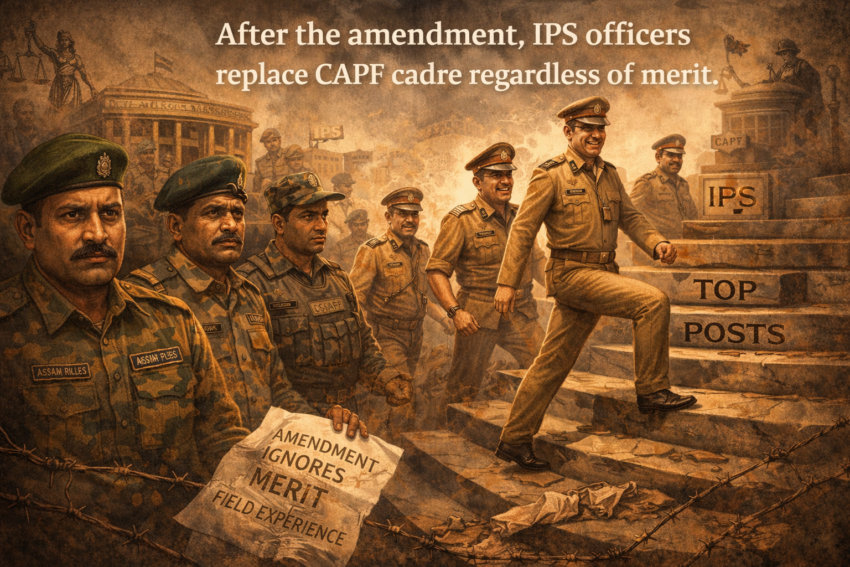
After this amendment, the Indian Police Service holds the top posts in the Central Armed Police Forces only because of their original status as IPS regardless of merit, field experience, or judicial direction.
Similarly the amendment if passed, completely ignores the merit and field experience of CAPF cadre.
In the first part of this series of articles on “Crises of Governance in India” it was articulated as under:
If the bureaucracy, police, regulators, and enforcement apparatus are internally sabotaging the elected government, is this still democracy? Or has it become a permanent state that tolerates elections but ensures elected governments cannot actually govern?
Here we are with another example where bureaucracy works overtime to protect itself from judicial interference.
Stagnation in Employment
In numerous cases Supreme Court has frowned at stagnation of cadre as denial of equal opportunity and therefore unconstitutional. In this case CAPF officers who had waited 14 years for a single promotion had approached the Supreme Court. Their grievance was exclusion from promotion in their own cadre, while IPS officers captured the higher positions.
In May 2025, after years of litigation, the Court directed that IPS deputation to senior CAPF ranks must be progressively reduced. The government filed a review petition. The Court dismissed it in October 2025. Contempt petitions followed. And then, in March 2026, the government introduced a Bill in Parliament that converts the practice the Court found troubling into a permanent statutory mandate. One hundred percent of the Director General posts. One hundred percent of the Special Director General posts are now reserved by law for IPS officers. Forever.
This is the IAS and IPS fraternity at work, and it is worth stating plainly what that means. The Ministry of Home Affairs, which drafted this Bill, is staffed and led by IAS and IPS officers. The Cabinet Secretariat, which cleared it, is headed by a Cabinet Secretary who chairs the governing council of the Civil Services Officers Institute, the exclusive IAS club on Vinay Marg in Chanakyapuri. The same class of people that benefits from the Bill is the class that wrote it, cleared it, and managed to get it steered through a voice vote while the opposition walked out. No recorded vote. No floor debate on the constitutional questions. Done and dusted in one sitting.
The CAPF forces, roughly ten lakh strong, guard every border India has. They fight insurgencies, manage elections, secure airports and nuclear installations, and absorb casualties that rarely make the front page. The officers who lead them at the field level spend decades in conditions that no IPS officer on a two-year deputation stint will ever experience. When those officers are told by statute that they will never lead their own force, the message travels down to every rank below them. The amendment tells the CAPF officers that it was not enough. Proximity to power in Delhi matters more.
There are various decisions which have held that Equality of opportunity in public employment under Article 16(1) includes not being left to stagnate indefinitely in one post when others are being promoted or when the structure allows for growth.
In K.G.S. Bhatt it was established that long‑term stagnation in employment, especially for highly qualified and senior employees, is a serious management failure and can amount to denial of a normal career path. The Court treated such stagnation as a factor that can justify institutional relief (e.g., promotion or consequential benefits), within the framework of Article 16(1), even though there is no absolute ‘fundamental right to promotion’. This is verbatim observations of case the Supreme Court in this case:
Respondent-1 is not a lay-man. He is a highly qualified engineer. Although joined service with a diploma in Engineering, he later passed Bachelor of Engineering (B.E.) and also acquired M. Tech. degree and one more diploma (D.P.M.). He was however, left without opportunity for promotion for about twenty years. This is indeed a sad commentary on the appellant’s management. It is often said and indeed, abroitly, an organisation public or private does not ‘hire a hand’ but engages or employees a whole man. The person is recruited by an organisation not just for a job, but for a whole career. One must, therefore, be given an opportunity to advance. This is the oldest and most important feature of the free enterprise system. The opportunity for advancement is a requirement for progress of any organisation. It is an incentive for personnel development as well. (See : Principles of Personnel Management by Flipo Edwin B. 4th Ed. p. 246). Every management must provide realistic opportunities for promising employees to move upward. “The organisation that fails to develop a satisfactory procedure for promotion is bound to pay a severe penalty in terms of administrative costs, misallocation of personnel, low morale, and ineffectual performance, among both no managerial employees and their supervisors”. (See : Personnel Management by Dr. Udai Pareek p. 277). There cannot be any modern management much less any career planning, man-power development, management development etc. which is not related to a system of promotions. (See : Management of Personnel in Indian Enterprises by Prof. N.N. Chatterjee, Chap. 12 p. 128). The appellant appears to have overlooked this basic requirement of management so far as respondent-1 was concerned till N.R. & A.S. was introduced.
Allahabad High court has also taken same view holding that genuine stagnation in employment due to lack of adequate promotional avenues is detrimental to efficiency of administration and must be avoided. Opportunity of advancement in service career by promotion is considered a normal incidence of service. Efficient administration alone can serve public interest.
Therefore, denial of opportunity of promotion is clearly an infraction of article 14 and 16 of the Constitution. Yet the Amendments to CAPF Act allocate 100%
Yet the amendment has been passed and it is likely to fail in Supreme Court. But the litigation will continue for decades and that is also a win.
This also demonstrates how the Government is the largest litigant clogging the judicial system. On 21 March 2026, Justice B.V. Nagarathna had pointed this out in her public speech.
Bureaucracy is gambling with law, in a court of law, with public money on public’s time.
Case Law:
- Council Of Scientific And Industrial … vs K.G.S. Bhatt And Anr. on 29 August, 1989: AIR1989SC1972, 1989(59)FLR577, JT1989(3)SC513, (1990)ILLJ246SC, 1989(2)SCALE395, (1989)4SCC635.
- Secretary, Government (NCT of Delhi) v. Grade‑I DASS Officers Association, (2014) 13 SCC 296.
- State of Tripura v. K.K. Rai, (2004) 9 SCC 65 .
- Hukum Chandra Gupta v. ICAR, (2012) 12 SCC 666).
- Pradeep Kumar Awasthi v. State of U.P. and Others (Allahabad High Court, 2019): https://www.casemine.com/judgement/in/5e01dbf08ef1524a1e206070
References:
- Is India in Governance Crises?: Chapter 1.
- Is India in Governance Crises?: Chapter 2.
- Is India in Governance Crises?: Chapter 3.
- Is India in Governance Crises?: Chapter 4.
- Is India in Governance Crises?: Chapter 5.
- Is India in Governance Crises?: Chapter 6.
- Is India in Governance Crises?: Chapter 7
- [Is India in Governance Crises?: Chapter 8]
- Law of Corruption in India by Sandeep Bhalla (2020):