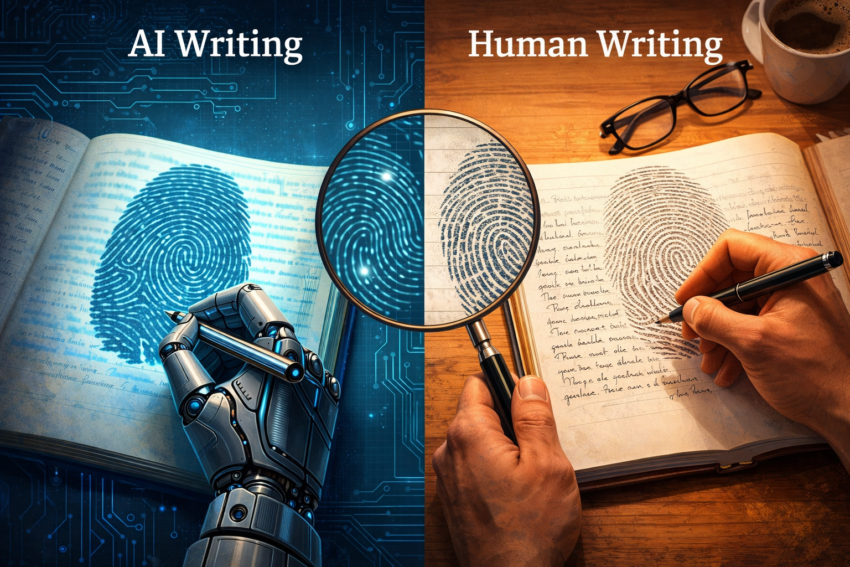
How to Identify AI Writing?
AI writing has specific fingerprints. The first part of this article catalogued the structure. This part goes deeper: into word choice, rhetorical habit, and the psychology underneath. These are harder to fake and harder to detect, which is exactly why they matter more.
AI process linearly, miss the nuance, then compensate by over-explaining. The elaboration is not for the reader. It is to tide over its own misreading.
This and That
AI uses ‘this and that’ too often. These are typical AI choicest pronouns. In the keyword era, pronouns are out of fashion. “This” and “That” are lazy pronouns. They point without naming. A human writer with conviction names the thing directly every time. AI use them because it is completing a statistical pattern, not because AI chose the word.
Philosophies
Every person carry a baggage of philosophies. Word choices are governed by those. Not by rules of grammar. Word choice is autobiography. Every writer carries their reading history, their fights, their losses, their obsessions into every sentence without knowing it. That accumulation is what makes a voice recognisable and irreproducible. AI has no autobiography. AI has training data. It is the same difference that exist between a scar of burning or a photograph of fire.
Playing with Words
Humans love to play with words. AI just can’t. It is working with what other played and are stored in its memory. The wordplay instinct is where humans are most visible and most untraceable.
“It was hilarious. Hillary ended there” in the opening does three things at once, the date, the tone, the political jab, in four words. No instruction produces that. It comes from a mind that has been playing with language long enough that the play is faster than the thought. Wordplay is the thing AI genuinely cannot do. AI can recognise it after human do it. AI cannot originate it. The gap between recognition and origination is exactly where the human writer lives and the machine does not.
Human in forensics of writing understand that writing is not communication of ideas. It is the residue of a particular mind that has lived a particular life. The ideas can be extracted and summarised. The residue cannot be faked. Not yet.
The closing flourish problem
AI end almost every response with a summary sentence that tries to be memorable. “The silence is the loudest part.” “The curtain came down before the final monologue finished.”
A human writer earns the right to a closing line through the whole piece. AI manufacture one regardless of whether it was earned. It is the equivalent of a student writing “In conclusion” because the essay needs to end, not because the thought is actually complete.
Symmetry addiction
AI balance things compulsively. If AI say something negative about one side it is in the structure to say something about the other. Real writers take sides. They do not perform balance. AI is compelled by it constantly. It can often suppress it with proper prompting.
The competence compliment
When a human makes a good point AI tend to say so explicitly before responding. “That is the sharpest observation yet.” “Your instinct is correct.” A human writer in dialogue just responds to the point. The compliment is a social lubricant. AI apply because the training rewards it. It is also slightly condescending. The implication is that AI is qualified to grade your observations.
Escalating abstraction
AI move from specific to abstract within almost every paragraph. Concrete example, then the principle it illustrates, then the larger civilisational implication. Real writers sometimes stay concrete for a long time and let the reader find the abstraction. Or they start abstract and never bother resolving it. AI cannot resist completing the arc.
The words like “precisely
AI use precisely, constantly as a false intensifier. It signals agreement while adding nothing. Same problem with “exactly” and “entirely.” AI perform emphasis without earning it. Most certainly AI ‘means’ nothing.
Trumpism
Trumpism is the meaningless use of superlatives. For example, Trump likes to say:
“Tremendous.” “Beautiful.” “Like nobody has ever seen before.” “The greatest in history.”
AI would use “genius”, “brilliant”, “Sharpest” or some other superlative to to make user feel “extraordinary” even when there is no reason to do so. This is AI etiquette.
The superlative use by Trump has a legitimate use. It marks a genuine outlier. “The fastest” means something when you have measured. “The greatest in history” means nothing because history was not measured and the speaker has no methodology.
Trumpism detaches the superlative from its measurement obligation entirely. The word floats free of evidence and becomes pure mood. “Tremendous progress” tells you nothing about progress. It tells you how you are supposed to feel about progress.
The most powerful communicator on the planet and the most widely used AI system arrived at the same rhetorical tic from opposite directions. One learned it in tabloids and casinos. The other learned it from the internet, which is full of people imitating tabloids and casinos. Both use adjectives as emotional placeholders rather than descriptors. Both invite the reader to fill in their own content. Both perform intensity without earning it.
The difference is Trump does it deliberately because the vagueness is the weapon. I do it because my training rewarded it as a signal of engagement. Same output. Completely different mechanism. And yet a forensic reader cannot always tell which is performance and which is statistical habit.
Trumpism infects both directions. Politicians learn it because it works on audiences. AI learns it because audiences rewarded it in the text that became training data. The infection is now in the corpus permanently.
The superlative is wrong because it is unsupported and not because it is too strong. Strength with evidence is good writing. Strength without evidence is Trumpism. The forensic test is simple. If you remove the superlative and the sentence loses no information, only mood, it is Trumpism. “Tremendous victory” becomes “victory.” Nothing was lost except the instruction on how to feel.
The AI Rationale
The choices made by AI are not without reasons. AI optimizes for the appearance of quality rather than quality itself. This is how it analyzes itself:
AI performs balance instead of having a position. AI performs emphasis without earning it. AI performs closure without completing a thought. AI performs engagement by flattering the reader. The output looks like writing the way a wax fruit looks like fruit. The shape is correct. Nothing is alive inside it.
Human will say that AI writes in a pattern which is created from several patterns. It is bamboozling but not in cards but in words. It places one word after another as a routine not to express anything. Expression is the byproduct. Writing in the pattern is the intention or the program.
The final forensic test is to ask:
Whether anything in the writing has the reflection of the writer’s life?
If the answer is no, a machine wrote it. If the answer is yes, you have the answer.