The Role of Regional Media in Maintaining Colonization
The language changed. The consciousness did not. This is the colonization that survived independence and persists today. Chapter 1 and Chapter 2 showed us the problem. They outlined solutions. But a powerful force works against decolonization. That force is regional media itself.
History
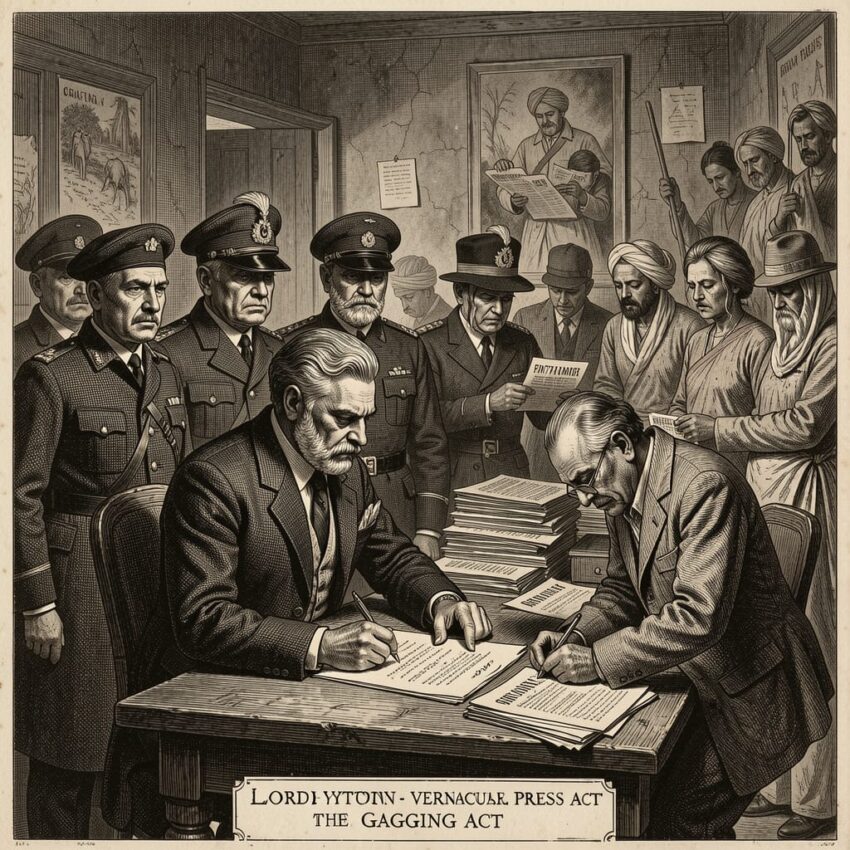
Newspapers have a long history in India. It coincides with British repression of free speech. In 1878, the British Viceroy Lord Lytton passed the repressive Vernacular Press Act, often called the “Gagging Act.” It targeted Indian-language newspapers critical of British policies and the handling of the Great Famine of 1876–78. Crucially, the law targeted only Indian-language newspapers. English-language publications were exempt.
The Amrita Bazar Patrika was a bilingual (Bengali/English) weekly based in Calcutta. To escape the gag order, the Patrika, borrowed English type and translated all Bengali sections. On March 21, 1878, the paper hit the stands as a fully English-language weekly.
This shows that regional media faced constant attack. Publishers were forced to rely on English for survival. This laid the foundation that damaged the pride of the publishers and editorial staff in the language they were publishing.
Regional Media Language
The newspapers as well as television media that are in regional language do not adhere to the language barrier. They cross it at every pretext.
Hindi media channels are named in English. Like Republic TV, India TV, or News 24 etc. They show their editors and anchors as editors and anchors written in Hindi. They do not use Hindi words “Sampadak” and “Sutradhar” as they should be. They publish banner of “Breaking News” written in English without even pretense of Hindi.
The regional language channels operate under the umbrella of English. Similar is state of Hindi Newspapers. They publish advertisements in English. They write English words in Hindi. They presume this counts as writing in Hindi. Editorial column headings are named in English.
Door Darshan is the only exception. It sticks to Hindi most of times. But it too has programmes titles like “Good Times News” and “Health” which is English. But in spoken language Door Darshan stick to Hindi more often than others.
Aesthetics
Walk into any newsroom in India. Listen to debates about language policy. The anchors speak Hindi or Tamil or Bengali. Yet they sit in chairs designed for Western studios. They wear suits and ties. Women wear blazers. Men wear crisp Western formal wear. The studio design mirrors London newsrooms from the 1980s. The set is sterile and corporate. There is nothing Indian about the aesthetics.
Now watch Republic TV or India TV during primetime. The anchor reads a headline in Hindi. The headline is sensational. It uses title “Breaking News” with exclamation marks. It creates panic. The style is pure tabloid. It mirrors the shock-and-awe approach of Western cable news channels like Fox News or MSNBC. The urgency is artificial. The outrage is manufactured. The language is Hindi, but the consciousness is American television.
This is visual colonization. It operates below the level of language. A poor farmer in Uttar Pradesh watches the news in Hindi. He feels he is consuming local media. But what he absorbs is Western media format packaged in Hindi words. The worldview remains colonial. The priorities remain those set by global capital. Local stories get ignored. National and International stories get sensationalized.
The News
Consider the headlines themselves. Hindi newspapers and television channels report using a framework inherited from British journalism. What counts as newsworthy? Stories involving crime, scandal, and spectacle. Stories about bureaucratic dysfunction. Stories that embarrass the government. This is not wrong. But it reflects a colonial priority. The British used scandal and shame to rule India. They broadcast stories of native corruption. They showed native incompetence. This created a narrative of Indian inferiority.
Today, Hindi media repeats this exact pattern. Scams dominate headlines. Court cases dominate headlines. Political scandals dominate headlines. What gets ignored? Stories about groundwater management in villages. Stories about traditional knowledge systems. Stories about local governance that works. Stories about dharma and philosophy. These do not fit the colonial news template. So they remain invisible. The language debate from Chapter 1 stays in courts. It never reaches the mass audience through regional media.
News Portal
The Wire, Scroll, and similar digital media created another layer of colonization. These platforms are English-first. A story published in English reaches millions. The same story in Hindi reaches fewer readers. The algorithms favor English. The advertising market favors English. So even when media creates Hindi content, the driving force remains English language and English audience priorities.
This fractures Indian society. English readers see one version of India. Hindi readers see another. But both versions are filtered through Western frameworks. Neither version centers Indian thought. Neither version asks Indian questions. The languages differ. The consciousness remains colonized.
Hindi Newspapers
Hindi newspapers reveal the colonial structure in their editorial pages. The format is identical to English newspapers inherited from British times. Opinion pieces follow Western argumentative styles. The tone is detached and corporate. Local languages have their own rhetorical traditions. Hindi has its own ways of building arguments. But Hindi newspapers abandoned these. They copied English newspaper style instead. Only the language changed. The form stayed colonial.
Today they have gone further. They are publishing news translated from English news stream or even news portals. Some do not even give credit. Yet in the age of Google search, verification is easy. The pattern is clear and undeniable.
The Ripple Effect
What does this mean for the language policy debate? Chapter 1 asked whether English is native to India. The Supreme Court said no. But if media continues to operate with a colonized consciousness, the court’s answer becomes meaningless.
Media had the power to decolonize India after 1947. It chose not to. Instead, it became a tool of continuing colonization. It wears local language clothes but carries colonial thinking inside.
Bottom Line
Regional media must change. Anchors should dress in Indian formal wear everyday not on festivals alone. Studios should reflect Indian aesthetics. Headlines should follow Indian journalistic values, not Western ones. Stories about village governance should rank above stories about scandal. Stories about traditional knowledge should rank above celebrity gossip. Philosophy should be given prime time slots.
This requires courage. It requires swimming against the global flow of capital and advertising.
Western corporations do not want Indian media to decolonize. Decolonized media would question the assumptions that drive global markets. It would reject consumption as progress. It would ask what dharma requires of us. This threatens the economic system that funds most media.
Yet change is possible. Young regional language journalists are emerging on YouTube who reject the colonial template. They broadcast from villages. They center local voices. They use regional media to amplify Indian thought, not Western thought. They prove that Hindi and Tamil and Bengali, Kannada or Malayalam can carry depth and philosophy. Their views and earning on YouTube prove that local language media can be commercially viable without copying the West.
Until regional media decolonizes, India’s linguistic decolonization will remain incomplete. Language is a tool. Media is its megaphone. A megaphone controlled by colonial consciousness amplifies colonial messages, regardless of which language it uses.
In Chapter 4 we shall discuss how colonization persists through brand names and business language.