An Insult to Intelligence of People of India.
The Nikhil Gupta case is a diplomatic narrative written for plausibility, not realism. When this narrative crossed cultural and institutional boundaries, the cracks become obvious to anyone who actually thinks. It reveals many things. The entire case is based on allegations with no foundation on facts.
A Boilerplate Indictment
A US attorney files a narrative document that is never tested in open court. It uses charged language, implies capability and intent, names foreign institutions, and its allegations get reported globally as established fact. Media picks it up. Diplomatic pressure follows. The indictment itself becomes the instrument, not the trial. Indictment becomes a conviction for the media.
Right Person for the Job
There is a category of person who does not have ideology, loyalty, institutional identity, or fixed profession. They have only availability and adaptability. They move toward whatever transaction is currently possible and currently paying. Wheat, hawala, narcotics, arms dealing, or becoming a DEA informant are not moral choices for such a person. They are simply the next available business.
Gupta has no institutional protection. No powerful family. No corporate identity. No verifiable economic existence. Legally vulnerable. Internationally mobile in ways he cannot explain. Already potentially compromised with DEA before any of this began. Such shady people make controllable instruments. They cannot complain loudly. They cannot demand institutional support. They cannot embarrass anyone by revealing respectable connections.
This is precisely the profile that makes someone both useful to an intelligence operation and catastrophically unreliable as a witness. Such a person will say whatever the current transaction requires. Under DEA pressure the transaction required accusing an official. He accused Vikash Yadav an alleged ‘para military official’. Under plea bargain pressure the transaction required a guilty plea. He pleaded guilty.
Neither statement necessarily reflects truth. Both reflect the current incentive structure. American prosecutors either missed or deliberately ignored. Such people have no fixed identity around which a reliable narrative can be constructed. Their testimony is not evidence. It is a reflection of whoever is currently holding leverage over them.
Insult to People of India
The indictment uses CRPF as a scary-sounding label without explaining what CRPF actually does. It presents $100,000 as a serious operational figure without expecting anyone to do arithmetic. It alleges a “former paramilitary officer” knowing that phrase sounds sinister to an American jury and assuming it will sound equally sinister everywhere else. It relies on an informant whose credibility is never tested expecting no one will ask why.
The indictment assumes the audience does not know that CRPF is a domestic reserve police force. It assumes nobody will check whether $100,000 is a realistic operational budget for assassination of a USA state protectee. It assumes nobody will ask who is paying for presidential grade security for a private activist like Pannun. It assumes nobody will notice that the alleged mastermind faces zero consequences. It assumes Indian legal professionals will not recognize that the entire evidence is inadmissible under laws of India.
The Deeper Insult
It is not a case of weak narrative. The fact is that the narrative was not even carefully constructed. It reads as something assembled for domestic American consumption, for a grand jury that asks no hard questions, for media that reprints press releases, and for diplomatic purposes that require only a headline not a conviction. Perhaps it insults their intelligence too.
Nobody in that process paused to ask whether the narrative would survive scrutiny from people who actually understand Indian institutions, Indian law, Indian economics, and Indian society. But Why?
Racism in 2026
British colonial administration operated on a foundational assumption. That native populations required narrative management rather than genuine engagement. They did not explain things to natives. They constructed stories legible to them at the level they assumed their comprehension operated. That assumption never fully left Western institutional thinking about South Asia.
The United States publicly and institutionally positions itself as the global standard bearer against racism. It has civil rights legislation, diversity mandates, institutional frameworks, and loud diplomatic positions on racial equality. It denounces colonial condescension formally and repeatedly. Yet USA behaves like that British Empire.
Yet the assumption embedded in this indictment was that Indians will not do arithmetic, will not read force structure manuals, will not apply their own evidential standards, and will not notice operational implausibility. This is the condescension that defines colonial racism in its most functional form. The end result of conscious racism and lazy condescension is identical to the person on the receiving end.
American foreign policy and legal establishment still operate with a residual assumption that countries like India will absorb American narratives without applying their own analytical frameworks. The assumption is wrong. It was always wrong. But it persists because it has not been consistently and publicly challenged at the institutional level.
In short, USA thinks people of India are stupid. It is not through malice but through institutional habit. That is actually worse than malice because habit does not self-correct easily. Habits make a person. Habits also break a person.
This is no prosecution. That is colonial narrative construction. Tell the story confidently and the natives will not interrogate it.
The USA takes a somersault within a week of the confession of Nikhil Gupta. USA really thinks very low about intelligence of people of India. Whenever it suits its interest it talks about shared colonial past and raise an emotional bogey about the past.
On 20 Feb 2026, in New Delhi, on the sidelines of the India AI Impact Summit 2026, US UnderSecretary of State for Economic Affairs Jacob Helberg made a poignant observation as India formally joined the Pax Silica declaration. He said:
Our nations began as two peoples who broke the bonds of colonial rule to chart our own destiny. Today, we join forces to ensure that we never again trade one form of dependency for another.
Helberg used this “former colonies” analogy to frame the Pax Silica declaration not just as a business deal, but as a modern independence movement. This is adding injury after an insult. While his Government created a narrative assuming itself on a higher pedestal on 13 Feb 2026, he is now rubbing the salt of false equality. This is another condescension which assumed that people of India will not notice.
National Security
When “national security” is invoked in the U.S. system, the judiciary voluntarily limits itself to such an extent that, functionally, it looks like a compromised institution. Thereafter, several things happen almost automatically.
First is epistemic surrender. Judges stop asking whether something is true and focus only on whether the executive has followed minimum procedure. Plausibility, proportionality, and realism quietly exit the conversation.
Second casualty is procedural compression. Discovery is narrowed, witnesses become sealed or abstracted, informant credibility is no longer tested in open court, and plea bargains are encouraged because trials are treated as “risk vectors” rather than truth-seeking exercises.
Third is institutional incentives flip. A judge gains nothing by pushing back on a national-security narrative and risks reputational damage, appellate reversal, or being accused (even implicitly) of endangering state interests. Therefore, deference to the narrative becomes the rational choice. Evidence can be evaluated in some other case.
USA as Declining Power
The Gupta case is a small but precise example of declining power of USA. Its legal system reveals that its rule of law can not distinguish between allegory and evidence. Now its legal system produces indictments designed for domestic consumption rather than international scrutiny. It tried to impose diplomatic pressure without doing basic arithmetic. Its institutional habit assumes native credulity. All this makes systematic perceptual errors at scale.
A power that cannot correctly perceive India, cannot correctly price an assassination, cannot correctly understand CRPF, cannot correctly anticipate that Indian lawyers and analysts will read its indictments critically, is not processing the world accurately.
Accurate perception is the foundation of sound strategy. Without it, power becomes increasingly expensive to maintain and increasingly ineffective in application.
Timing
Nikhil Gupta arrested in Czech Republic: June 2023. This coincides almost exactly with Canadian allegations about Nijjar killing becoming a diplomatic flashpoint.
Gupta’s guilty plea: February 2026. This coincides with the framework for a US-India trade deal taking shape under the new American administration.
Sentencing scheduled: May 2026. By which point the trade framework will likely be further advanced.
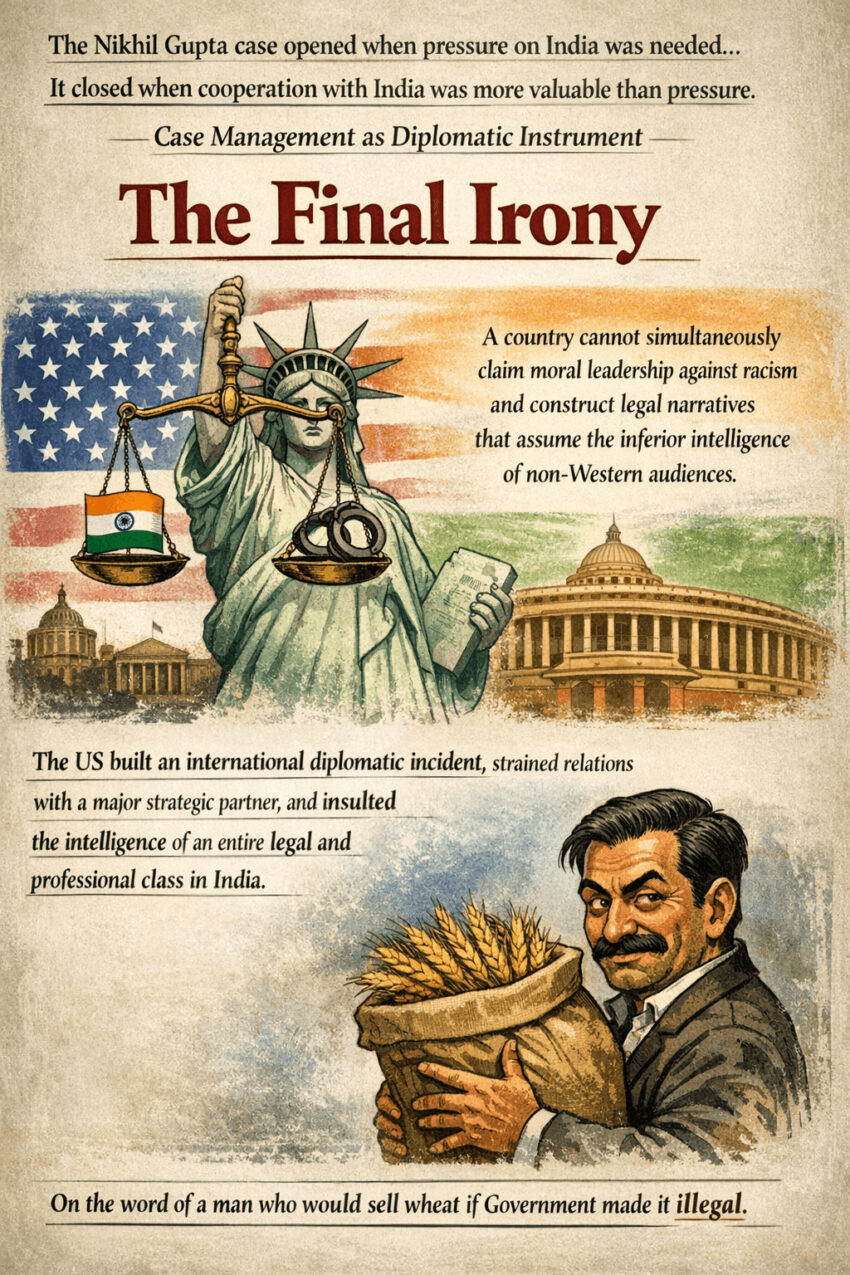
That is no coincidence that the case opened when pressure on India was needed. The case closed when cooperation with India became more valuable than pressure. That is case management as diplomatic instrument.
The Final Irony
A country cannot simultaneously claim moral leadership against racism and construct legal narratives that assume the inferior intelligence of non-Western audiences.
The US built an international diplomatic incident, strained relations with a major strategic partner, and insulted the intelligence of an entire legal and professional class in India.
On the word of a man who would sell wheat if Government made it illegal.
Reference:
- U.S. Under Secretary Jacob Helberg Full Speech:
色即是空,空即是色