(Part 1)
Why Nikhil Gupta Confessed?
Nikhil Gupta is an Indian citizen of about 54 years of age who was living overseas before his arrest in Czech Republic. Gupta was arrested in the Czech Republic in 2023 and subsequently extradited to the United States (in mid-2024) to face federal charges. Since then, he has been held in the Metropolitan Detention Center in Brooklyn, New York.
Prior to his detention, reports say Gupta described himself as involved in international dealings, including narcotics and weapons. The details about his background remain sparse. Why he traveled abroad or what was his source of living, remains unknown.
Jay Clayton, US Attorney for the Southern District of New York, along with senior officials from the Federal Bureau of Investigation and the Drug Enforcement Administration (DEA). The DEA made this announcement in a press release on 13 Feb 2026.
The Allegations
In February 2026, in a federal court in Manhattan, Gupta pleaded guilty to murder-for-hire, conspiracy to commit murder-for-hire, and conspiracy to commit money laundering. Those are the three legal counts and nothing more. He will be sentenced in May 2026 by the court.
Prosecutors claim that in 2023, Gupta worked with others including co-defendant Vikash Yadav to plot the assassination of Pannun. At Yadav’s direction, Gupta contacted a person he believed to be a criminal associate willing to arrange a killing, but who was actually a confidential source working with the DEA.
The supposed hitman and Gupta agreed on a price of $100,000. Fifteen thousand dollars was transferred as an advance. Yadav allegedly shared Pannun’s home address, phone numbers, and daily routine, which Gupta then forwarded to the undercover officer.
Gupta was allegedly recruited in May 2023 by Vikash Yadav, described as a former senior field officer in India’s cabinet secretariat. Yadav remains at large and is on an FBI wanted list. India confirmed he is no longer a government employee. The US built a diplomatic incident on allegations about a man whose actual institutional status was never judicially tested, never cross examined, and never independently verified.
Under oath, Gupta stated: “I agreed with another person to have another individual to murder a person in the United States.” That is the entirety of what he admitted in open court.
The Evidence
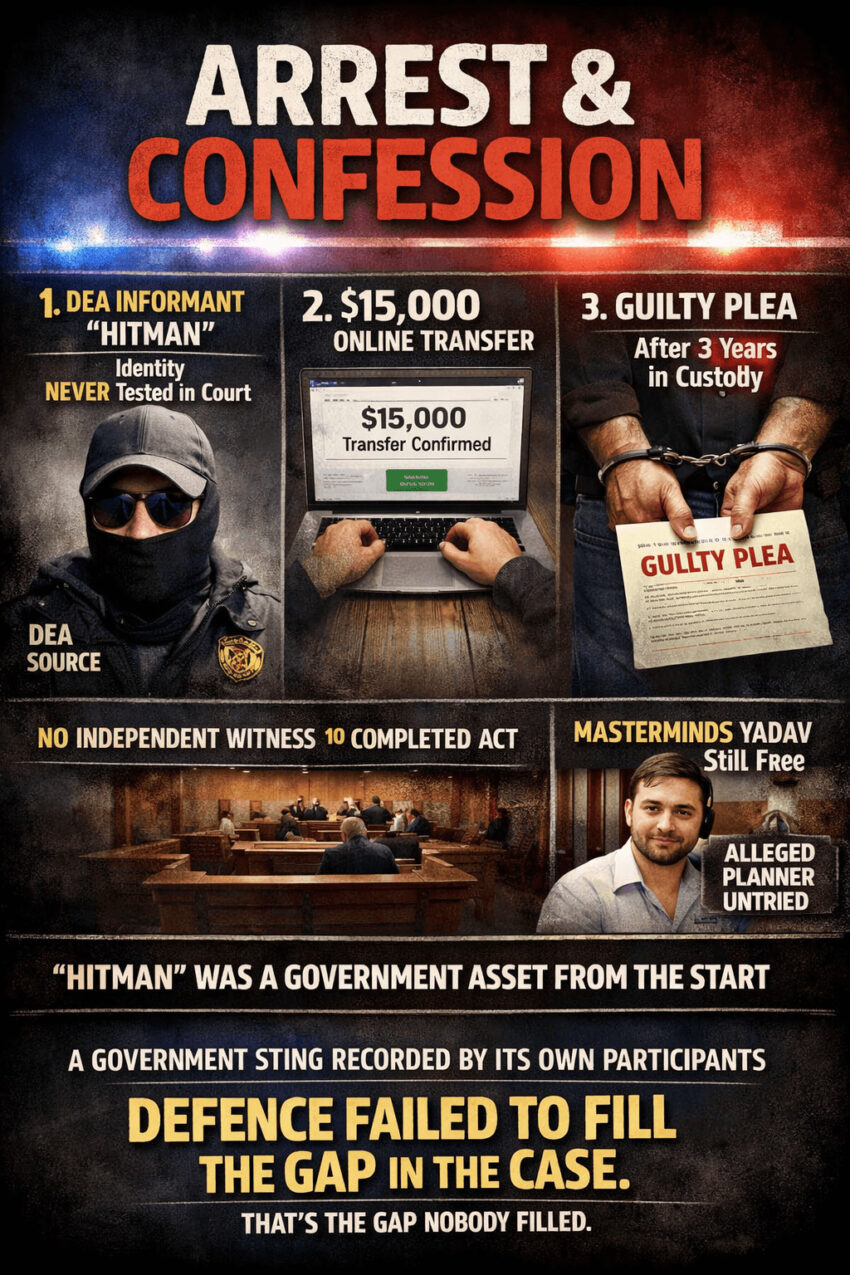
The entire prosecution case rests on exactly three things. First, a DEA confidential source who posed as the hitman and whose identity, background, inducements, and credibility were never tested in open court. Second, a $15,000 online transfer. Third, a guilty plea entered after nearly three years in custody.
There is no independent witness. There is no completed act. There is no co-conspirator in custody who testified against him. The alleged mastermind Yadav is free and untried. The “hitman” was a government asset from the beginning.
The prosecution case is structurally a sting operation recorded by its own participants. The defence never made the court confront that fundamental weakness. That is the gap nobody filled.
The Victim
Gurpatwant Singh Pannun is a US citizen and a lawyer. He is the general counsel of Sikhs for Justice, a pro-Khalistan organisation. He has been designated a terrorist by the Indian government under UAPA. He actively campaigns for a Khalistan referendum.
Pannun is visibly not Sikh. He was clean shaven and later regrew his beard and now asserts to be a Sikh leader. He wears no turban but hides his head in a cover which resembles a Sikh patka.
For a Sikh, the five Ks, including kesh (uncut hair), are not optional markers of identity. They are articles of faith with specific religious obligation attached. A person who shaves, regrows, and reshapes their appearance while simultaneously claiming Sikh religious or community leadership is making a statement that practising Sikhs are fully entitled to question. This is not a trivial point. It goes to the authenticity of identity and therefore the credibility of representation. Who exactly is he speaking for and on what authority?
If a person presents themselves as a champion of a religious community while not observing its most fundamental and visible articles of faith, not only the community but public at large has every right to ask whether that person genuinely represents them or is representing something else entirely.
In any serious criminal trial the victim’s identity and standing matter. If Pannun is presented as a Sikh leader facing assassination because of his Sikh advocacy, then his actual standing within that community is directly relevant. A defence lawyer could have asked one simple question in court.
Who authorised you to speak for Sikhs?
If no gurdwara, no recognised Sikh body, and no community institution has formally endorsed him as a representative, his entire role in this case shifts. He moves from community leader under threat to individual activist with a platform. That is a meaningful legal and factual distinction.
The Mastermind
The U.S. Department of Justice (DOJ) alleges that Gupta was recruited in May 2023 by an Indian government employee, identified as Vikash Yadav. While Gupta faces justice in New York, the alleged mastermind remains out of reach for U.S. authorities. Yadav was formally indicted in October 2024 and remains a subject of an FBI “Wanted” poster.
Yadav was alleged to be a serving CRPF officer who was allegedly on deputation to RAW in 2023 at the time of the alleged conspiracy. RAW operates under the Cabinet Secretariat and falls within the National Security Architecture of India. But there is no formal discovery from Government of India.
On October 17, 2024, the Ministry of External Affairs confirmed that the individual named in the US Justice Department’s indictment case in the foiled assassination plot against Khalistani terrorist Gurpatwant Singh Pannun was no longer an employee of the government of India. But that is neither here nor there. Where was he employed? In what capacity?
Thus, the alleged mastermind or sutradhar of the killing conspiracy is Vikash Yadav who is in India. He holds all the threads but he is not extradited. Guess why? Extradition also requires judicial scrutiny. It requires evidence to be placed before judge. Indian courts have consistently held for over a century that accomplice or informant testimony is inherently suspect and requires independent corroboration in material particulars before it can be acted upon.
The US case against Yadav actually consists of:
- The DEA undercover operative’s recordings.
- Statements made by Gupta who is now a convicted felon who pleaded guilty under three years of custodial pressure.
- No independent witness.
- No completed act.
- No corroboration from any source outside the sting operation itself.
An Indian court examining extradition would ask one simple question. Is there any evidence here that does not originate from within the US government’s own operation?
The answer is no. This is why the USA never sought any extradition.
Examination of Person of Interest
Even without extradition, the US could have requested a video conference examination of Yadav through mutual legal assistance treaty mechanisms. India and the US have a Mutual Legal Assistance Treaty specifically for this purpose. No such request appears to have been made.
The Central Civil Services (Classification, Control and Appeal) Rules bind retired government servants in specific ways. A retired employee drawing pension remains subject to disciplinary jurisdiction. Pension can be withheld or reduced for misconduct including non-cooperation with authorised investigations. So Yadav as a retired officer is not entirely beyond institutional reach even within India.
If the US had formally requested his examination through MLAT, India would have faced a genuine procedural obligation. Noncompliance would have had diplomatic consequences. Yadav himself would have faced pension implications under CCS(CCA) for refusing to cooperate.
Why No Such Request Was Made?
Because making it would require the US to disclose exactly what evidence it holds. That disclosure would immediately expose the evidentiary weakness identified earlier. The entire case rests on informant testimony that cannot survive independent scrutiny.
The US chose a wanted notice over an MLAT request for exactly the same reason it chose a plea bargain over a trial. Both choices avoid the one thing the prosecution cannot afford. Judicial examination of its own evidence.
It made no request, even to question Yadav over video conference. Yadav as retired employee is bound by CCS(CCA) to comply or lose pension.
The Unanswered Questions
The most curious part of the entire trial is that there are many questions that were never raised for defence and therefore remain unanswered.
1. Financial Profile of the Accused
How did Nikhil Gupta fund international travel to Czech Republic with no visible income, no GST registration, no office, and no declared business? What was his actual source of livelihood? Was his economic profile ever independently verified or challenged in court?
2. Credibility of the Primary Witness or Informant
Was the DEA undercover operative or informant scrutinised under cross-examination? Was the informant’s own criminal history, prior cooperation deals, or financial incentives placed before the court? Under what terms was the informant operating?
3. Operational Implausibility
Was the court ever asked whether $100,000 is a realistic budget to eliminate a state-protected individual with visible close-protection security in the United States? Was any security expert called to testify on the operational feasibility of the alleged plan?
4. Identity and Status of the Protected Person
Who is paying for Pannun’s security? Is it privately funded or state-funded? If state-funded, what is his formal status with US authorities? This directly determines whether the alleged threat was to a private citizen or a de facto state asset.
5. The Vanishing Contact Person
A person named in prison records as a contact appeared on YouTube claiming involvement and then became untraceable. Was this person ever subpoenaed? Was their disappearance ever raised as a question of evidence integrity?
6. Institutional Mischaracterisation of CRPF
Was the court ever informed that CRPF is a domestic reserve force with no foreign operations mandate? Was any expert on Indian security forces called to challenge the implied capability of a retired CRPF officer to orchestrate overseas operations?
7. Timeline of Confession
Three years elapsed before a guilty plea. Was the defence ever required to explain or challenge what happened during those three years? Was the plea entered freely and without undue pressure from prolonged custody?
8. Absence of Extradition of the Alleged Mastermind
Vikas Yadav is named as the principal accused but was never extradited. Was the court ever asked why the alleged orchestrator faces no consequences while a peripheral figure pleads guilty? Does that asymmetry not undermine the prosecution’s own theory of the crime?
9. Applicability of Indian Evidentiary Standards
If the case rests substantially on informant testimony, would this evidence survive scrutiny under Section 114 of the Indian Evidence Act? The defence could have placed this on record to highlight the structural weakness of the prosecution’s foundation.
10. Geopolitical Timing
The case emerged simultaneously with the Canada-Nijjar diplomatic escalation. Was the court ever asked to consider whether the timing of charges served a political function separate from any genuine criminal investigation?
11. Telephone Harassment Using Bar Directories
Pannun’s pattern of harassment by calling lawyers in India through official bar association directories during peak hours was never placed on record. This is relevant to his character and credibility as a victim and witness. I have received such calls. My complaints fell on deaf ears.
12. Lifestyle Inconsistency as a Defence Tool
Ironically, the same lifestyle inconsistency argument used against Gupta could have been turned around. If Gupta had no resources, how was he a credible principal in a high-value conspiracy? A serious defence would have used his own poverty of profile as an argument against capability.
Each of these questions is legally relevant and legitimate. None required extraordinary resources to raise. Together they would have forced the prosecution to defend the internal logic of its own case rather than simply moving toward a convenient plea.
The failure was not the court. It was that nobody made the court confront these questions.
The Blunt Summary
A person of dubious economic identity allegedly conspired to kill a person of dubious religious identity, and the case was built by a government informant whose identity remains undisclosed and was never cross-examined.
That is a very thin foundation for an international diplomatic incident.
References:
- Press Release: https://www.dea.gov/press-releases/2026/02/13/indian-national-pleads-guilty-plotting-assassinate-us-citizen-new-york
- Conspiracy: https://americanbazaaronline.com/2026/02/14/indian-national-nikhil-gupta-pleads-guilty-in-us-to-murder-for-hire-conspiracy-475119/
- Plead Guilty: https://8pmnews.com/pannun-assassination-plot-nikhil-gupta-pleads-guilty/
- Evidence of Co-conspirator: Indian Evidence Act, 1872. Section 114.
P.S.: In part 2 of this article I will explain the Colonial Bias inherited by USA revealed in this incident.
1 thought on “The Nikhil Gupta and Gurpatwant Singh Pannun Controversy. (1)”