Habits: What is Life? (Chapter 2)
The Paradox of Habits.
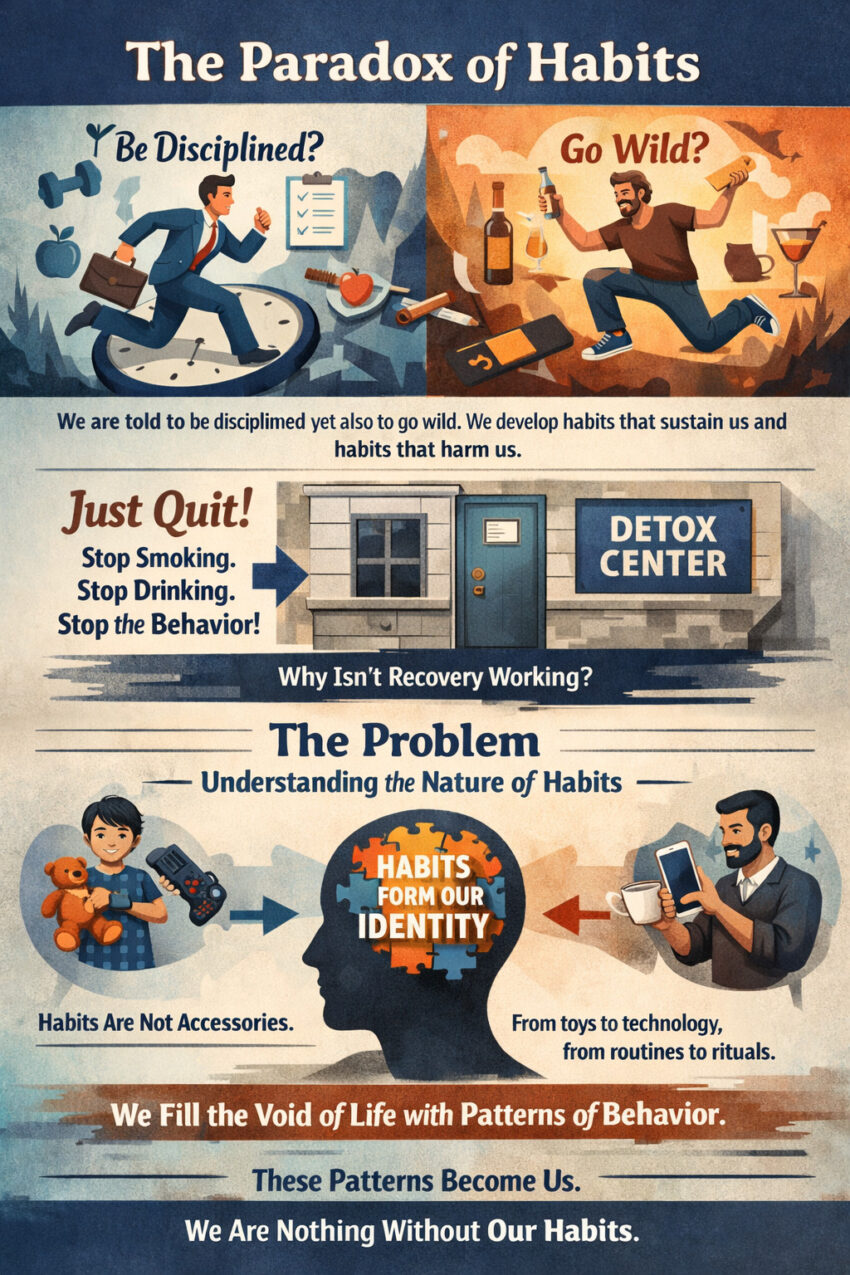
Modern life presents us with a fundamental contradiction. We are told to be disciplined yet also to go wild. We develop habits that sustain us and habits that harm us. The cultural narrative around harmful habits is simple: just quit. Stop smoking. Stop drinking. Stop whatever behavior troubles you. But this approach fails consistently. Detoxification centers promise recovery, yet few people emerge truly free from their addictions. It is difficult to meet a single person who successfully recovered through such programs alone.
The Problem
The deeper problem lies in misunderstanding what habits actually are. We treat them as optional accessories to our lives, things we can discard when convenient. But habits are not accessories. They form the very fabric of our identity. From childhood toys to adult gadgets and routines, we fill the emptiness between birth and death with patterns of behavior. These patterns become us. We are nothing without our habits.
This creates a dangerous situation. When people try to eliminate habits without understanding their fundamental role, they either fail immediately or succeed temporarily only to face worse consequences. The vacuum left by a removed habit demands filling. Nature abhors a vacuum, and so does human psychology.
Philosophy
There is a radically different framework. Don’t change habits. Replace habits. This isn’t mere wordplay. It recognizes that human beings are refined animals with inherent wildness that requires channeling, not suppressing.
Discipline rewards us socially and financially. It enables earning money and maintaining good relationships. Yet discipline alone doesn’t address the habit problem. Even disciplined people acquire troublesome patterns: excessive coffee, sweets, or substances.
There exists a glamorous narrative about being wild. People embrace this wildness as a lifestyle philosophy. The speaker questions why no counter narrative exists. Going wild as an experiment for limited time might be acceptable. But many people make wildness their permanent approach to life.
They spend a few hours in the office as disciplined workers. Then they transform completely. After office hours come party hours. After parties, something else follows. Eventually comes hurried sleep that produces worried mornings. People wake up anxious and rushed.
The morning rush to the office creates cascading problems. A person running late becomes indisciplined in multiple ways. If they drive themselves, their driving becomes reckless and dangerous. They weave through traffic, honk aggressively, cut off other vehicles. If someone else drives them, they trouble that driver constantly. They demand speed, urging the driver to go faster and take risks. Either way, they create trouble on the road.
This person, desperate to compensate for delay, becomes a hazard to everyone around them. Their wildness the previous night now endangers strangers during morning commute. The ripple effects spread outward from their personal choices.
The philosophical insight is that habits occupy specific roles in our psychological ecosystem. A smoker who quits often substitutes chewing gum or cardamom. When the substitute becomes problematic, many revert to cigarettes. That psychological space must be filled by something. The question isn’t whether to have habits but which habits to cultivate.
Discipline itself is deeply personal, as individual as one’s relationship with God. Those who believe in God understand this connection as profoundly personal. Those who don’t believe understand disconnection from God as equally personal. No external force can impose discipline successfully. The work must come from within, with clear understanding of what habits truly are: the building blocks of identity.
Examples
There is an opium addict folklore which demonstrates gradual reduction elegantly. A sadhu gave the man chalk identical in size to his usual dose of opium and told him to weigh his dose with the chalk and not to over consume. After each dose, the man drew a line on the wall to track consumption. Imperceptibly, the chalk diminished from use. As it shrank, so did the habit. Over a year, the dose became so insignificant that continuing seemed pointless. The addiction ended not through willpower alone but through systematic reduction to irrelevance.
A coffee dependency shows similar principles. Consuming a cup every hour became unsustainable. The solution involved multiple steps. First, switching from mugs to cups reduced quantity. Then moving to even smaller cups (like those in Kolkata High Court) further decreased intake. The mind registered satisfaction from the ritual even with less substance. Next came extending intervals: from hourly to 75 minutes, then 90 minutes, then two hours. Eventually the need disappeared during daytime. Now just two morning cups or one evening cup suffices.
The alcohol examples cut both ways. One person successfully substituted evening drinking with evening walks and early dinner. This required restructuring his entire schedule: getting up earlier, eating dinner at 7 PM rather than late night (usual in India). The substitution worked.
But the cautionary tale haunts. A 70-year-old neighbor proudly announced quitting after decades of daily drinking. He had no health problems. H quit due to social taboo, prevalent in India. Three or four months later, a white tent appeared at his home, signaling death. Correlation doesn’t prove causation, but the timing raises questions. Removing a habit that constituted part of his identity for so long may have created an unbearable vacuum.
Our bodies and minds adapt to substances over decades. What remains poison to others becomes integrated into our biological and psychological systems. Removing it suddenly disrupts that integration. Some habits truly are poisons. Yet long-term adaptation creates a new reality. The poison becomes part of homeostasis.
Poison is a poison till we are not used to it.
Conclusion
The wisdom here is ancient yet neglected. We are creatures of habit by nature. Fighting this nature leads to failure or worse. Accepting it enables intelligent management of our behavioral patterns.
Choose positive habits that enrich your experience of being alive. If harmful habits exist, substitute them with beneficial ones rather than creating voids. When substitution proves difficult, reduce gradually to insignificance. Respect the power of habits to define who you are. Mild intoxicants that don’t obliterate consciousness may be acceptable, but anything robbing you of life’s experience should be carefully, systematically replaced.
Live life with awareness of what habits do. They don’t diminish us. They constitute us. Treat them with dignity they deserve.
See also:
1 thought on “Problems of Habits and its Solution”